On this page
How to identify it
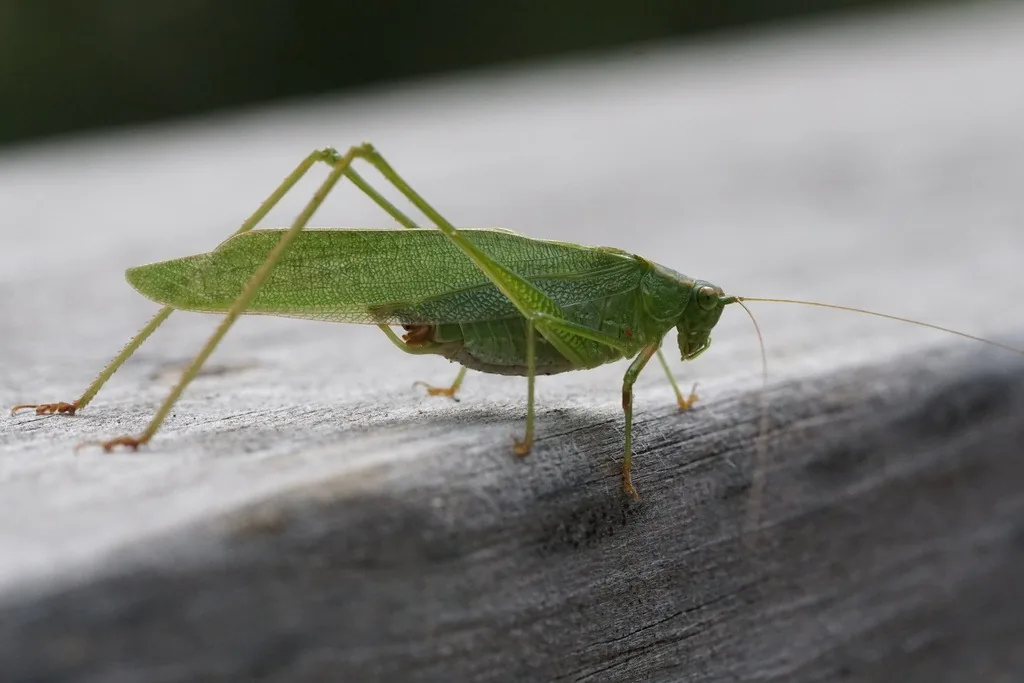
- Adults are fairly large, slender, leaf-mimicking insects, mostly green but sometimes brown or tan. MDC notes that some populations include bright pink or yellow individuals.[1][3]
- Their slender antennae are nearly as long as the body or longer.[1][2][3]
- Other family marks: wings held over the body like a roof, hearing organs on the front legs, four-segmented feet and, in females, a flattened, sword-like egg-laying tube.[2][3]
- Wisconsin Extension gives a size range of 1/2 to 4 inches depending on species, with females usually larger than males.[2]
- Forktailed bush katydids are about 1-1/8 inches long; angle-winged katydids are larger and humped. UC IPM gives about 1-4/5 inches for the lesser angle-winged (which it calls angularwinged) and about 2-1/4 inches for the greater angle-winged (which it calls broadwinged); MDC gives just over 2 inches and about 2 1/2 inches.[1][3]
- Nymphs are wingless, and some have black-and-white banded antennae.[1]
Look-alikes
| Look-alike | How to tell them apart |
|---|---|
| Grasshoppers | Grasshoppers are active by day and have short, thickened antennae; katydids rest by day, feed at night and have very long, thin antennae.[1][2] |
Where it lives
Katydids live across North America: Wisconsin Extension counts 255 native species and MDC about 250 north of Mexico, and UC IPM says at least 74 occur in California. MDC says the forktailed bush katydid ranges throughout the Lower 48. The map shows bush katydids (Scudderia) and angle-winged katydids (Microcentrum): GBIF holds about 21,500 U.S. records of the two since 1990, most from California, Texas, New York and Massachusetts.[2][3][1][4][5]
Biology and life cycle
They overwinter as eggs. UC IPM describes eggs inserted in leaf edges or lined up in rows on twigs; Wisconsin Extension says females lay them in soil, plant stems or tree bark in late summer or fall.[1][2]
Forktailed bush katydid eggs are oval, about 1/8 inch long, and show as swellings along a leaf edge. Angle-winged katydids lay flat gray eggs about 1/5 inch long in single or double overlapping rows.[1]
In California, eggs of the forktailed bush katydid and greater angle-winged katydid hatch from late March through May, and adults appear in midsummer. A few forktailed bush katydid eggs hatch in July and August for a second generation; angle-winged katydids have one generation a year.[1]
Nymphs look like small adults and usually molt about five times as the wings develop.[2]
Most are active at night. Adults sometimes come to lights and are sluggish in cool early mornings.[1][2]
Most katydids eat leaves and other plant parts; a few prey on insects or scavenge. In lab trials, coneheads and other katydids found on milkweed readily ate monarch butterfly eggs.[3][2][6]
Katydids are important food for birds, bats, frogs, spiders and many other animals.[2][3]
Damage and signs
- Leaf chewing doesn't matter to plant health, since katydids eat only one or a few leaves before moving on.[1][2]
- Forktailed bush katydid nymphs also feed on young citrus and stone fruit, and in blueberry and pear the adults and nymphs both feed on fruit.[1]
- They take a bite or two from a fruit and move on, so a few can mark many fruit. Wounds heal over and grow into sunken, corky, roughly circular patches; internal fruit quality is little affected, though damaged fruit sometimes grows distorted or drops.[1]
- Damage depends on the citrus type. California studies found the forktailed bush katydid a major pest in sweet oranges, while some mandarins (Citrus reticulata) resist it: katydids only scratch the fruit surface. In clementines they feed readily, leaving jagged, web-like scars that look more like caterpillar damage and often lead to split or dropped fruit.[7][8][9]
Health risk
They feed on plants and fruit. MDC says some large species, such as coneheads and meadow katydids, have strong jaws and can give a hearty nip, so handle them with care; the long egg-laying tubes of females are not harmful to people.[3]
Control
Prevention
Usually no control is recommended on home fruit trees, since the damage is cosmetic and katydids are gone by the time scars show.[1]
Traps and physical control
Because they're rarely abundant, catch and dispose of the few you see, easiest on cool early mornings.[1]
Pesticides
Where scarring was unacceptable before, spinosad after petal fall, when fruit are small, is an option. Spinosad is toxic to honey bees and some beneficial predators for at least several hours, so don't spray while plants are flowering.[1]
Relatives and names
Despite the nickname long-horned grasshoppers, katydids are closer kin to crickets; 255 species are native to North America, about 20 of them in the Midwest.[2]
Common names vary by source. Microcentrum rhombifolium is the broadwinged katydid to UC IPM and the greater angle-winged katydid to MDC and Wisconsin; Microcentrum retinerve is UC IPM's angularwinged katydid and MDC's lesser angle-winged katydid.[1][3][2]
Katydid songs
Males sing by rubbing a scraper on one front wing against a file on the other; each species has its own song. The common true katydid gives the raspy 'katy-did, katy-didn't' call from treetops on late summer nights.[2][3]
In Wisconsin, calls usually start late at night and run into the early morning in late summer, slowing as it cools and ending by October.[2]
Pink katydids
Pink individuals turn up now and then. Wisconsin Extension cites an estimate of about one in 500 and says the color comes from recessive genes; MDC, describing pink oblong-winged katydids, says researchers found pink is caused by a dominant gene and green is recessive.[2][3]
Common questions
- What made the corky scars on my oranges?
- Katydid feeding on small fruit is one cause, though cutworms and earwigs can leave similar scars. A California study found earwig and katydid scars on navel oranges differ only subtly.[1][10]
- Are katydids grasshoppers?
- No. They look similar, but katydids are closer kin to crickets, have much longer, slender antennae and feed at night.[2][1]
- Can katydids bite?
- Some large ones, such as coneheads and meadow katydids, can give a hearty nip if handled.[3]
Sources
- University of California Statewide IPM Program, “Katydids (Pests in Gardens and Landscapes).” ipm.ucanr.edu/PMG/GARDEN/FRUIT/PESTS/katydids.html (accessed 2026-11-11)
- University of Wisconsin-Madison Extension, “Katydids – Wisconsin Horticulture.” hort.extension.wisc.edu/articles/katydids/ (accessed 2026-11-11)
- Missouri Department of Conservation, “Katydids (Field Guide).” mdc.mo.gov/discover-nature/field-guide/katydids (accessed 2026-11-11)
- Global Biodiversity Information Facility (GBIF), “Scudderia (bush katydids): U.S. occurrence records since 1990 by state (GBIF occurrence search).” api.gbif.org/v1/occurrence/search?taxonKey=1694374&country=US&hasGeospatialIssue=false&occurrenceStatus=PRESENT&year=1990%2C2026&facet=stateProvince&facetLimit=400&limit=0 (accessed 2026-11-11)
- Global Biodiversity Information Facility (GBIF), “Microcentrum (angle-winged katydids): U.S. occurrence records since 1990 by state (GBIF occurrence search).” api.gbif.org/v1/occurrence/search?taxonKey=1692094&country=US&hasGeospatialIssue=false&occurrenceStatus=PRESENT&year=1990%2C2026&facet=stateProvince&facetLimit=400&limit=0 (accessed 2026-11-11)
- Scientific Reports, via PubMed, “Predators of monarch butterfly eggs and neonate larvae are more diverse than previously recognised (Hermann et al. 2019).” pubmed.ncbi.nlm.nih.gov/31586127/ (accessed 2026-11-11)
- Journal of Economic Entomology, via PubMed, “Impacts of fruit-feeding arthropod pests on oranges and mandarins in California (Cass et al. 2019).” pubmed.ncbi.nlm.nih.gov/31127848/ (accessed 2026-11-11)
- Journal of Economic Entomology, via PubMed, “Resistance of fruits from a mandarin cultivar to feeding by fork-tailed bush katydids (Cass et al. 2019).” pubmed.ncbi.nlm.nih.gov/31587058/ (accessed 2026-11-11)
- Journal of Economic Entomology, via PubMed, “Profile of fork-tailed bush katydid feeding on fruit of clementine mandarins (Cass et al. 2021).” pubmed.ncbi.nlm.nih.gov/33210704/ (accessed 2026-11-11)
- Journal of Economic Entomology, via PubMed, “Characterizing herbivory by European earwigs on navel orange fruit with comparison to forktailed bush katydid herbivory (Kahl et al. 2021).” pubmed.ncbi.nlm.nih.gov/34185851/ (accessed 2026-11-11)
- iNaturalist, “Scudderia furcata taxon page (order and family).” www.inaturalist.org/taxa/55957 (accessed 2026-10-06)