On this page
How to identify it
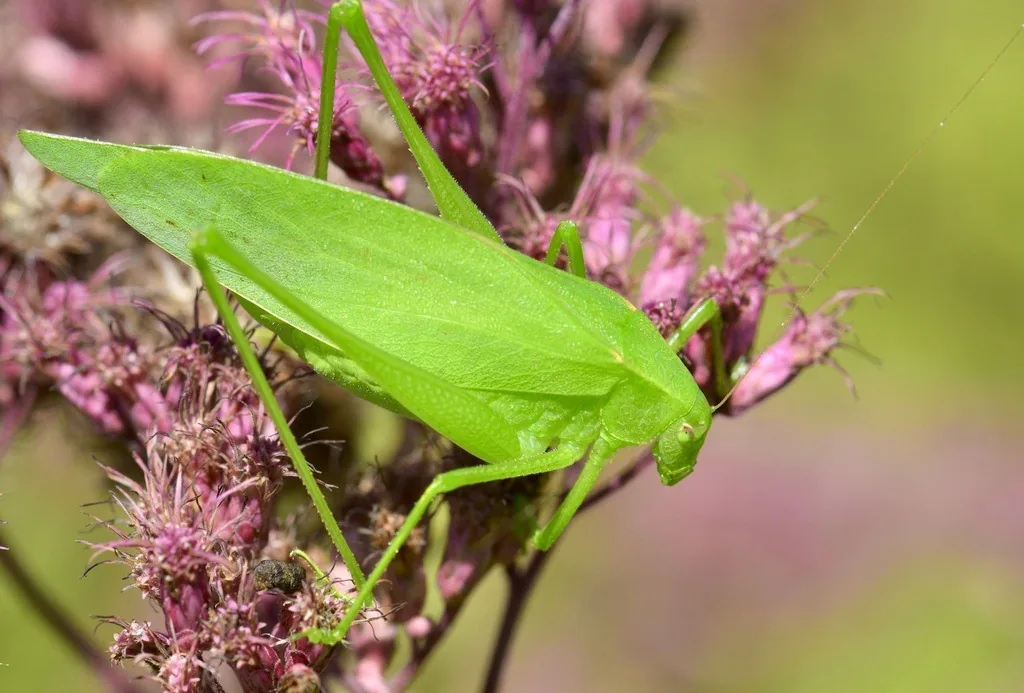
- It belongs to the round-headed katydids, named for the rounded top of the head, and like others in its genus it has very long hind legs.[1][3]
- The rasping organs, a flattened, elongated triangle just behind the pronotum (the shield behind the head), are dark or blackish.[1][3]
- Most are green, but pink, yellow, orange and tan individuals occur; the Orthopterists' Society song archive pictures a green male, a yellow male and a pink female.[1][2]
- Like other katydids, it has thin antennae as long as the body or longer and holds its wings roof-like over the back, and the female has a flattened, sword-like egg-laying blade at the tip of the abdomen.[4][3]
- UF/IFAS gives an adult length of 42 to 52 mm (1.6 to 2 in), with forewings typically 3.1 to 4 times as long as they are wide.[5]
- As a false katydid, its hind wings extend beyond its leathery forewings, and it has a fully exposed eardrum (tympanum) at the base of each front leg's tibia.[5]
Look-alikes
| Look-alike | How to tell them apart |
|---|---|
| Common true katydid | Its oval, leaf-like wing covers bulge outward, its legs are short for its size, and it sings the familiar raspy 'katy-did, katy-didn't' from high in trees. UF/IFAS adds that true katydids have relatively shorter forewings that bulge out at the sides.[3][5] |
| Greater angle-winged katydid | Another false katydid, larger (to about 2½ inches) with a small tooth on the front edge of the pronotum. Its song is a sharp 'Dzt!' every few seconds plus a fairly even, rapid series of 10 to 20 tics. UF/IFAS says that in Florida, plants need protecting from katydid damage only on citrus seedlings, and only against this species.[3][5] |
| Florida false katydid | UF/IFAS says Amblycorypha floridana looks very similar and is commonly encountered in Florida, but its song lasts much longer and sounds like a bouncing table-tennis ball made to buzz; the oblong-winged katydid is recorded in Florida only from the Panhandle.[5] |
Where it lives
GBIF records since 1990 come from across the eastern and central United States, most from Texas, New York, Minnesota, Pennsylvania and Vermont, and west to the Dakotas, Nebraska, Kansas and Oklahoma; there is a single Florida record. Canada has the next-largest set of records after the United States, and Mexico has two. In Missouri, pink populations turn up on native tallgrass prairie in summer. UF/IFAS says it is found throughout the eastern United States but collection records are absent from Georgia and most of Florida, where it is recorded only from the Panhandle; it also occurs in Quebec (mainly Montreal) and Ontario.[6][7][1][5]
Biology and life cycle
Males call with a single, rapid 'tzeety-tik!' and pause several seconds between calls. UF/IFAS renders the sound as 'itzic.' Unlike most katydids, males of this subfamily approach females when they hear the females answer.[1][3][5]
A 2008 study describes sporadic calling like this as a first defense against bats that find katydids by listening for their songs. When the calls of a gleaning bat (Myotis septentrionalis) were played to singing males, fewer oblong-winged katydids stopped singing than sword-bearing coneheads, a species that calls almost nonstop.[8]
UW–Madison Extension notes that katydids in Wisconsin overwinter as eggs laid in soil, plant stems or bark in late summer or fall. Nymphs hatch the next spring, look like small adults without full wings, and grow wings over about five molts.[4]
Katydids in general live in grasslands, open woods and along the edges of plantings; most are active at night.[4]
UF/IFAS says eggs are laid in soil and, depending on location, can take two or more years to hatch; in captivity, males of a cohort hatch before females. Nymphs look like adults but have rounder abdomens and no wings, and reach maturity in about two months.[5]
Adults peak once a year, between late June and mid-August depending on latitude, and live four to six months on average. It frequents the understory of deciduous forests, shrubs and tall weeds, mostly in damp places, and is commonly found on goldenrod flowers along fences and thicket edges.[5]
Damage and signs
Health risk
None of these sources reports a risk to people. MDC notes that the long egg-laying blade of female katydids is not harmful to people and is used only to lay eggs.[3]
Control
Prevention
Control is rarely needed, since katydids seldom do significant damage to garden or ornamental plants, and they are food for many birds and other animals. UF/IFAS says the best approach is to tolerate them, since only minor damage occurs; if plants need protecting, netting or floating row covers keep katydids off.[4][3][5]
Why some are pink
MDC reports research showing that in this species pink is apparently caused by a dominant gene and green is recessive: when pink and green individuals interbreed, at least 50 percent of the offspring are pink. Green still predominates in most places, apparently because green camouflage works better and most green katydids have no pink neighbors to breed with.[1][3]
UW–Madison Extension, writing about katydids in general, gives a different picture: it puts pink coloration (erythrism) at about one in 500 individuals and attributes it to recessive genes, as with albino animals.[4]
UF/IFAS says the colors were once thought to be a seasonal change, but in 1916 entomologist Joseph Hancock found they are an inherited condition called erythrism, and that pink, orange, tan, brown or yellow individuals are rare in the wild.[5]
Where sources disagree
Song: Missouri renders the call as a rapid 'tzeety-tik!', UF/IFAS as 'itzic.'[1][5]
Common questions
- Is a pink katydid a different species?
- Usually not. Pink oblong-winged katydids are a color form of the normally green species, and MDC says pink is apparently controlled by a dominant gene in this species.[1]
- Will katydids eat my garden?
- Not much. Katydids may nibble leaves and flowers, especially in late summer, but rarely cause significant damage.[4]
- When are oblong-winged katydids out?
- Adults peak once a year between late June and mid-August, depending on latitude, according to UF/IFAS, and live four to six months on average.[5]
Sources
- Missouri Department of Conservation, “Oblong-Winged Katydid (Field Guide).” mdc.mo.gov/discover-nature/field-guide/oblong-winged-katydid (accessed 2026-11-11)
- Orthopterists' Society, Singing Insects of North America (SINA), “Oblong-winged katydid, Amblycorypha oblongifolia (Singing Insects of North America).” orthsoc.org/sina/007a.htm (accessed 2026-11-11)
- Missouri Department of Conservation, “Katydids (Field Guide).” mdc.mo.gov/discover-nature/field-guide/katydids (accessed 2026-11-11)
- University of Wisconsin–Madison Extension, “Katydids (Wisconsin Horticulture).” hort.extension.wisc.edu/articles/katydids/ (accessed 2026-11-11)
- University of Florida IFAS Extension (EDIS), “Oblong-Winged Katydid (suggested common name), Amblycorypha oblongifolia (De Geer, 1773), EENY638/IN1109 (J. Gillett-Kaufman and S. Bresin; Featured Creatures).” ask.ifas.ufl.edu/publication/IN1109 (accessed 2026-11-14)
- Global Biodiversity Information Facility (GBIF), “Amblycorypha oblongifolia: U.S. occurrence records since 1990 by state (GBIF occurrence search).” api.gbif.org/v1/occurrence/search?taxonKey=1688348&country=US&hasGeospatialIssue=false&occurrenceStatus=PRESENT&year=1990%2C2026&facet=stateProvince&facetLimit=400&limit=0 (accessed 2026-11-11)
- Global Biodiversity Information Facility (GBIF), “Amblycorypha oblongifolia: occurrence records since 1990 by country (GBIF occurrence search).” api.gbif.org/v1/occurrence/search?taxonKey=1688348&hasGeospatialIssue=false&occurrenceStatus=PRESENT&year=1990%2C2026&facet=country&limit=0 (accessed 2026-11-11)
- Journal of Experimental Biology, via PubMed, “The neuroethology of song cessation in response to gleaning bat calls in two species of katydids, Neoconocephalus ensiger and Amblycorypha oblongifolia (ter Hofstede and Fullard 2008).” pubmed.ncbi.nlm.nih.gov/18626077/ (accessed 2026-11-11)
- iNaturalist, “Amblycorypha oblongifolia taxon page (order and family).” www.inaturalist.org/taxa/1399823 (accessed 2026-10-06)