On this page
How to identify it
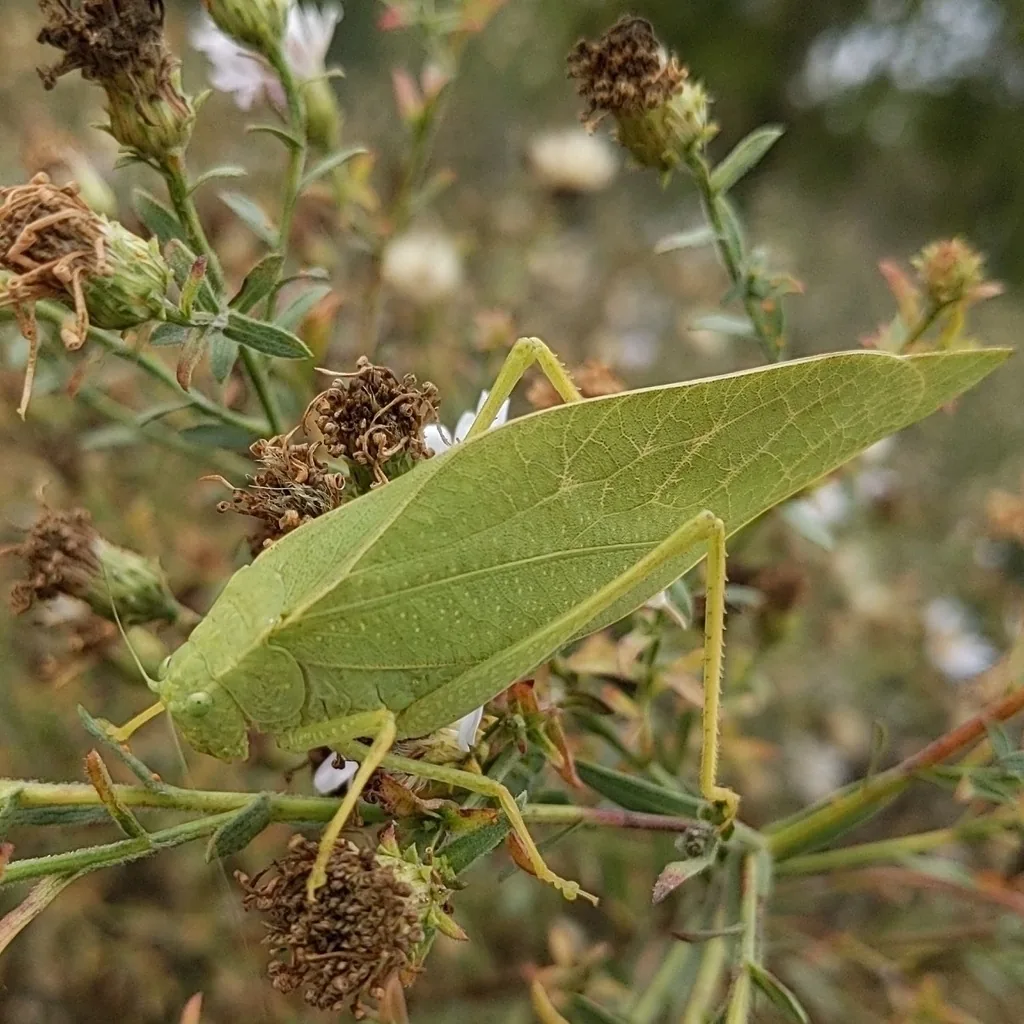
- Adults reach about 2 1/2 inches long. Like other katydids, they have thin antennae as long as or longer than the body, wings held over the back like a roof, and hearing organs on the front legs. UF/IFAS's citrus guide, which calls it the broadwinged katydid, gives adults as 2 to 2.5 inches long and bright green, a color that hides them among citrus leaves.[1][3][5]
- It is similar to the lesser angle-winged katydid but larger, lacks the brown patch on the back and has a small tooth on the front edge of the shield behind the head.[1]
- Females have a flattened, blade-like egg-laying organ (ovipositor) at the tip of the abdomen. It can look like a knife but isn't harmful to people.[1][3]
- Nymphs look like small adults without fully developed wings; UW-Madison Extension pictures an immature greater angle-wing among its examples.[1][3]
- Eggs are oval and brown or gray, laid in a row along the edge of a leaf where you can see them on the surface.[5]
Look-alikes
| Look-alike | How to tell them apart |
|---|---|
| Lesser angle-winged katydid | Smaller, at just over 2 inches, with a brown patch behind the pronotum and no tooth on its front edge. Its song is a quick 3- to 5-pulsed rattle with a second or two of silence between rattles.[1] |
| Oblong-winged katydid | Another false katydid; a round-headed species with very long hind legs, and some populations are pink, yellow, orange or tan instead of green.[1] |
| Common true katydid | Its oval wing covers bulge outward, its legs are short for its size, and it sings the raspy 'katy-did, katy-didn't' call from treetops on late summer nights.[1] |
Where it lives
Missouri's field guide gives it a broad range across the eastern and southwestern United States. GBIF has 1990-2026 records from 45 states and Washington, D.C., with the most from Colorado, California, New York, Utah and Texas. UF/IFAS says katydids are common throughout Florida.[1][4][5]
Biology and life cycle
The song is a sharp single 'Dzt!' given every few seconds plus an even, rapid series of 10 to 20 tics.[1]
Males sing by rubbing a scraper on one front wing against a file on the other, mainly to attract females, and each katydid species has its own song.[3][1]
Most katydids are active at night. In Wisconsin, katydids spend the winter as eggs laid in late summer or fall in soil, plant stems or bark; the nymphs that hatch in spring reach adulthood after about five molts. Songs slow down as fall cools and usually end by October.[3]
Katydids are food for many animals, including birds, bats, tree frogs and spiders, and great golden digger wasps stock their nests with paralyzed katydids.[3][1]
In Florida citrus, UF/IFAS says high katydid populations are most common from June through September.[5]
Damage and signs
- Katydids chew leaves and flowers, often in late summer. UW-Madison Extension says they rarely cause significant damage to crops or ornamental plants, and Missouri's field guide says their numbers are generally too low to cause serious problems. On citrus, UF/IFAS says katydids leave leaf edges notched and jagged like grasshoppers do, and they also feed on fruit, leaving large smooth or sunken areas on the surface. Damage is rarely extensive, but younger trees are more open to damage and defoliation than older ones, and nurseries and young groves may have occasional problems.[3][1][5]
Health risk
It doesn't sting, and the female's blade-like ovipositor is not harmful to people. Missouri's field guide warns that some large katydids, naming coneheads and meadow katydids, can give a hearty nip, so handle any big katydid gently.[1]
Control
Prevention
Treatment is rarely worth it: both sources describe katydid feeding as seldom significant, and katydids are an important food for birds and other wildlife. UF/IFAS points to nurseries and young citrus groves as the main places where katydid numbers occasionally become a problem.[3][1][5]
Where the sources disagree
Name: UF/IFAS's citrus guide calls Microcentrum rhombifolium the broadwinged katydid; Missouri's field guide calls it the greater angle-winged katydid.[5][1]
Damage: UW-Madison Extension says katydids rarely cause significant damage to crops or ornamentals; UF/IFAS agrees damage to citrus is rarely extensive but flags fruit scarring and defoliation of younger trees.[3][5]
Common questions
- What is the big leaf-shaped green insect ticking at night?
- It may be a greater angle-winged katydid. Most katydids are active at night, and this one gives a sharp 'Dzt!' every few seconds plus a rapid series of 10 to 20 tics.[1][3]
- How do I tell it from the lesser angle-winged katydid?
- The greater is larger, has no brown patch on its back and has a small tooth on the front edge of the shield behind the head.[1]
- Will katydids hurt my garden?
- Rarely. They nibble leaves and flowers, but damage is seldom significant.[3][1]
- What are the rows of flat, oval eggs along my leaf edges?
- They may be katydid eggs. UF/IFAS describes this species laying oval brown or gray eggs in a row along the leaf edge, visible on the leaf surface.[5]
Sources
- Missouri Department of Conservation, “Katydids (Field Guide).” mdc.mo.gov/discover-nature/field-guide/katydids (accessed 2026-11-11)
- iNaturalist, “Microcentrum rhombifolium taxon page (order and family).” www.inaturalist.org/taxa/84752 (accessed 2026-11-11)
- University of Wisconsin-Madison Extension (Wisconsin Horticulture), “Katydids (S. Mahr, revised October 2026).” hort.extension.wisc.edu/articles/katydids/ (accessed 2026-11-11)
- Global Biodiversity Information Facility (GBIF), “Microcentrum rhombifolium (greater angle-winged katydid): occurrence records in the U.S., 1990-2026 (GBIF occurrence search).” api.gbif.org/v1/occurrence/search?taxonKey=5097361&country=US&hasGeospatialIssue=false&occurrenceStatus=PRESENT&year=1990%2C2026&facet=stateProvince&facetLimit=400&limit=0 (accessed 2026-11-11). State counts are records reported (iNaturalist research-grade, museum specimens, surveys), not abundance.
- University of Florida IFAS Extension, EDIS, “Citrus Pest Quick Guide: Broadwinged Katydid (Microcentrum rhombifolium), ENY-2109/IN1423.” ask.ifas.ufl.edu/publication/IN1423 (accessed 2026-11-14)