On this page
How to identify it
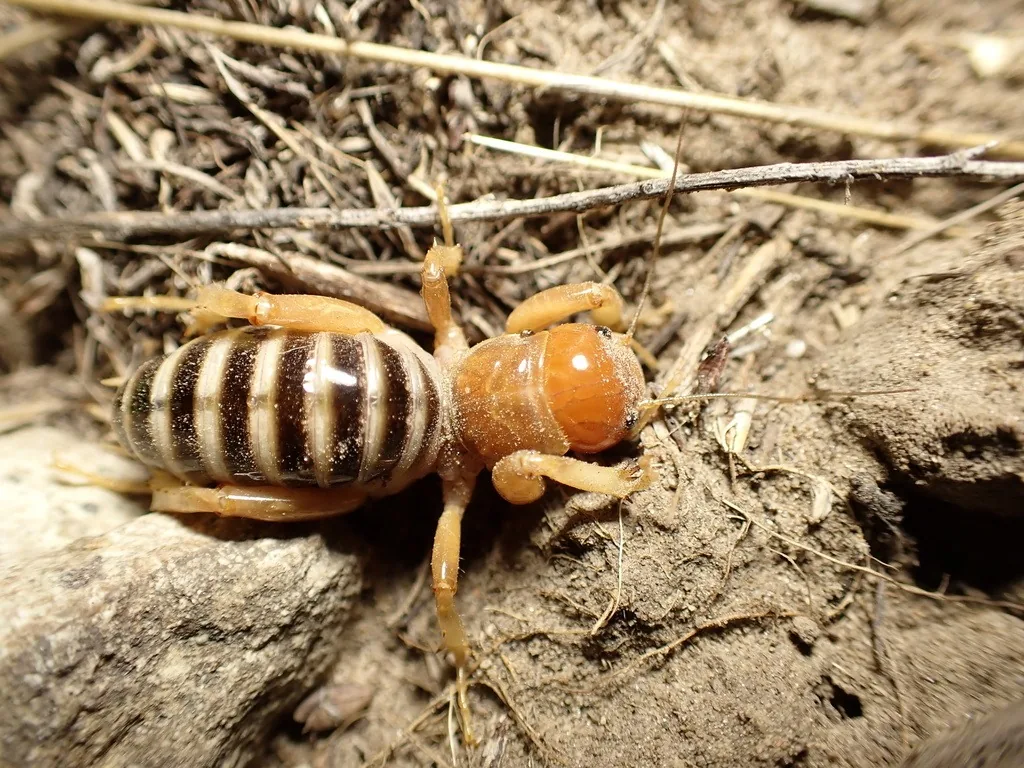
- Look for a bald, round, humanlike head, a fat abdomen with dark bands (orangish with black rings to UC IPM, shiny brown with dark stripes to the Bohart Museum), long brownish antennae and spiny hind legs.[2][1]
- Adults and young are wingless and crawl slowly; nymphs look like small adults.[1][2]
- Size is given two ways: the Bohart Museum says 1 to 2 1/2 inches long, and UC IPM says they grow up to about 2 inches.[1][2]
Look-alikes
| Look-alike | How to tell them apart |
|---|---|
| Pillbugs and sowbugs | They share the confusing nickname potato bug; none of these is a true bug, so check for the Jerusalem cricket's bald, round head and banded abdomen.[2] |
| Colorado potato beetle | Also called potato bug; the Jerusalem cricket is instead a large, wingless cricket that lives mostly underground.[2] |
Where it lives
In North America they are found only west of the Rocky Mountains; the most widespread species in California is Ammopelmatus fuscus, the species this profile centers on. Idaho's species catalog lists it (as Stenopelmatus fuscus) as a native Idaho insect.[1][3][4]
Biology and life cycle
They feed and tunnel underground by day and come aboveground mostly at night or twilight, often after heavy rain or irrigation.[2][1]
In summer they hide under rocks, logs and boards during the day.[1]
They eat insects, nonwoody roots and tubers, and sometimes dead animal matter.[2][1]
Eggs are laid in soil; nymphs molt up to about 10 times and can live up to about 2 years.[2]
They make sound by rubbing a hind leg against the abdomen, and females sometimes kill males after mating.[1]
Their legs carry tiny vibration sensors: a small sense organ just under the skin of the lower leg holds 10 to 17 sensory cells, which may pick up vibrations traveling over the leg's surface.[5]
Their names have shifted. A 2021 revision moved the U.S. species, including A. fuscus, from Stenopelmatus to Ammopelmatus, and says true Stenopelmatus species live only south of the U.S. border; GBIF's backbone taxonomy now treats Stenopelmatus fuscus as a synonym of Ammopelmatus fuscus. Idaho's species catalog still uses the older name.[4][6][3]
Damage and signs
Health risk
The Bohart Museum says Jerusalem crickets can bite, so some care should be taken when handling them; otherwise it calls them harmless despite their ferocious appearance, and UC IPM says they are harmless to people.[1][2]
Control
Traps and physical control
No control is necessary. If one turns up where it isn't wanted, UC IPM says it can be scooped into a box and thrown away; handle it with care, because it can bite.[2][1]
Biological control
Leave them be where possible: UC IPM calls them important food for some vertebrate predators, and the Bohart Museum names barn and burrowing owls and small hawks such as kestrels, especially in winter.[1][2]
Where the sources disagree
Size: the Bohart Museum gives 1 to 2 1/2 inches long; UC IPM says they grow up to about 2 inches.[1][2]
Abdomen color: UC IPM describes a fat orangish abdomen with black rings; the Bohart Museum, a large shiny brown abdomen with dark stripes.[2][1]
Crop damage: UC IPM calls them occasional pests of potatoes that only occasionally damage turf and vegetables; the Bohart Museum says they do not cause noticeable damage to garden or crop plants.[2][1]
Name: Idaho's species catalog lists the species as Stenopelmatus fuscus; the 2021 revision and GBIF place it in Ammopelmatus.[3][4][6]
Common questions
- Are Jerusalem crickets dangerous?
- The Bohart Museum says much of their dangerous reputation is mythology that comes from their large size, bald humanlike head and massive jaws. They can bite, so handle them with care; apart from that, it calls them essentially harmless.[1]
- Why are they called potato bugs?
- They occasionally feed on potato tubers, though the same nickname is used for several unrelated creatures.[1][2]
- Do Jerusalem crickets live outside California?
- Yes. In North America they occur only west of the Rocky Mountains, and the Idaho Department of Fish and Game lists Stenopelmatus fuscus as native and regularly occurring in Idaho.[1][3]
Sources
- Bohart Museum of Entomology, University of California, Davis, “Information Sheet No. 008: Jerusalem Crickets.” bohart.ucdavis.edu/sites/g/files/dgvnsk4616/files/media/documents/note_08_jerusalem_cricket.pdf (accessed 2026-11-13)
- University of California Statewide IPM Program, “Jerusalem Cricket (Pest Notes, Home and Landscape).” ipm.ucanr.edu/home-and-landscape/jerusalem-cricket/ (accessed 2026-11-13)
- Idaho Department of Fish and Game, “Stenopelmatus fuscus (Jerusalem cricket), Species Catalog.” idfg.idaho.gov/species/taxa/1476568 (accessed 2026-11-13)
- Zootaxa, via PubMed, “Weissman DB et al. (2021), Generic relationships of New World Jerusalem crickets (Orthoptera: Stenopelmatoidea: Stenopelmatinae), including all known species of Stenopelmatus, Zootaxa 4917(1).” pubmed.ncbi.nlm.nih.gov/33756684/ (accessed 2026-11-13)
- Arthropod Structure & Development, via PubMed, “Strauss J (2017), The scolopidial accessory organ in the Jerusalem cricket (Orthoptera: Stenopelmatidae), Arthropod Structure & Development 46(2):171-177.” pubmed.ncbi.nlm.nih.gov/27998741/ (accessed 2026-11-13)
- Global Biodiversity Information Facility (GBIF), “Stenopelmatus fuscus Haldeman, 1852: synonym of Ammopelmatus fuscus (GBIF Backbone Taxonomy).” api.gbif.org/v1/species/1725010 (accessed 2026-11-13)
- Global Biodiversity Information Facility (GBIF), “Ammopelmatus fuscus (Haldeman, 1852) (GBIF Backbone Taxonomy).” api.gbif.org/v1/species/11377201 (accessed 2026-11-13)
- iNaturalist, “Ammopelmatus fuscus taxon page (order and family).” www.inaturalist.org/taxa/1193580 (accessed 2026-10-06)