On this page
How to identify it
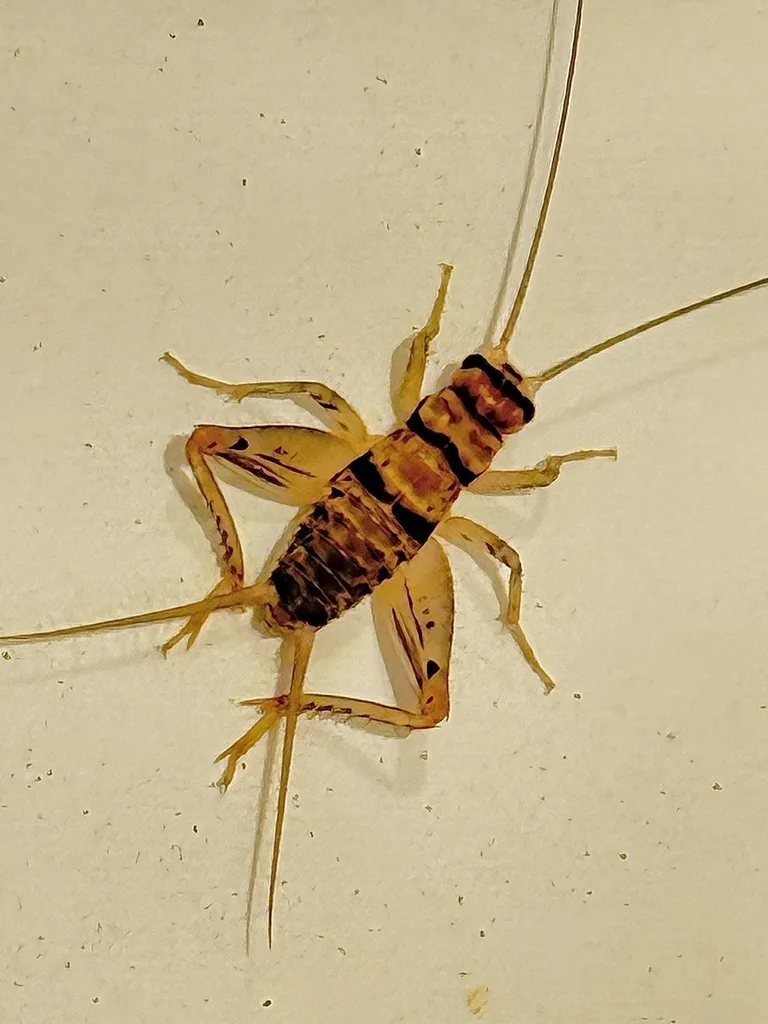
- Mature crickets are light yellowish brown or tan with darker bands and spots and about 3/4 inch long.[2]
- Males sing at night; the female has a long, sword-like egg-laying tube at the tip of her abdomen. Sound recordings and photos of males and females are on the Singing Insects of North America species page.[2][4]
- Arizona Extension calls it the Indian house cricket and uses an older name, Gryllodes supplicans, which Singing Insects of North America treats as the same species as G. sigillatus.[2][4]
- UF/IFAS gives 13 to 18 mm for adults: light yellowish brown and somewhat flattened. Males have wings that cover only half the abdomen, females are practically wingless, and a single dark band crosses the head between the eyes.[3]
Look-alikes
| Look-alike | How to tell them apart |
|---|---|
| Field crickets | Field crickets are larger, slightly over 1 inch when mature, and dark brown to shiny black. They live and breed outdoors and, though they may wander in, don't produce young indoors.[2] |
| House cricket | Another introduced cricket in the same subfamily, and the other species most often farmed in North America. Compare the two species pages before settling on an ID. UF/IFAS says that very rarely a tropical house cricket has long wings and looks like a house cricket; it still has the single dark band between the eyes, and the space between its antennae is narrow, about the width of the first antenna segment.[4][5][3] |
Where it lives
Found throughout the tropics and widely around the world, mostly in cities and permanently warm places. In the US it was first recorded in Miami in 1904 and in Tucson, Arizona, in 1963, with later records as far as Mississippi and California. UF/IFAS says it is probably native to southwestern Asia and has been spread by commerce to tropical regions throughout the world.[1][6][2][4][3]
Biology and life cycle
Development is fast in warmth. Reared at 30°C (86°F), eggs hatched in about 11 days, nymphs went through seven stages, females first reached adulthood at 29 days and males at 35, and pairs laid about 57 eggs every two days over a 30-day test.[5]
Adults hide by day and come out at night to feed on crumbs, pet food and plant debris.[2]
It is farmed in North America for food and feed, partly because it was believed to tolerate the viruses that hit house cricket colonies; USDA researchers have since found cricket iridovirus causing mass die-offs in a lab colony and covert house cricket densovirus infections.[5][7]
UF/IFAS says there is no special overwintering stage and generations are continuous; depending on temperature, development from egg to adult takes two to three months.[3]
Only males call. UF/IFAS describes the calling song as a series of brief chirps, each with three main pulses. When a female comes to the song, the male attaches a sperm packet to her, surrounded by a protein-rich mass that she eats while the sperm passes into her body.[3]
Damage and signs
- Mostly a nuisance: chirping at night and crickets gathering around foundations and doors. In very high numbers they may chew fabrics and drywall, and outdoors they may damage young garden plants and annual flowers.[2]
Health risk
A household nuisance; none of the sources describes it as a health risk to people or pets. UF/IFAS says tropical house crickets generally do no harm.[2][1][3]
Control
Keep them out
Caulk and weather-strip gaps in foundations, siding, windows and doors, keep doors closed at night and make sure screen and garage doors fit tightly.[2]
Sanitation
Clear vegetation and debris near the house, put pet food away, keep the kitchen clean, check potted plants, and keep outdoor lights off or use bulbs that don't draw insects.[2]
Traps and physical control
Kill crickets you can reach with a swatter, vacuum or shoe.[2]
Pesticides
Cricket baits work particularly well indoors. Use other insecticides only as a last resort and only in cracks and crevices where crickets hide; spraying the air or large open surfaces doesn't help. Follow the label.[2]
UF/IFAS says that if they cause problems indoors by their presence or calling, baits sold for cockroach or earwig control can eliminate them. Follow the label.[3]
How it reached North America
Singing Insects of North America describes it as found throughout the tropics, partial to cities and permanently warm places. The first US record was nine specimens caught in Miami in February 1904.[1]
In Arizona it was first seen in Tucson in 1963 and by the late 1970s was common in many parts of the state and the household pest most often recorded by exterminators.[2]
Later records added to the Singing Insects of North America map include males heard calling behind a gas station in Starkville, Mississippi, in 2016 and a singing cricket recorded in Sierra County, California, in 2023.[4]
Where the sources disagree
Size: UF/IFAS gives 13 to 18 mm for adults; Arizona Extension says mature crickets are about 3/4 inch long.[3][2]
Use as food: UF/IFAS says that, unlike the house cricket, it is seldom used for pet food or fish bait; the 2025 study describes it as mass-reared for food and feed.[3][5]
Common questions
- What's chirping inside my house in Florida?
- Possibly tropical house crickets, which come in through cracks and, unlike field crickets, can breed indoors. They are tan with darker bands and about 3/4 inch long.[2][1]
- Are tropical house crickets harmful?
- Not to people; the sources treat them as a nuisance. Large numbers may chew fabrics and drywall, and cricket baits indoors plus sealing gaps usually handle them.[2]
- Do tropical house crickets have a winter stage?
- No. UF/IFAS says there is no special overwintering stage and generations run continuously, each taking two to three months from egg to adult depending on temperature.[3]
- Why do I see crickets coming out of the cracks in my patio at night?
- In Florida these are often tropical house crickets. UF/IFAS says they live in or near paved areas and come out at night from crevices between pavement blocks to forage and sing.[3]
Sources
- Singing Insects of North America (Orthopterists' Society), “Origins and spread of SINA species that are aliens: Gryllodes sigillatus.” orthsoc.org/sina/sinaaliens.htm (accessed 2026-11-14)
- University of Arizona Cooperative Extension, “Crickets (Backyard Gardener #205, adapted from Jeff Schalau, 2024).” extension.arizona.edu/sites/extension.arizona.edu/files/attachment/Crickets.pdf (accessed 2026-11-14)
- University of Florida/IFAS Extension (Featured Creatures), “Tropical House Cricket, Gryllodes sigillatus (F. Walker), EENY-064/IN221 (Featured Creatures).” ask.ifas.ufl.edu/publication/IN221 (accessed 2026-11-14)
- Singing Insects of North America (Orthopterists' Society), “Tropical house cricket (Gryllodes sigillatus) species, map and subfamily Gryllinae pages.” orthsoc.org/sina/501a.htm (accessed 2026-11-14)
- Peer-reviewed literature (PubMed Central), “Growth, development, and life history of a mass-reared edible insect, Gryllodes sigillatus (Orthoptera: Gryllidae) (Kong JD et al., Journal of economic entomology, 2025).” pmc.ncbi.nlm.nih.gov/articles/PMC12167847/ (accessed 2026-11-14)
- Mitochondrial DNA Part B, via PubMed, “Mitochondrial genome characterization of Gryllodes sigillatus and its phylogenetic implications (Yang et al. 2021).” pubmed.ncbi.nlm.nih.gov/33796736/ (accessed 2026-11-14)
- Frontiers in Microbiology, via PubMed, “Active and Covert Infections of Cricket Iridovirus and Acheta domesticus Densovirus in Reared Gryllodes sigillatus Crickets (Duffield et al. 2021).” pubmed.ncbi.nlm.nih.gov/34917059/ (accessed 2026-11-14)
- iNaturalist, “Gryllodes sigillatus taxon page (order and family).” www.inaturalist.org/taxa/154340 (accessed 2026-11-14)