On this page
How to identify it
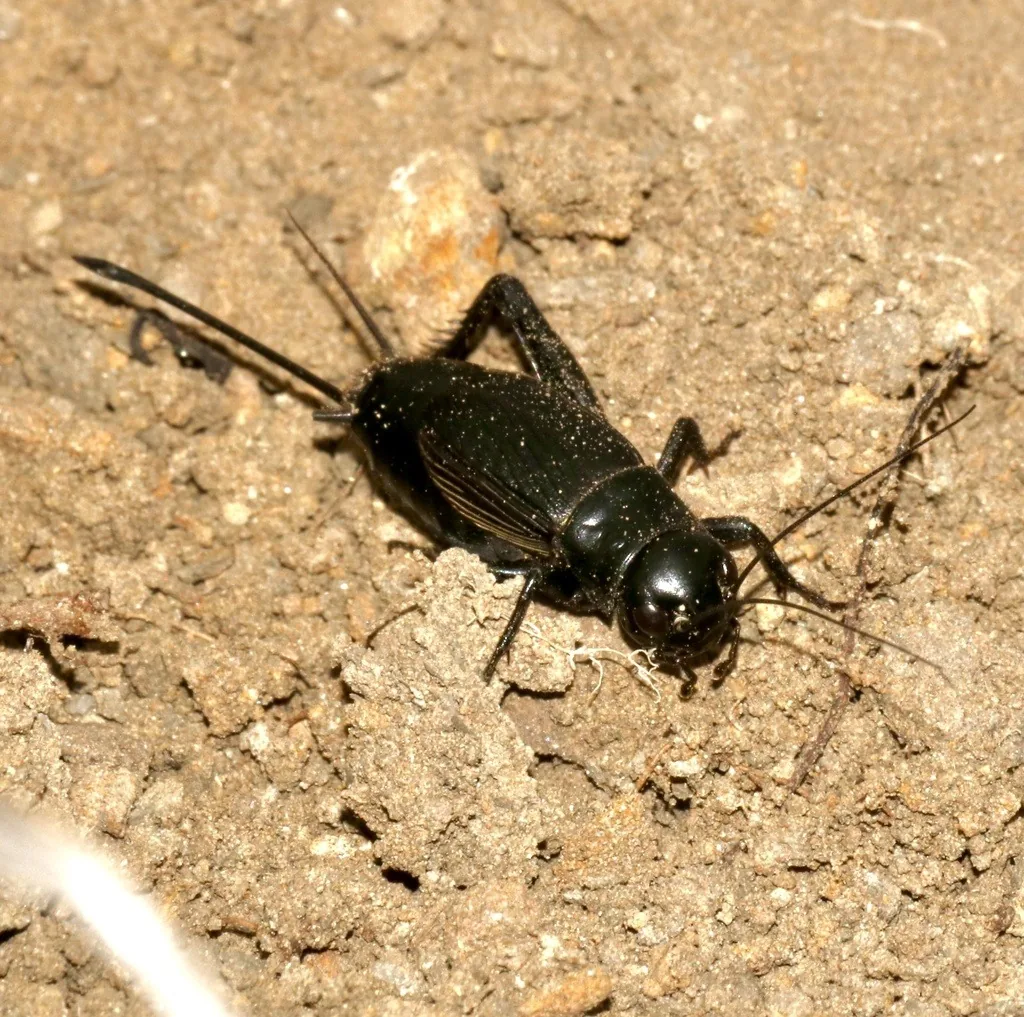
- Usually black or dark brown, sometimes lighter shades of brown, and roughly 1/2 inch to over 1 inch long (sources differ; see below).[1][2][3]
- The brownish hind wings stick out past the front wings like pointed coattails.[1]
- Antennae as long as the body or longer, big jumping hind legs with short, sharp spines, and two feelers at the tail end; females also carry a long, sword-like egg-laying tube.[2][3][1]
- Young look like small adults without wings.[2]
Look-alikes
| Look-alike | How to tell them apart |
|---|---|
| House cricket | Light yellowish brown with three dark bands across the head, about 3/4 to 1 inch long, and able to live and lay eggs indoors year-round.[1][2][3] |
| Camel cricket | Tan and humpbacked, and wingless, so it can't chirp; it isn't attracted to lights and usually stays in cool, damp basements and crawl spaces.[1][3] |
| Ground crickets | Much smaller, about 0.3 to 0.5 inch, dark reddish brown to black, with a shriller, higher-pitched chirp; their small size lets them get indoors more easily.[1] |
Where it lives
Field crickets live in fields, pastures, meadows, along roadsides and in yards, and they are among the most common house-invading crickets in Missouri.[2][3][1]
Biology and life cycle
Females push their eggs into the soil, which is why field crickets seldom build up in large numbers indoors.[1][2]
Minnesota says crickets have one generation a year there and rarely reproduce indoors; crickets that get inside usually die by autumn or early winter.[3]
Adult males chirp by rubbing their wings together, one wing working as a comb and the other as a file, to attract and court females or to warn rivals.[1][2]
They hide by day in mulch, tall grass, weeds and rock, brick or wood piles and come out at night, when lights draw them.[2][1]
They feed on a variety of plants and on dead or weakened insects, including other crickets.[3][1]
Damage and signs
- Indoors they chew cotton, linen, wool, silk and fur, especially items soiled with food or perspiration, leaving roughened patches on the surface of the fabric.[1][2][3]
- Because they lay eggs in soil, field crickets rarely build up large numbers inside and are usually only occasional invaders.[2]
- Outdoors, large numbers can damage garden plants and sometimes field crops. UC IPM says crickets moving in from drying weedy areas can destroy several rows of seedlings in a day or two.[4][1][2]
Health risk
The main problems are chirping indoors, which many people find annoying, and chewing damage to fabrics, especially soiled items; Minnesota says they don't cause major damage and are usually just a nuisance.[2][1][3]
Control
Prevention
Limit outdoor lighting, or switch to yellow or sodium vapor bulbs, which attract fewer crickets than white, neon or mercury vapor lights.[2][1][3]
In gardens, protective cones or row covers keep crickets off seedlings; UC IPM says garden control is rarely needed.[4]
Keep them out
Caulk or repair foundation cracks and gaps around doors, ground-level windows and vents, and keep screens in good condition.[1][2][3]
Sanitation
Mow tall grass, weed beds near the house, keep heavy mulch back from the foundation, and move rock, brick, board and firewood piles away. Set garbage cans up off the ground.[2][1][3]
Traps and physical control
Vacuum crickets indoors and discard the bag outside, and set sticky traps near entry points. Remove dead crickets so they don't feed ants or beetles.[2][1][3]
Pesticides
Indoors, use cricket baits or labeled crack-and-crevice treatments rather than spraying open surfaces; outdoors, a bait band between habitat and the house works better than sprays on bare concrete.[1][2]
Minnesota suggests an outdoor-labeled insecticide band along the foundation and ground only if other steps fail and large numbers are getting in; Missouri notes barriers are temporary and may need repeating.[3][1]
Where sources disagree
Size: Missouri gives 0.5 to 1.25 inches; Clemson 1/2 inch to over 1 inch; Minnesota a 1/2- to 3/4-inch body; UC IPM gives 0.6 to 1 inch for adult crickets in general.[1][2][3][4]
Indoor insecticides: Clemson says to use them only when a large infestation is present; Missouri calls cricket baits particularly effective indoors.[2][1]
Timing: Missouri says field crickets invade most often in fall as nights cool; Minnesota says crickets enter especially in late summer and fall.[1][3]
Common questions
- Why do crickets come inside in the fall?
- Field crickets move toward buildings as nights cool and are drawn to lights; they get in through gaps around doors, windows and foundations.[1][3]
- Will field crickets infest my house?
- Rarely. They usually lay eggs outdoors in soil, and those that get inside normally die by early winter, unlike house crickets, which can breed indoors.[2][3][1]
- Do field crickets damage gardens?
- Occasionally. Crickets leaving drying weedy areas can chew seedlings and vegetables for a short time; cones or row covers protect young plants.[4][1]
Sources
- University of Missouri Extension, “Crickets (Publication G7366, reviewed August 2025).” extension.missouri.edu/publications/g7366 (accessed 2026-11-11)
- Clemson Cooperative Extension, Home & Garden Information Center, “House and Field Crickets (HGIC 2425).” hgic.clemson.edu/factsheet/house-and-field-crickets/ (accessed 2026-11-11)
- University of Minnesota Extension, “Crickets.” extension.umn.edu/garden-and-home/home-maintenance/household-insects/crickets (accessed 2026-11-11)
- University of California Statewide IPM Program, “Crickets.” ipm.ucanr.edu/home-and-landscape/crickets/ (accessed 2026-11-11)
- iNaturalist, “Gryllus pennsylvanicus taxon page (order and family).” www.inaturalist.org/taxa/122193 (accessed 2026-11-11)