On this page
How to identify it
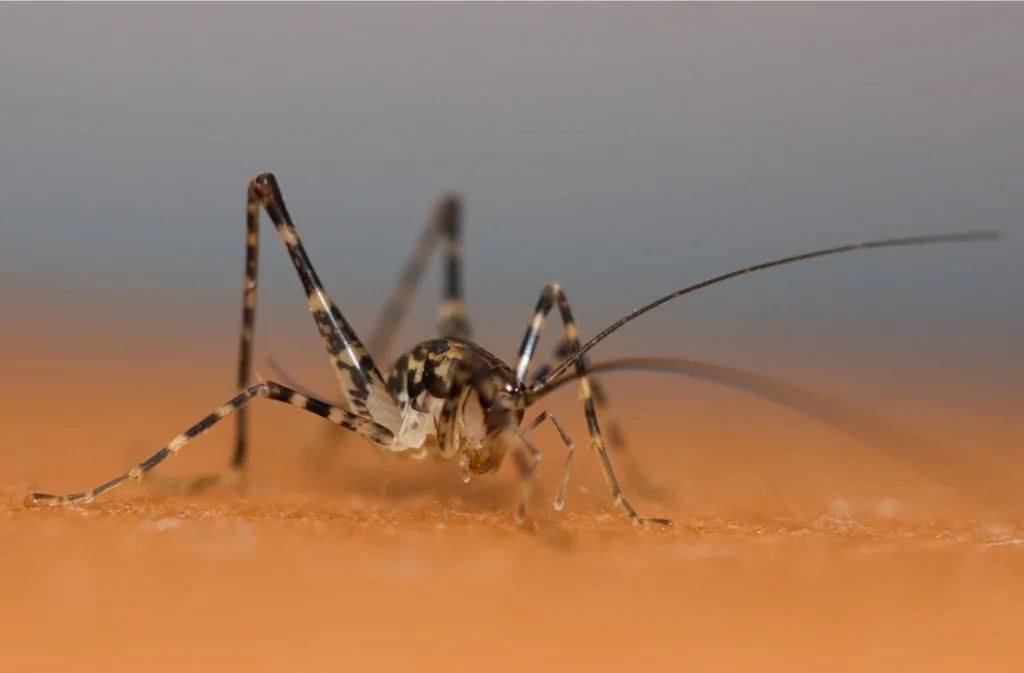
- Like other camel crickets it is humpbacked and wingless, with long antennae and large hind legs. Camel crickets cannot fly or chirp, but they can jump a surprisingly long way.[2]
- It is told apart from the much more common greenhouse camel cricket by the spines on the long lower segment of its legs (the tibiae), about 30 instead of about 60, and by tibial spur length, the luster and distinctive pattern of the pronotum, and its coloring.[1]
- The Missouri Department of Conservation says camel crickets are generally tan, reddish brown or dark brown and grow to about 1 inch long, not counting legs and antennae; Cornell gives 1/2 to 1 1/2 inches (see where the sources disagree). The young look like small adults.[2][3]
Look-alikes
| Look-alike | How to tell them apart |
|---|---|
| Greenhouse camel cricket (Diestrammena asynamora) | The other Asian camel cricket in North American houses, and by far the more common one: 94 percent of the household Diestrammena records identified to species in the 2014 survey. It has about 60 tibial spines, roughly twice as many.[1] |
Where it lives
It is an Asian species. In the 2014 survey its household records came only from Massachusetts, Pennsylvania and New Jersey. GBIF's U.S. records since 1990 now come from 12 states and the District of Columbia, almost all in the Northeast, led by New York, New Jersey, Pennsylvania and Connecticut. In southwestern China it is the dominant insect in karst caves.[1][4][5]
Biology and life cycle
The 2014 identification rested on photographs, so the researchers called it putative D. japanica and recommended examining museum specimens to confirm it. It was the first report of the species as an introduced insect in the United States in the scientific literature.[1]
Of the 108 household Diestrammena submissions that could be identified to species, seven were Japanese camel crickets and the rest greenhouse camel crickets. Overall, these Asian camel crickets turned up in eastern houses far more often than native camel crickets did.[1]
Camel crickets favor cool, moist places such as basements, cellars, caves and the undersides of logs. They are almost entirely nocturnal and feel their way in the dark with their long antennae and legs.[2]
Camel crickets eat organic debris, insects and other small arthropods. In Chinese caves this species is omnivorous and its diet follows the light: near cave entrances it eats more moss and ferns, and in dim and dark zones more animal carcasses and fungi.[2][5]
Whether they breed indoors is reported both ways: the Missouri Department of Conservation says camel crickets are unlikely to breed inside buildings unless darkness and moisture are just right, while Cornell Cooperative Extension says camel crickets can breed throughout the year indoors.[2][3]
They eat organic material, and Cornell Cooperative Extension says house camel crickets will chew fabrics, from sponge mops to lace curtains. Outdoors they live in leaf piles, under logs and in holes in the ground, and eggs hatch in the spring.[3]
Damage and signs
Health risk
The Missouri Department of Conservation, Cornell Cooperative Extension and the 2014 study describe camel crickets as nuisance insects of damp basements that can chew fabrics; none of them mentions bites, stings or disease.[2][3][1]
Control
Prevention
Large numbers of camel crickets in a basement can point to a moisture problem, so fix the dampness first: keep basements and crawl spaces as dry as possible.[2][3]
Keep them out
Seal entry points such as vents and doorways, fix cracks in foundations and poorly fitting doors, and remove moist hiding places outdoors close to the house.[3]
Traps and physical control
Vacuum up as many as you can and throw the bag away each time, or the crickets may crawl back out. Sticky glue traps help keep numbers down; remove them once they fill, or the dead crickets start to smell.[3]
Pesticides
Cornell names boric acid as one approved insecticide for camel crickets (read and follow the label), or you can call a certified pesticide applicator. It cautions that there is no one-time fast way to get rid of them. In greenhouses, pesticides are occasionally needed.[3][2]
Where the sources disagree
Size: the Missouri Department of Conservation gives camel crickets up to about 1 inch long, not counting appendages; Cornell gives 1/2 to 1 1/2 inches at maturity.[2][3]
Breeding indoors: the Missouri Department of Conservation says they are unlikely to breed inside buildings unless darkness and moisture are just right; Cornell says they can breed throughout the year indoors.[2][3]
Which camel crickets live in houses: Cornell says the camel crickets entering homes are mostly the native genus Ceuthophilus; the 2014 citizen-science study found Asian Diestrammena camel crickets in eastern houses far more often than native ones.[3][1]
Common questions
- How can I tell a Japanese camel cricket from a greenhouse camel cricket?
- With a sharp photo, count the spines on the long lower leg segments: about 30 on the Japanese camel cricket and about 60 on the greenhouse camel cricket. The pattern, sheen and coloring of the pronotum also differ.[1]
- Are Japanese camel crickets a problem?
- Mostly as a nuisance. Cornell calls camel crickets a minor pest in most homes, though they can turn up in large numbers in damp basements and chew fabrics; the Missouri Department of Conservation says they are of no economic importance but can become a nuisance in greenhouses.[3][2]
- Why do camel crickets show up in my basement?
- They seek out cool, damp, dark places, and finding many of them in a basement can mean there is a moisture problem.[2]
- How far north and south does the Japanese camel cricket go?
- GBIF holds about 1,400 U.S. records since 1990, almost all from the Northeast: New York (475), New Jersey (269), Pennsylvania (235) and Connecticut (205) lead, with fewer from Massachusetts, Maryland, Vermont, Delaware and nearby states and a single record from Virginia.[4]
Sources
- PeerJ, full text in PubMed Central (PMC4157299), “Epps, Menninger, LaSala and Dunn. Too Big to Be Noticed: Cryptic Invasion of Asian Camel Crickets in North American Houses. PeerJ 2: e523 (2014), doi:10.7717/peerj.523.” doi.org/10.7717/peerj.523 (accessed 2026-11-13)
- Missouri Department of Conservation, “Camel Crickets (Cave Crickets) (Field Guide).” mdc.mo.gov/discover-nature/field-guide/camel-crickets-cave-crickets (accessed 2026-11-13)
- Cornell Cooperative Extension, Nassau County, “Cave (Camel) Crickets (Home Grounds Fact Sheet).” ccenassau.org/resources/cave-camel-crickets (accessed 2026-11-13)
- Global Biodiversity Information Facility (GBIF), “Diestrammena japanica: U.S. occurrence records since 1990 by state (GBIF occurrence search).” api.gbif.org/v1/occurrence/search?taxonKey=1729009&country=US&hasGeospatialIssue=false&occurrenceStatus=PRESENT&year=1990%2C2026&facet=stateProvince&facetLimit=400&limit=0 (accessed 2026-11-13). State counts are records reported, not abundance. 1,423 records on 2026-11-13.
- Frontiers in Microbiology (Frontiers), full text in PubMed Central (PMC9812492), “Dong, Chen, Fang, Wu et al. Gut Bacteria Reflect the Adaptation of Diestrammena japanica (Orthoptera: Rhaphidophoridae) to the Cave. Frontiers in Microbiology 13: 1016608 (2022), doi:10.3389/fmicb.2022.1016608.” doi.org/10.3389/fmicb.2022.1016608 (accessed 2026-11-13)
- Global Biodiversity Information Facility (GBIF), “Diestrammena japanica Blatchley, 1920 (GBIF Backbone Taxonomy).” api.gbif.org/v1/species/1729009 (accessed 2026-11-13)
- iNaturalist, “Diestrammena japanica taxon page (order and family).” www.inaturalist.org/taxa/425403 (accessed 2026-11-09)