On this page
How to identify it
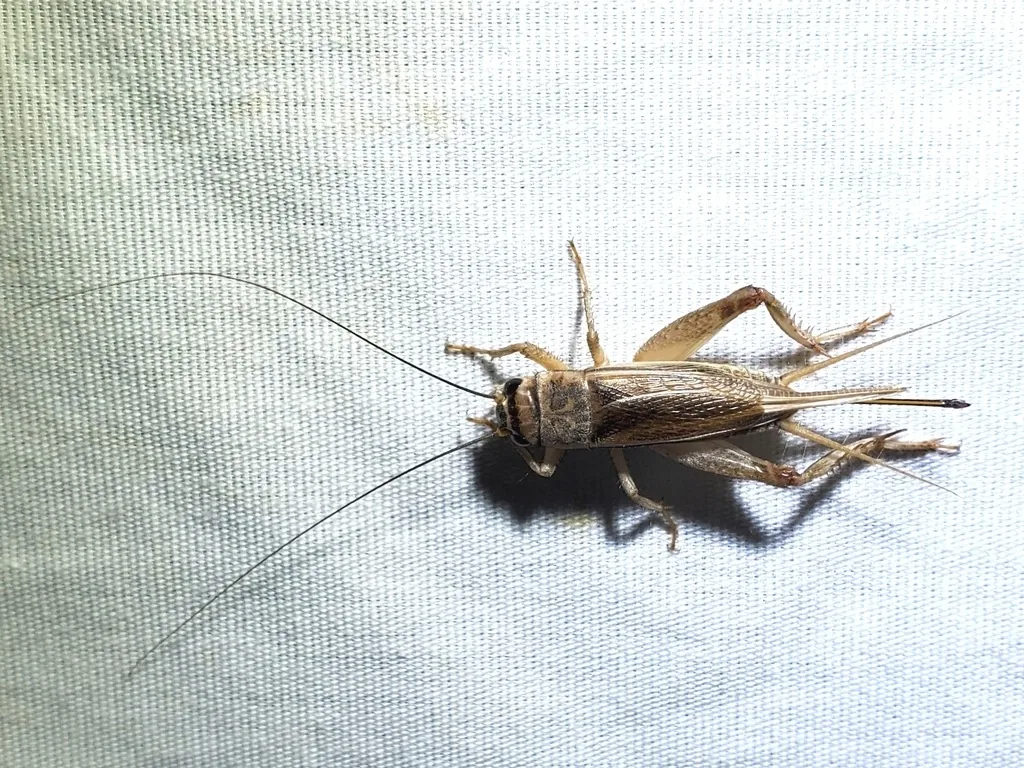
- Light yellowish brown to tan, with three dark bands across the head and long, pointed wings held flat over the back. UF/IFAS gives 16 to 21 mm (5/8 to 7/8 inch) and says the dark bands run across the top of the head and between the eyes.[1][3][2][4]
- Slender antennae as long as the body or longer and large, spiny hind legs for jumping; females have a needlelike egg-laying tube at the tip of the abdomen.[1][3][2]
- Young crickets look like the adults but are smaller and have no wings.[3]
- Males chirp by rubbing their wings together, mainly to attract females. UF/IFAS says the male rubs a scraper on the left wing against a file under the right wing; the calling song is a series of short chirps, each of two or three pulses.[1][3][4]
- UF/IFAS says all house crickets have long hind wings as adults but sometimes shed them later.[4]
Look-alikes
| Look-alike | How to tell them apart |
|---|---|
| Field cricket | Dark brown to black, 1/2 to 3/4 inch, with rounded wings covering most of the body. Field crickets lay their eggs in soil, so they are less likely to build up indoors.[1][3] |
| Camel cricket | Tan, humpbacked and wingless, found in cool, damp, dark places such as basements and not attracted to light.[1] |
Where it lives
Common outdoors, particularly around garbage dumps; enters buildings through open doors and windows and cracks in foundations.[1]
Biology and life cycle
Crickets are mostly active at night.[1][3]
Outdoors, house crickets hide in moist spots such as mulch, tall grass and weeds and in rock, brick and wood piles; Minnesota says they are particularly common around garbage dumps.[3][1]
Indoors they settle in warm areas with moisture and food; in winter they are often near fireplaces, kitchens, water heaters and furnaces.[3]
They eat a wide variety of foods, including plant material and dead or weakened insects.[2][1]
UF/IFAS says the life cycle takes two to three months when reared at 80°F to 90°F. Eggs go into whatever damp material is available, such as sand or peat moss.[4]
There is no special overwintering stage; UF/IFAS says house crickets survive cold weather in the northern states and Canada in and around buildings and in dumps, where heat from fermentation may keep them going.[4]
Damage and signs
Health risk
None of these sources reports crickets biting or stinging people; Minnesota says they don't cause major damage in most homes and are usually just a nuisance. Eating them is another matter for some people: a 2024 case report traced a man's allergic reaction to a cricket snack to a house cricket tropomyosin, and he was also sensitized to shrimp tropomyosin.[1][5]
Control
Prevention
Turn off unneeded outdoor lights or use yellow or sodium vapor bulbs, cut tall grass and weeds near the foundation, and move firewood, mulch, bricks and debris away from the house. Set garbage cans up off the ground.[1][3]
Keep them out
Caulk or repair cracks and gaps in the foundation and around doors and ground-level windows, and keep screens in good condition.[1][3]
Traps and physical control
Vacuum up crickets indoors and throw the bag away outside; sticky traps set where crickets are found or around entry points also help, and less clutter means fewer hiding spots.[1][3]
Pesticides
Minnesota says insecticides are generally neither effective nor necessary indoors; if large numbers keep entering, an exterior band along the foundation, labeled for the site, can supplement exclusion.[1][3]
UF/IFAS says house crickets generally do no harm, but if escaped pet-food or bait crickets annoy you with their calling indoors, baits sold for cockroach or earwig control can eliminate them.[4]
More on where it's found
Missouri's conservation department says house crickets are probably native to Eurasia but are now found nearly worldwide, having traveled the globe with people. They are commonly sold as fish bait and as live pet food. UF/IFAS gives southwestern Asia as the probable home. It says house crickets turn up wherever they are sold in the United States but survive in the wild only in the eastern U.S. (except peninsular Florida) and southern California; why they fail in peninsular Florida is not known.[2][4]
In Missouri they live in many habitats, especially lawns, fields, pastures, prairies and roadsides, and are also quite common in houses.[2]
Where sources disagree
Breeding indoors: Minnesota says crickets that come inside usually don't lay eggs and normally die by autumn or early winter, and that crickets rarely reproduce indoors; Clemson says house crickets can spend their whole lives inside buildings and lay many eggs there.[1][3]
Size: Minnesota gives about 3/4 inch; Missouri gives 1/2 to 3/4 inch; Clemson says one inch or less.[1][2][3]
Indoor insecticides: Minnesota says they are generally not effective or necessary; Clemson allows crack-and-crevice treatment indoors when a large infestation is present and says treating attics is sometimes needed for house crickets.[1][3]
Native home: Missouri says probably Eurasia; UF/IFAS says probably southwestern Asia.[2][4]
Winter: Minnesota says crickets that get indoors normally die by autumn or early winter; UF/IFAS says house crickets survive cold weather in the North in and around buildings and in dumps.[1][4]
Size (continued): UF/IFAS gives 16 to 21 mm (5/8 to 7/8 inch).[4]
Common questions
- Will crickets breed in my house?
- Sources differ. Minnesota says crickets that get indoors usually don't lay eggs and die by early winter; Clemson says house crickets can live their whole lives in buildings and lay many eggs in warm, damp spots.[1][3]
- Are pet-store and bait crickets house crickets?
- Often. Missouri's conservation department says house crickets are commonly sold for fish bait and as live pet food. UF/IFAS says those crickets come from large commercial cricket farms, and in Florida, house crickets are mostly met as bait and pet food, usually where some have escaped or been released, such as on shores where people fish.[2][4]
Sources
- University of Minnesota Extension, “Crickets (reviewed 2024).” extension.umn.edu/garden-and-home/home-maintenance/household-insects/crickets (accessed 2026-11-14)
- Missouri Department of Conservation, “House Cricket (Field Guide).” mdc.mo.gov/discover-nature/field-guide/house-cricket (accessed 2026-11-14)
- Clemson Cooperative Extension Home & Garden Information Center, “House and Field Crickets, HGIC 2425.” hgic.clemson.edu/factsheet/house-and-field-crickets/ (accessed 2026-11-14)
- University of Florida/IFAS Extension (Featured Creatures), “House Cricket, Acheta domesticus (Linnaeus), EENY-063/IN220 (T. J. Walker).” ask.ifas.ufl.edu/publication/IN220 (accessed 2026-11-14)
- Molecular Nutrition & Food Research, via PubMed, “Allergic Reaction to a Commercially Available Insect Snack Caused by House Cricket (Acheta domesticus) Tropomyosin (Wangorsch et al. 2024).” pubmed.ncbi.nlm.nih.gov/38332580/ (accessed 2026-11-14)
- iNaturalist, “Acheta domesticus taxon page (order and family).” www.inaturalist.org/taxa/133220 (accessed 2026-11-14)