On this page
How to identify it
- Soft-bodied insects usually under 1/4 inch long (Minnesota puts psocids at under 3/16 inch), with long, slender antennae. Adults may be winged or wingless, and large gatherings hold both.[1][4][2]
- Winged adults have four wings held roof-like over the body at rest.[5][2]
- They have chewing mouthparts and relatively large heads. Most psocids are white, pale cream or light to dark gray.[5][6]
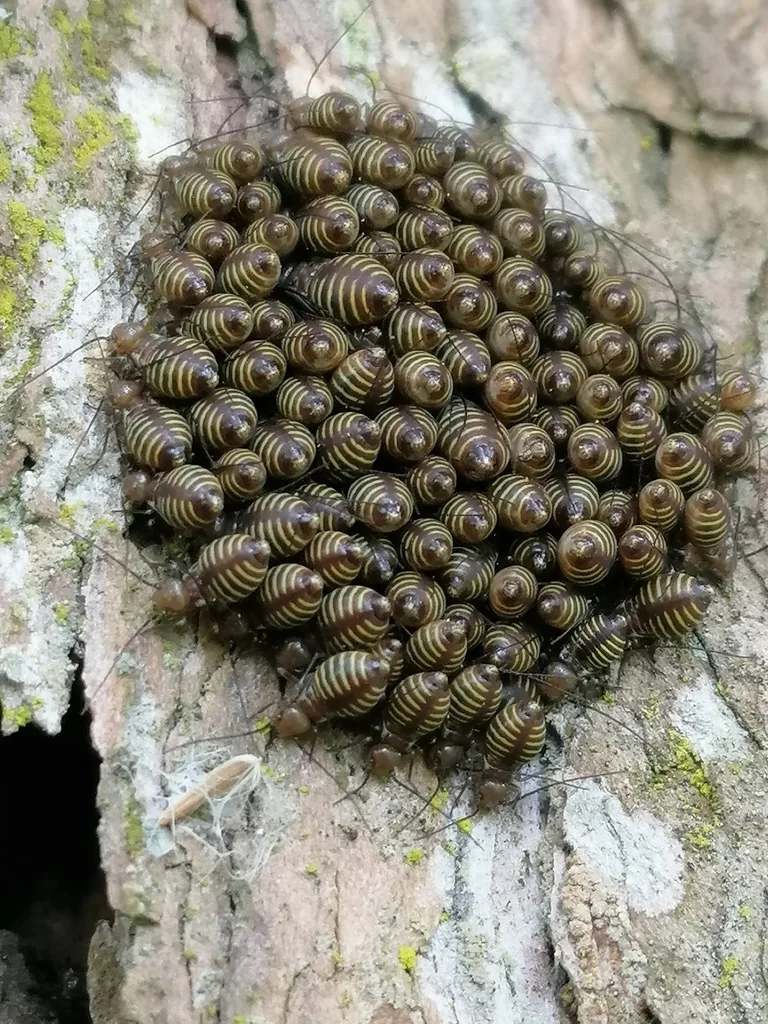
- The common barklouse, Cerastipsocus venosus, grows to only 1/8 inch. Its nymphs are dark gray with pale bands between the abdominal segments and cluster together on bark.[5]
- Two species draw the most attention in the Southeast. The common barklouse moves over bark in quarter- to palm-sized groups that look like a herd of grazing animals, which is why barklice are nicknamed 'tree cattle'. Archipsocus nomas, the webbing barklouse, covers trunks and limbs with fine silk.[3][1][7][5]
Look-alikes
| Look-alike | How to tell them apart |
|---|---|
| Spider mites | Barklice webbing is rarely found on the foliage, which helps tell it apart from spider mite webbing.[1] |
| Webworms and tent caterpillars | Certain caterpillars web foliage; barklice webbing stays on the bark of trunks and limbs.[1] |
| Booklice | Booklice are wingless psocids, usually Liposcelis, found indoors near books, paper and stored food in damp places. Most outdoor psocids have wings and are the ones called barklice.[4][6] |
Where it lives
Clemson counts more than 300 barklouse species in 26 families in the United States and Canada. The herding common barklouse occurs throughout Mississippi and is noticed most on smooth-barked trees such as crape myrtle, sycamore and young oaks. The webbing barklouse turns up along the Gulf Coast and, in South Carolina, mostly in coastal plain counties.[1][3][5]
Biology and life cycle
Barklice feed on mold, fungi, pollen, algae, lichens, decaying organic matter and fragments of dead insects, not on living plant tissue.[1][4][7][2]
Young pass through six nymphal stages that look like small wingless adults. Females lay eggs singly or in clusters on bark, sometimes covering them with silk or debris, or inside the webbing some species spin.[1][5]
Common barklouse nymphs appear in April, and webbing barklouse silk is most noticeable in late summer.[5][1]
Webbing barklice spin a fine layer of silk that protects them from predators; in years of high numbers, the trunks of large oaks can be entirely encased.[3]
Psocids favor damp places such as under stones and loose bark, in grass and leaves, on damp wood and on tree trunks and foliage. Large populations are usually temporary.[2]
Damage and signs
Health risk
None. Psocids are not true lice, can't bite or sting, and are harmless to people and pets.[1][4][8]
Control
Prevention
No control is needed. Iowa State says insecticide treatment is not justified, and NC State says no pesticide recommendation is needed.[2][5][1]
Traps and physical control
If the webbing or clusters bother you, wash them off the bark with a strong stream of water.[1][5]
Barklice and true lice
Barklice and booklice (Psocoptera) share the order Psocodea with the parasitic lice of birds and mammals. A large 2021 genetic study concluded that parasitism arose only once within the order.[9]
An earlier 2005 analysis of one gene region pointed the other way: it suggested parasitism may have evolved twice, with one family of booklice, the Liposcelididae, most closely related to a group of true lice.[10]
Where sources disagree
Spraying: Clemson and Iowa State call insecticides unnecessary. NC State agrees no recommendation is needed but notes that any contact insecticide would kill them if control is wanted.[1][2][5]
Size: under 1/4 inch (Clemson), under 3/16 inch (Minnesota) or 1/16 to 1/8 inch (Washington State, for psocids in general).[1][4][6]
Origin of parasitic lice: once, by the 2021 genome-scale study, or possibly twice, by the 2005 single-gene study.[9][10]
Common questions
- What is the silky webbing covering my tree trunk?
- In the Southeast it is often the webbing barklouse, a harmless insect that feeds on lichens and fungi under the silk. It is most noticeable along the Gulf Coast and in late summer.[1][3]
- Will barklice kill my tree?
- No. They feed on lichens, fungi and debris, not the tree.[1][2]
- Should I spray them?
- No. Hose the webbing or clusters off if you dislike the look.[1][5][2]
- What are 'tree cattle'?
- Groups of barklice, usually the common barklouse Cerastipsocus venosus, that move together over bark like grazing cattle. Run a finger slowly through a group to watch them herd.[3][7]
Sources
- Clemson Cooperative Extension Home & Garden Information Center, “Barklice, HGIC 2365 (revised May 7, 2024).” hgic.clemson.edu/factsheet/barklice/ (accessed 2026-11-11)
- Iowa State University Extension and Outreach (Yard and Garden), “Barklice on Trees (July 24, 2020).” yardandgarden.extension.iastate.edu/article/2020/07/barklice-trees (accessed 2026-11-11)
- Mississippi State University Extension, “Bark Lice, Vol. 3, No. 5 (Bug's Eye View, 2017).” extension.msstate.edu/newsletters/bugs-eye-view/2017/bark-lice-vol-3-no-5 (accessed 2026-11-11)
- University of Minnesota Extension, “Psocids (barklice, booklice).” extension.umn.edu/garden-and-home/home-maintenance/household-insects/booklice-barklice (accessed 2026-11-11)
- NC State Extension, “Common Barklouse (Cerastipsocus venosus).” content.ces.ncsu.edu/common-barklouse-1 (accessed 2026-11-11)
- Washington State University Extension, PestSense, “Psocids (booklice or barklice).” pestsense.cahnrs.wsu.edu/fact-sheet/psocids-booklice-or-barklice/ (accessed 2026-11-11)
- Clemson Cooperative Extension Home & Garden Information Center, “What is It? Wednesday: Barklice.” hgic.clemson.edu/what-is-it-wednesday-barklice/ (accessed 2026-11-11)
- Iowa State University Extension and Outreach (Yard and Garden), “Psocids, Booklice, Barklice (encyclopedia).” yardandgarden.extension.iastate.edu/encyclopedia/psocids-booklice-barklice (accessed 2026-11-11)
- Systematic Biology, via PubMed, “de Moya and others (2021), Phylogenomics of parasitic and nonparasitic lice (Insecta: Psocodea).” pubmed.ncbi.nlm.nih.gov/32979270/ (accessed 2026-11-11)
- Parasitology Research, via PubMed, “Murrell and Barker (2005), Multiple origins of parasitism in lice: phylogenetic analysis of SSU rDNA indicates that the Phthiraptera and Psocoptera are not monophyletic.” pubmed.ncbi.nlm.nih.gov/16007465/ (accessed 2026-11-11)
- iNaturalist, “Archipsocus nomas taxon page (order and family).” www.inaturalist.org/taxa/270483 (accessed 2026-10-06)