On this page
How to identify it
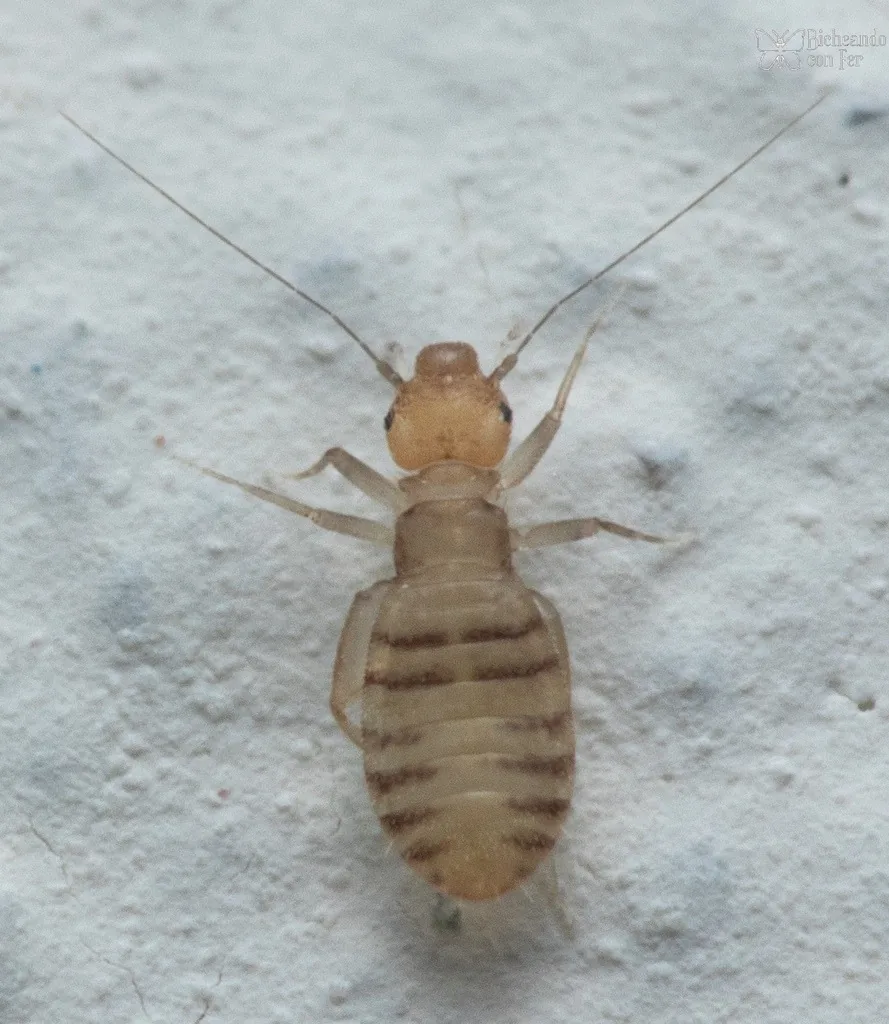
- Sizes vary by source: Penn State says indoor booklice are 1 to 2 mm long, Clemson about 1/25 inch, Washington State 1/16 to 1/8 inch for psocids in general, and Minnesota less than 3/16 inch. Penn State says an adult is about the size of a newly hatched bed bug.[1][3][2][5]
- Penn State describes most as light to dark tan, sometimes gray, dark brown, orange-brown or nearly clear (especially the young); Clemson calls them yellowish to buff.[1][3]
- They are soft-bodied and flattened, with a wide head and a large, nose-like front plate; the head is nearly as wide as the body, and the thighs of the legs are flattened and wide.[1]
- The psocids found indoors (usually Liposcelis species) are wingless; most outdoor psocids, called barklice, have wings.[5]
- Despite the name, psocids are not lice and don't bite people or pets.[2][3][6]
Look-alikes
Where it lives
Booklice occur worldwide and are widely distributed throughout the United States.[1][3]
Biology and life cycle
Indoors they live in humid, damp, dark, undisturbed places, where they feed on mold growing on paper, book bindings, wallpaper, flour and stored grain. Outdoors they live on trees and shrubs and in bird nests, eating lichen, algae and fungi.[1][3][5]
Clemson gives their ideal range as 75 to 82°F and 75 to 90 percent relative humidity, and says they can die within weeks if humidity stays low; Minnesota says psocids don't survive when humidity falls below 45 to 50 percent.[3][5]
In warm months a female can lay about 60 eggs and egg to adult can take less than a month; in cool conditions it can take over three months. Clemson says adults live about three more months.[1][3]
Young booklice look like small adults; the species that live in buildings usually have four nymphal stages. Washington State says that under favorable conditions psocids can exceed six generations a year.[1][2]
Large numbers sometimes build up in new buildings, where fresh plaster and drywall still hold moisture that supports mold.[3][1]
For decades the common household booklouse, Liposcelis bostrychophila, was known only from females reproducing without mating; males were first found in Hawaii in 2002 and a sexually reproducing strain in Arizona in 2009.[9]
Damage and signs
- Sources disagree about books. Penn State says booklice don't directly damage paper or fabric the way silverfish can, and Iowa State says they don't destroy property; Clemson calls their feeding very destructive to old books and says they damage damp books by feeding on moldy paper and starchy binding glue.[1][6][3]
- Their droppings contaminate stored food, and some wingless species infest flour, sugar and cereal. Minnesota notes psocids are sometimes pests in commercial food storage and manufacturing.[1][2][5]
Health risk
Control
Prevention
Bring indoor relative humidity below 50 percent with a dehumidifier, fan or better ventilation; that stops mold growth and booklouse development.[1][3][5]
Fix leaky pipes and roofs, leave an air space under potted plants on windowsills, and check for poor attic ventilation, branches over the roof and leaves in the eaves.[1][5]
If moisture is trapped inside a wall, such as in new construction, holes may need to be cut in the drywall so the void can dry out.[1]
Sanitation
Throw out infested food, vacuum food debris from cracks and corners, buy dry goods in amounts you'll use within a few months, and store them in tightly sealed glass or heavy plastic containers.[1][2]
Keep books, papers and boxes in well-ventilated, uncluttered areas and off the floor.[3][5]
Traps and physical control
Small numbers can be ignored or vacuumed up.[5]
Pesticides
Most sources say pesticides aren't needed: booklice often rest where sprays can't reach, humidity control alone works well, and Minnesota says insecticides fail while moisture remains and the products sold to residents generally don't work on psocids. Iowa State allows light residual sprays only where booklice are abundant and people and pets won't be exposed.[1][3][5][6]
Booklice and allergies: what the research shows
A 2017 study in the journal Allergy notes that earlier surveys found the common household booklouse, Liposcelis bostrychophila, made up most of the insects detected in house dust and could be a potent cause of respiratory allergy. The study identified an allergen from it, named Lip b 1, that reacted with blood serum from sensitized allergy patients.[7]
A 2025 case report from Japan described severe anaphylaxis in a 52-year-old man after he ate oatmeal infested with this booklouse; tests found the booklouse allergen only in the leftover oatmeal.[8]
Common questions
- Why do I have booklice in my new house?
- New plaster and drywall can hold a lot of moisture that supports mold, and booklice can build up quickly feeding on it; lowering the humidity is the fix.[3][1]
- Are booklice the same as head lice?
- No. Psocids are not lice, don't live on people or pets, and don't bite; they feed on mold and debris.[2][3][6]
- Should I spray for booklice?
- Usually not. Fixing the moisture problem and lowering humidity below 50 percent works better than insecticides.[1][3][5]
- Can booklice cause allergies?
- Research says they can. A booklouse protein called Lip b 1 reacts with blood serum from people allergic to booklice, and one published case linked severe anaphylaxis to eating booklouse-infested oatmeal.[7][8]
Sources
- Penn State Extension, “Booklice (updated July 23, 2024).” extension.psu.edu/booklice (accessed 2026-11-11)
- Washington State University Extension, PestSense, “Psocids (booklice or barklice).” pestsense.cahnrs.wsu.edu/fact-sheet/psocids-booklice-or-barklice/ (accessed 2026-11-11)
- Clemson Cooperative Extension, Home & Garden Information Center, “Booklice, HGIC 2403.” hgic.clemson.edu/factsheet/booklice/ (accessed 2026-11-11)
- iNaturalist, “Liposcelis taxon page (order and family).” www.inaturalist.org/taxa/252648 (accessed 2026-11-11)
- University of Minnesota Extension, “Psocids (barklice, booklice) (J. Hahn, S. Kells).” extension.umn.edu/garden-and-home/home-maintenance/household-insects/booklice-barklice (accessed 2026-11-11)
- Iowa State University Extension and Outreach, “Psocids, Booklice, Barklice (Yard and Garden, 2016).” yardandgarden.extension.iastate.edu/encyclopedia/psocids-booklice-barklice (accessed 2026-11-11)
- Allergy, via PubMed, “Ishibashi O, Sakuragi K, Fukutomi Y, et al. (2017), Lip b 1 is a novel allergenic protein isolated from the booklouse, Liposcelis bostrychophila, Allergy 72(6):918-926.” pubmed.ncbi.nlm.nih.gov/27873335/ (accessed 2026-11-11). Cited from the PubMed abstract.
- Journal of Dermatology, via PubMed, “Matsumoto C, Kawakami Y, Ishibashi O, et al. (2025), A clinical case of anaphylaxis after eating oatmeal contaminated with booklice (Liposcelis bostrychophila), Journal of Dermatology 52(1):146-149.” pubmed.ncbi.nlm.nih.gov/39126249/ (accessed 2026-11-11). Cited from the PubMed abstract.
- Scientific Reports, via PubMed, “Yang Q, Kucerova Z, Perlman SJ, et al. (2015), Morphological and molecular characterization of a sexually reproducing colony of the booklouse Liposcelis bostrychophila (Psocodea: Liposcelididae) found in Arizona, Scientific Reports 5:10429.” pubmed.ncbi.nlm.nih.gov/26013922/ (accessed 2026-11-11). Cited from the PubMed abstract.