On this page
How to identify it
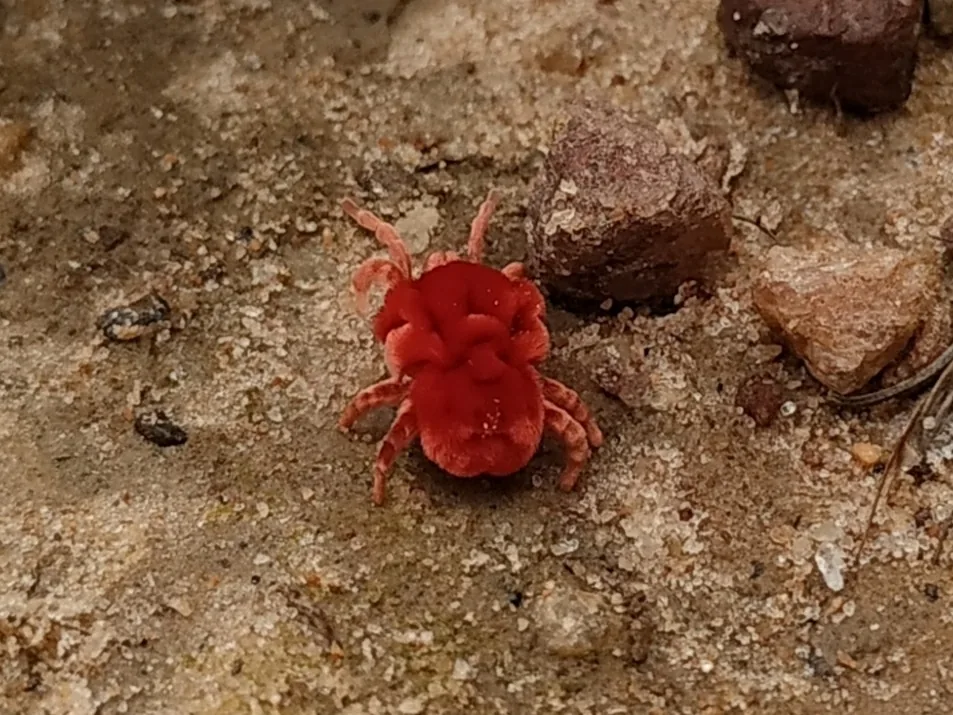
- Adults are usually no bigger than about 1/8 inch, red and velvety, and just large enough to see crawling about. Giant velvet mites (Dinothrombium) can reach nearly 1/2 inch.[2][1]
- Adults have eight legs. The extremely small larvae have six and are usually seen only when attached to an insect or other arthropod, where they look like tiny red eggs.[2][1]
- Like other mites, they show one obvious body section, with the mouthparts looking stuck onto an egg-shaped body.[2]
Look-alikes
| Look-alike | How to tell them apart |
|---|---|
| Clover mites | Clover mites are much smaller, about 0.75 mm, reddish or greenish plant feeders with a very long first pair of legs, and they can enter homes in vast numbers in spring.[3][2] |
| Spider mites | Spider mites are tinier, suck juices from plant leaves and spin wispy webs; squashed, they often leave a red mark.[2] |
| Chiggers | Chiggers belong to a different family (Trombiculidae), and their larvae feed on vertebrates, including people. Velvet mite larvae feed only on insects, spiders and other small arthropods.[2][4] |
Where it lives
Found in soil and leaf litter; NC State and the Missouri Department of Conservation describe them in their states. Giant velvet mites (Dinothrombium) are most common in the arid Southwest, where they come out in large numbers after heavy rain, though they can occur in eastern states too. Red velvet mites in the genus Allothrombium are active even in winter in southwestern Ontario.[1][2][5]
Biology and life cycle
Most of the year they live in soil and litter. In spring, adults come out onto patios, bricks and other surfaces hunting insects and insect eggs; adults of the genus Trombidium apparently feed almost only on springtail eggs.[1][2]
Eggs are laid in the soil from March through July in North Carolina (midspring to midsummer in Missouri) and hatch in one to two months. They need very humid conditions: eggs develop normally at 100 percent relative humidity and don't survive below 80 percent.[1][2]
Larvae feed on insects as external parasites for a week or two, then drop into the soil. After a resting stage, a second nymph stage forages for prey in summer or fall, and adults emerge in autumn.[1][2]
Adults usually spend the winter in the soil. Allothrombium adults collected in winter in Ontario survived being frozen, and half died at about -20 °C in midwinter.[1][5]
There is usually one generation a year. Depending on the species, 6 to 10 months pass from egg to adult, and nymphs that appear late may take a second or even third year to finish.[1][2]
Males leave sperm packets on the ground and court females with circling dances, foreleg tapping and silk threads.[2]
Damage and signs
Health risk
Harmless to people. True velvet mites don't feed on people or other vertebrates at any stage; it is the larvae of chiggers, a different mite family, that feed on people.[2][4]
Control
Prevention
No control is needed. No pesticide is labeled for velvet mites, and NC State suggests washing them off a patio with a garden hose, or using soapy water, rather than leaving a pesticide residue.[1]
Biological control
Lawn pesticides that kill all arthropods also kill these beneficial mites.[2]
Velvet mites and chiggers
In both groups only the larvae are parasites. Chigger larvae feed on vertebrates, including people, and Leptotrombidium chiggers carry scrub typhus; velvet mite larvae feed on other arthropods and are potential biological control agents of crop pests.[4]
Many people take velvet mites for adult chiggers. The two are in the same superfamily but separate families that are not closely related, despite the similar names Trombidiidae and Trombiculidae.[2]
Where sources disagree
Egg-laying season: March through July (NC State) or midspring to midsummer (Missouri Department of Conservation); both note that some species lay eggs in autumn instead.[1][2]
Treatment: NC State says a common landscape pyrethroid would very likely kill them when applied against a pest on its label, but recommends a hose or soapy water instead; the Missouri Department of Conservation counts them among the beneficial creatures destroyed by broad lawn pesticides.[1][2]
Common questions
- What are the tiny red velvety bugs on my patio?
- Most likely velvet mites, which come out onto patios and brick walls in spring hunting insects and insect eggs.[1][2]
- Do velvet mites bite people?
- No. They don't feed on people or pets at any stage of life.[2]
- Should I spray them?
- No. They eat pest insects, and no pesticide is labeled for them; hose them off the patio if they bother you.[1][2]
- Are velvet mites adult chiggers?
- No. Chiggers are a separate family, and their larvae are the ones that bite people. Velvet mites never feed on people.[2]
Sources
- NC State Extension, “Velvet Mites, Brick Mites or Patio Mites (PDIC Factsheet).” content.ces.ncsu.edu/velvet-mites-brick-mites-or-patio-mites (accessed 2026-11-11)
- Missouri Department of Conservation, “True Velvet Mites (Red Velvet Mites) (Field Guide).” mdc.mo.gov/discover-nature/field-guide/true-velvet-mites-red-velvet-mites (accessed 2026-11-11)
- Penn State Extension, “Clover Mites.” extension.psu.edu/clover-mites (accessed 2026-11-11)
- GigaScience, via PubMed, “Dong and others (2018), Genomes of trombidid mites reveal novel predicted allergens and laterally transferred genes associated with secondary metabolism.” pubmed.ncbi.nlm.nih.gov/30445460/ (accessed 2026-11-11)
- Physiological and Biochemical Zoology, via PubMed, “Anthony and Sinclair (2019), Overwintering red velvet mites are freeze tolerant.” pubmed.ncbi.nlm.nih.gov/30724653/ (accessed 2026-11-11)
- Experimental and Applied Acarology, via PubMed, “Pluta, Makol and Felska (2025), Host species of larvae contribute to intraspecific variation of deutonymphs: a case study of Allothrombium fuliginosum parasitizing aphids.” pubmed.ncbi.nlm.nih.gov/40828476/ (accessed 2026-11-11)
- iNaturalist, “Trombidiidae taxon page (order and family).” www.inaturalist.org/taxa/57652 (accessed 2026-10-06)