On this page
How to identify it
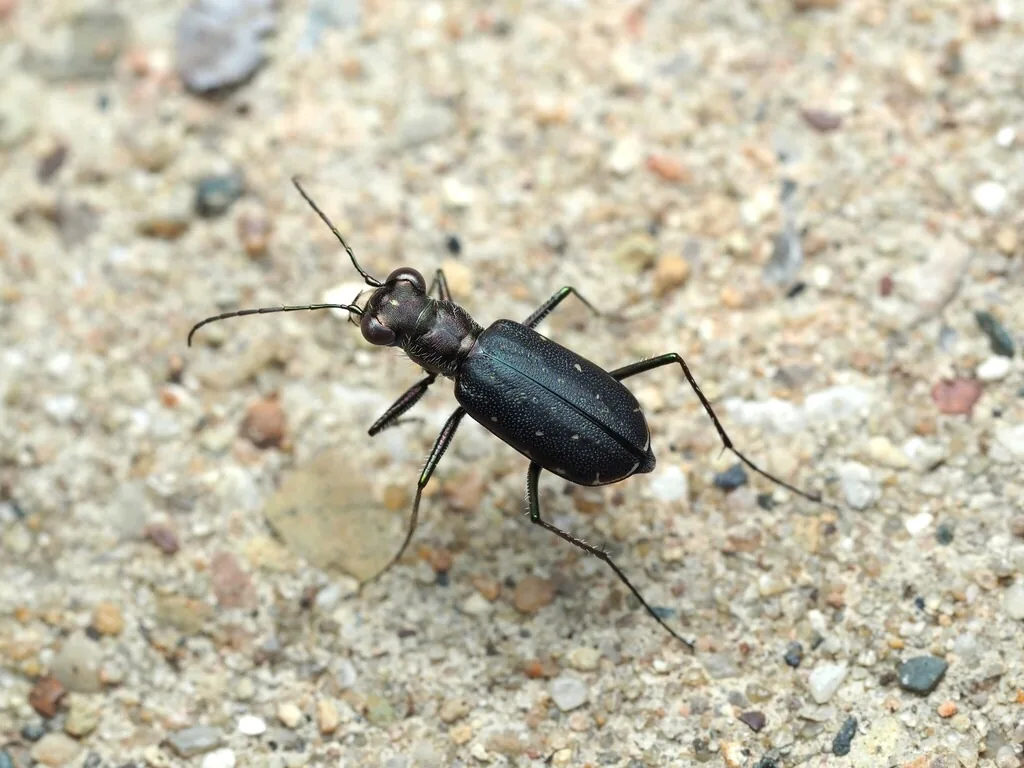
- Adults are moderately sized for tiger beetles: 11 to 13 mm long according to Colorado State, 11 to 14 mm according to Penn State.[1][2]
- Colorado State describes the wing covers as nearly black to green, blue or purple, with creamy yellow spots that may be reduced or missing; Penn State describes them as iridescent brown to copper, often with white spots. The underside is blue to green with copper.[1][2]
- Penn State says a row of small metallic green pits (punctures) on each wing cover sets it apart from other tiger beetles; Colorado State places rows of small punctures along the inner edge of the wing covers.[2][1]
- Like other tiger beetles it has bulging eyes that make the head wider than the narrow, necklike thorax, large pointed pincer jaws and long, skinny legs.[3][2][1]
- Handled beetles often give off a fruity, apple-like smell, a defensive chemical (benzaldehyde).[1]
- The larva is a pale grub with a broad, flat head and large jaws. It rests at the top of its burrow, where its head plugs the entrance.[1][3]
Look-alikes
| Look-alike | How to tell them apart |
|---|---|
| Ground beetles | Penn State and the Missouri Department of Conservation treat tiger beetles as part of the ground beetle family. The punctured tiger beetle is active by day, runs fast and flies off when approached, and its bulging eyes make its head wider than its thorax.[2][3] |
| Antlions (doodlebugs) | Tiger beetle larvae are sometimes called doodlebugs, but the name is more often used for antlion larvae, which sit at the bottom of small cone-shaped pits in sand or dust instead of in a vertical burrow.[3] |
Where it lives
Colorado State calls it the most common tiger beetle in Colorado, and Penn State lists it among the common ground and tiger beetles of central Pennsylvania. GBIF holds about 16,000 US records since 1990 from 44 states, most from Colorado, Texas and Utah.[1][2][6]
Biology and life cycle
Adults appear from mid-June, peak by mid-July and can be found into September. They are active in the daytime and make short flights when approached; Penn State says they can fly several yards.[1][2]
Adults hunt other insects and grab them with their large pointed jaws; Penn State notes a broad insect diet.[1][2]
Larvae live in vertical burrows 14 to 40 cm deep in dry, hard-packed soil, most often near water. Each waits at the entrance and grabs passing prey, typically ants or other crawling insects.[1]
Larvae feed through the summer, spend the winter in the burrow as second-stage larvae and pupate there in late spring.[1][2]
In Colorado it lives in rangeland and grasslands, along the edges of cultivated fields and in cities, at elevations exceeding 3000 m; Penn State finds it commonly in cultivated fields.[1][2]
In Pennsylvania melon and squash plots its activity was higher in strip-tilled fields than in plastic-mulch fields, and in a New Mexico desert grassland its activity rose after a summer wildfire.[4][5]
Damage and signs
Health risk
No source reports harm to people. Colorado State notes that adults come to lights at night and sometimes wander indoors, and the Missouri Department of Conservation warns that tiger beetles can pinch hard if handled.[1][3]
Control
Prevention
No control is needed; these are predators of other insects. On farms, Penn State says reduced tillage and leaving surface residue help conserve ground and tiger beetles.[1][2]
Where sources disagree
Size: Colorado State gives 11 to 13 mm, Penn State 11 to 14 mm.[1][2]
Color: Colorado State describes nearly black to green, blue or purple wing covers whose spots may be missing; Penn State describes iridescent brown to copper, often with white spots.[1][2]
Classification: Colorado State, Penn State and the Missouri Department of Conservation place tiger beetles in the ground beetle family, Carabidae; iNaturalist, which this page follows, treats them as their own family, Cicindelidae, and Colorado State still uses the older genus name Cicindela.[1][2][3][7]
Life cycle length: Colorado State describes larvae that overwinter once and pupate the next spring; the Missouri Department of Conservation says tiger beetles in general take 1 to 4 years to reach adulthood, depending on species.[1][3]
Common questions
- What is the shiny dark beetle that runs and flies ahead of me on the sidewalk?
- Likely the punctured (sidewalk) tiger beetle, which hunts on bare paths and makes short flights when approached.[1][2]
- Are tiger beetles harmful?
- No; they are predators of other insects.[1][2]
- Why does it smell like apples?
- Handled beetles release benzaldehyde, a defensive chemical with a fruity odor.[1]
- What are the small round holes in hard, bare ground?
- They may be tiger beetle larval burrows. The larva waits at the top of a vertical tunnel with its flat head plugging the entrance and grabs ants and other insects that pass.[1][3]
Sources
- Colorado State University Extension (Colorado Insects of Interest, W. Cranshaw), “Punctured Tiger Beetle/Sidewalk Tiger Beetle (Colorado Insect of Interest).” wci.extension.colostate.edu/wp-content/uploads/sites/14/2017/03/SidewalkTigerBeetle.pdf (accessed 2026-11-11)
- Penn State Extension, “Ground and Tiger Beetles (Coleoptera: Carabidae).” extension.psu.edu/ground-and-tiger-beetles-coleoptera-carabidae/ (accessed 2026-11-11)
- Missouri Department of Conservation, “Tiger Beetles (field guide).” mdc.mo.gov/discover-nature/field-guide/tiger-beetles (accessed 2026-11-11)
- Environmental Entomology, via PubMed, “Horticultural production systems influence ground beetle (Coleoptera: Carabidae) distribution and diversity in cucurbits (Lewis et al. 2016).” pubmed.ncbi.nlm.nih.gov/26994134/ (accessed 2026-11-11). Cited from the PubMed abstract.
- Environmental Entomology, via PubMed, “Short-term effects of a summer wildfire on a desert grassland arthropod community in New Mexico (Parmenter et al. 2011).” pubmed.ncbi.nlm.nih.gov/22251717/ (accessed 2026-11-11). Cited from the PubMed abstract.
- Global Biodiversity Information Facility (GBIF), “Cicindelidia punctulata: US occurrence records since 1990 by state (GBIF occurrence search API).” api.gbif.org/v1/occurrence/search?taxonKey=1034795&country=US&hasGeospatialIssue=false&occurrenceStatus=PRESENT&year=1990%2C2026&facet=stateProvince&facetLimit=400&limit=0 (accessed 2026-11-11). State counts are records reported (iNaturalist research-grade, museum specimens, surveys), not abundance.
- iNaturalist, “Cicindelidia punctulata taxon page (order and family).” www.inaturalist.org/taxa/1643817 (accessed 2026-11-11)