On this page
How to identify it
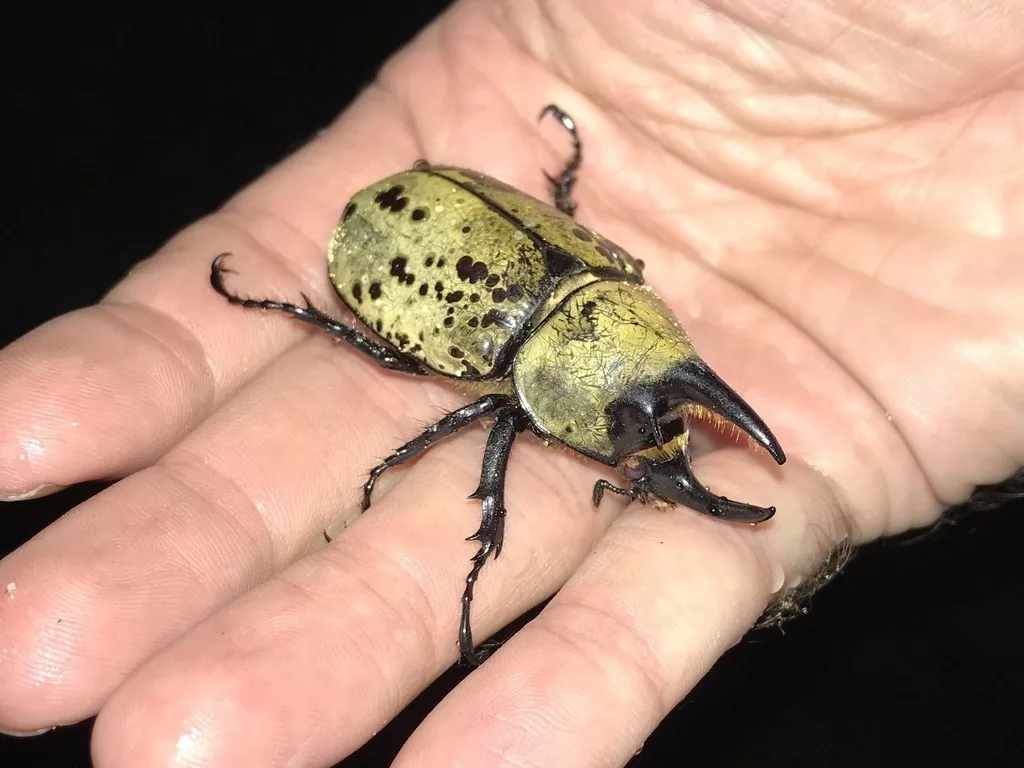
- Adults are greenish-gray, yellowish or tan with brown to black spots; the amount of spotting varies a lot, and some are almost completely black or brown. Clemson gives a length of nearly 3 inches; Missouri Department of Conservation says males can be nearly 2½ inches counting the horns.[1][2]
- Males have a long horn projecting forward from the thorax that nearly meets an upward horn on the head; females have no horns.[1][2][3]
- The horns are typically about 1/3 of the body length.[3]
- Larvae are large white grubs, about as big as a finger.[1]
- Fun fact: the beetle changes color with humidity. Researchers found the wing covers shift from yellow-green to deep brown as water seeps into their microscopic structure, and the change reverses when they dry. UF/IFAS reports the same effect in its tropical relative, whose wing covers turn black as humidity rises.[4][3][5]
Look-alikes
| Look-alike | How to tell them apart |
|---|---|
| Western Hercules beetle (Dynastes grantii) | The only other Hercules beetle in the United States; it lives in the Southwest, while the eastern Hercules beetle lives in the eastern part of the country. UF/IFAS lists it and the eastern Hercules beetle as the two members of the genus Dynastes in southern North America; the genus has seven species in all.[3][5] |
| Hercules beetle (Dynastes hercules) | The famous tropical Hercules beetle lives from southern Mexico south to Bolivia and in the Lesser Antilles, not in the U.S. UF/IFAS gives adults as 50 to 85 mm long; males have a black body with olive-shaded wing covers and much larger horns, and are reared by breeders for size.[5] |
Where it lives
Found in the eastern United States; Clemson notes it is the only Hercules beetle in South Carolina. Look for it in deciduous forests and around lights at night.[1][3][2]
Biology and life cycle
Grubs feed in rotting hardwood stumps and on dead leaves and other decaying material.[1]
Adults come to lights at night; little is known about what they eat, though they have been seen feeding on bark and leaves.[1]
Missouri Department of Conservation says the grubs eat rotting heartwood, usually of deciduous trees, and the adults eat rotting fruit and tree sap. Despite their size, the adults can fly.[2][3]
Decaying ash trees are among their favorite larval nurseries, so there is some concern that the loss of ash to the invasive emerald ash borer could make Hercules beetles scarcer.[2]
UF/IFAS says grubs of its tropical relative feed on dead wood in rotten logs and trunks and help with nutrient cycling and biodegradation, the same role Clemson describes for eastern Hercules beetle grubs in rotting wood.[5][1]
Damage and signs
- They are not pests; the grubs help break down rotting wood.[1]
Health risk
They don't bite or jab with their horns; at most you may feel a scratch from the claws on their feet if you pick one up.[1]
Control
Prevention
No control is needed.[1]
Where sources disagree
Size: Clemson says adults can be nearly 3 inches long; Missouri Department of Conservation says males can be nearly 2½ inches counting the horns.[1][2]
Adult food: Clemson says little is known about what adults eat, though they have been seen feeding on bark and leaves; Missouri Department of Conservation says adults eat rotting fruit and tree sap.[1][2]
Common questions
- Is the huge horned beetle dangerous?
- No; eastern Hercules beetles won't bite or jab with their horns.[1]
- Why do only some have horns?
- Only males have horns, used in fights over females. UF/IFAS describes the tropical Hercules beetle fighting like a pair of pliers: the horns squeeze and lift a rival, then toss him to the ground.[1][5]
- Where do the grubs live?
- In rotting hardwood stumps and decaying plant material.[1]
- Why did my Hercules beetle turn dark?
- Their color changes with humidity: in damp air the wing covers turn from greenish to deep brown or black, and they lighten again as they dry.[4][3]
- Is this the same as the giant Hercules beetle from the tropics?
- No. It is a close relative in the same genus. UF/IFAS says the tropical Hercules beetle lives from southern Mexico to Bolivia and in the Lesser Antilles, and that only the eastern and western Hercules beetles occur in southern North America.[5]
Sources
- Clemson Cooperative Extension Home & Garden Information Center, “Eastern Hercules Beetles.” hgic.clemson.edu/eastern-hercules-beetles/ (accessed 2026-11-14)
- Missouri Department of Conservation, “Eastern Hercules Beetle.” mdc.mo.gov/discover-nature/field-guide/eastern-hercules-beetle (accessed 2026-11-14)
- Mississippi Entomological Museum, Mississippi State University, “Eastern Hercules Beetle (fact sheet 16).” mississippientomologicalmuseum.org.msstate.edu/MIMS/FactSheets/16_EHerculesBeetle.pdf (accessed 2026-11-14)
- Scientific Reports 2021;11(1):808, via PubMed, “Investigation of the selective color-changing mechanism of Dynastes tityus beetle (Coleoptera: Scarabaeidae).” pubmed.ncbi.nlm.nih.gov/33436867/ (accessed 2026-11-14). Cited from the PubMed abstract.
- University of Florida/IFAS Extension (EDIS, Featured Creatures), “Hercules Beetle, Dynastes hercules (Linnaeus, 1758) (Insecta: Coleoptera: Scarabaeidae), EENY659/IN1142.” ask.ifas.ufl.edu/publication/IN1142 (accessed 2026-11-14). Account of the tropical Hercules beetle; used here for the genus and the lookalike.
- iNaturalist, “Dynastes tityus taxon page (order and family).” www.inaturalist.org/taxa/83804 (accessed 2026-11-14)