On this page
How to identify it
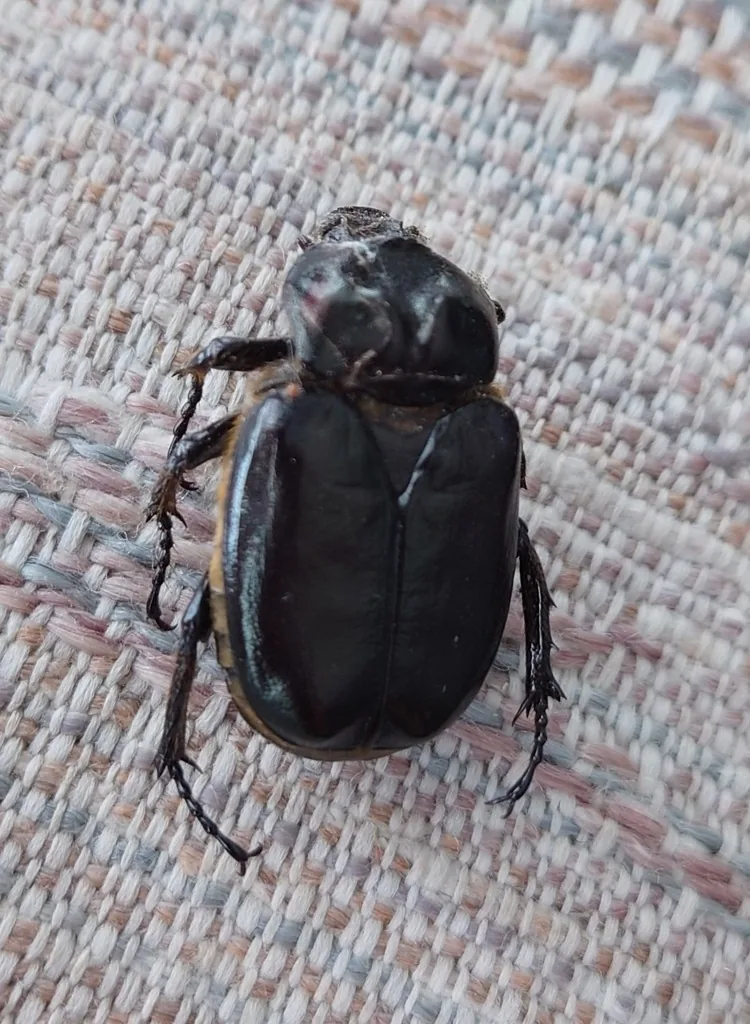
- Adults are about 1 inch long and dark brown to black or mahogany. They look like a June beetle but are less oval and flat on top.[1][2]
- Larvae are big, C-shaped, dirty-white to creamy grubs with a reddish-brown head and six legs. Iowa State gives up to 1 1/4 inches long; Minnesota Extension says 1 1/2 to 2 inches.[2][1][3]
Look-alikes
| Look-alike | How to tell them apart |
|---|---|
| June beetles | More oval; the hermit flower beetle is flatter on top.[1][2] |
| Grapevine beetle | Tan to reddish brown with three black spots on each wing cover, rather than plain dark brown.[1] |
Where it lives
Three Osmoderma species live in North America, and Minnesota Extension says two occur in Minnesota, where O. eremicola is the most common. Iowa State calls it one of the largest insects in Iowa, and a 2024 study trapped it in Wisconsin and Illinois.[1][2][4]
Biology and life cycle
Adults are out in midsummer: July to September according to Minnesota Extension, July and August according to Iowa State. They are strongly attracted to lights at night.[1][2]
Grubs develop in debris-filled tree cavities and in very rotted stumps and logs, and are found from August through the next spring. Minnesota lists oak, maple, elm, apple, cottonwood, cherry and hickory among the trees they use.[1][2][3]
Males release a scent, (R)-(+)-gamma-decalactone, that draws both sexes. In the 2024 study the same compound also attracted a second North American species, O. scabra, and a click beetle, Elater abruptus.[4]
Damage and signs
Health risk
Iowa State says the adults are harmless. Neither Iowa State nor Minnesota Extension mentions bites or any other risk to people or pets.[2][1]
Control
Prevention
No control is needed. Both extension services say to leave them be, and Minnesota counts them as beneficial decomposers.[1][2]
Hermit beetles in Europe
Europe has its own hermit beetle, Osmoderma eremita, which also develops inside hollow trees and whose males use the same scent compound.[4][5]
Researchers in Europe have used that pheromone in traps to count populations and track flights. One study estimated that at least half of a population flew away from the trees where the beetles grew up.[6][5]
A 2024 review of insects that live in tree hollows, drawn from European studies, concluded that keeping old hollow trees standing and growing new ones nearby is what keeps these animals around.[7]
Common questions
- What is the big dark beetle at my light?
- In midsummer it may well be a hermit flower beetle. They are about an inch long, dark brown and strongly drawn to lights.[1][2]
- Are the grubs killing my tree?
- No. They feed only on wood that is already rotting, so something else caused the tree to decline.[1][2][3]
- Is it dangerous?
- No. Iowa State says the adults are harmless.[2]
Sources
- University of Minnesota Extension, “Scarab beetles: hermit flower beetle and grape pelidnota (reviewed 2018).” extension.umn.edu/yard-and-garden-insects/scarab-beetles (accessed 2026-11-13)
- Iowa State University Extension and Outreach (Yard and Garden), “Hermit Flower Beetle (September 12, 2016).” yardandgarden.extension.iastate.edu/encyclopedia/hermit-flower-beetle (accessed 2026-11-13)
- University of Minnesota Extension, “Hermit flower beetle larva (What insect is this?).” apps.extension.umn.edu/garden/diagnose/insect/general-curiosity-insects/immature-insects/medium/hermit-flower-beetle-larva.html (accessed 2026-11-13)
- J Chem Ecol 2024;50(3-4):122-128, via PubMed, “(R)-(+)-gamma-Decalactone is Conserved in North America as a Pheromone Component of Osmoderma eremicola and a Kairomone of Elater abruptus (Steffek et al., 2024).” pubmed.ncbi.nlm.nih.gov/38388901/ (accessed 2026-11-13)
- J Chem Ecol 2004;30(2):353-63, via PubMed, “Attraction of the larval predator Elater ferrugineus to the sex pheromone of its prey, Osmoderma eremita, and its implication for conservation biology (Svensson, Larsson & Hedin, 2004).” pubmed.ncbi.nlm.nih.gov/15112729/ (accessed 2026-11-13)
- Conserv Biol 2009;23(6):1516-25, via PubMed, “Pheromone monitoring of rare and threatened insects: exploiting a pheromone-kairomone system to estimate prey and predator abundance (Larsson & Svensson, 2009).” pubmed.ncbi.nlm.nih.gov/19508672/ (accessed 2026-11-13)
- Biol Rev Camb Philos Soc 2024;99(6):2022-2034, via PubMed, “Habitat requirements of deadwood-dependent invertebrates that occupy tree hollows (Ranius, Gibbons & Lindenmayer, 2024).” pubmed.ncbi.nlm.nih.gov/38856004/ (accessed 2026-11-13)
- Global Biodiversity Information Facility (GBIF), “Osmoderma eremicola (Knoch, 1801) (GBIF Backbone Taxonomy).” api.gbif.org/v1/species/1079615 (accessed 2026-11-13)
- iNaturalist, “Osmoderma eremicola taxon page (order and family).” www.inaturalist.org/taxa/226688 (accessed 2026-10-06)