On this page
How to identify it
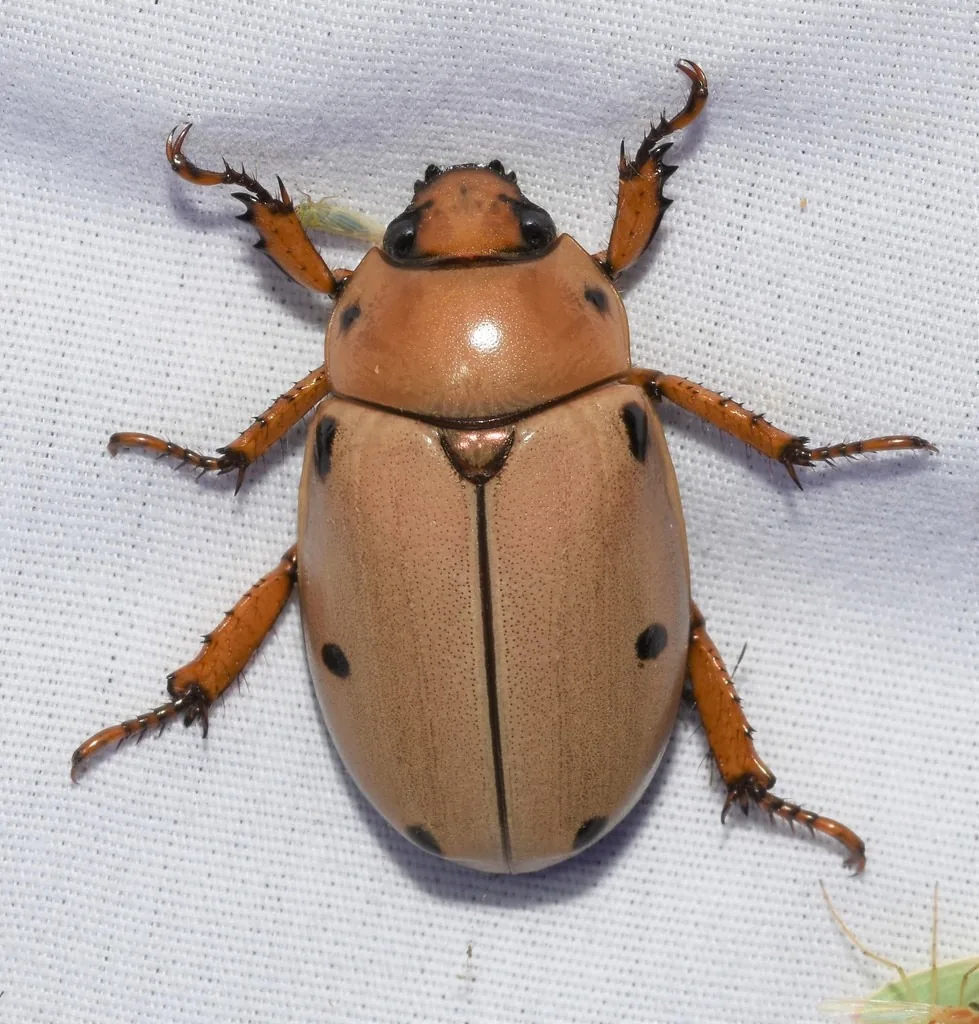
- About 1 inch long, oval and robust, tan to reddish brown (Missouri says ivory-tan to rusty gold), with three small black spots on each wing cover (six in all).[1][2][3]
- Color and markings vary. UW-Milwaukee says southern beetles have light-colored legs and northern ones dark legs, and Animal Diversity Web that some forms have smaller or less distinct spots, with a black spot on each side of the shield behind the head.[7][8]
- It resembles a June beetle; Minnesota says it is more closely related to Japanese beetles.[1][2]
- Larvae are large white grubs found in well-rotted stumps and logs.[2][1]
Look-alikes
| Look-alike | How to tell them apart |
|---|---|
| June beetles | Similar shape, but May and June beetles are usually brown, rusty or black with no spots, and their grubs live underground on roots instead of in rotting wood.[4][2] |
| Hermit flower beetle | Another 1-inch scarab drawn to lights in summer, but dark brown to black and less oval.[1] |
Where it lives
Animal Diversity Web describes it as widespread through the eastern United States and Canada, west to Texas and in Canada mainly in Ontario; UW-Milwaukee says to look for it east of the Great Plains. Minnesota finds it in wooded areas and sites next to them. GBIF holds about 17,000 U.S. records since 1990, from 38 states and the District of Columbia, the most from Texas (1,811), Florida (1,222) and North Carolina (993).[8][7][1][5]
Biology and life cycle
Adults are active in July and August in Minnesota, and are attracted to lights, so they show up around homes even without grapes.[1]
Adults feed mainly on grape leaves. Missouri and Animal Diversity Web add grape fruit, Animal Diversity Web and UW-Milwaukee add Virginia creeper, and Minnesota says they sometimes eat willow, poplar and oak leaves too.[1][3][8][7]
Larvae develop in rotting stumps and logs of hardwood trees; Animal Diversity Web lists decaying elm, walnut, cherry and birch among many others.[8][3][1]
Development takes about two years. Animal Diversity Web says eggs are laid in June, July and August, larvae overwinter in decaying wood and can take over 600 days to develop, and adults live about 30 days; UW-Milwaukee cites a Kansas rearing in which grubs hatched in July 1920 had become adults by July 1922.[8][7]
Damage and signs
Health risk
It feeds on grape leaves and rotting wood, and no cited source describes any risk to people or pets.[1][2][3]
Control
Traps and physical control
No control is usually needed; handpick beetles from grapevines and discard them if they become numerous.[1][2]
Where the sources disagree
Color: Minnesota says tan to reddish brown, Missouri ivory-tan to rusty gold, Animal Diversity Web yellowish orange with a slight metallic tint, and UW-Milwaukee pale straw yellow to rich saffron.[1][3][8][7]
Size: Minnesota and Iowa State say about 1 inch, UW-Milwaukee an inch or more, and Animal Diversity Web 20 to 25 mm.[1][2][7][8]
Season: Minnesota says adults are active July through August but can be found through late spring and summer, while Animal Diversity Web says eggs are laid from June to August.[1][8]
Pest status: Minnesota, Iowa State and Missouri say it is not a serious pest, while Animal Diversity Web says outbreaks can substantially defoliate grape crops.[1][2][3][8]
Where larvae feed: Minnesota and Iowa State place them in rotting logs and stumps, while Animal Diversity Web says they can live in the center of a stump but more commonly tunnel in the tree roots.[1][2][8]
Common questions
- What is the big tan beetle with black spots at my porch light?
- Often a grapevine beetle (spotted pelidnota), which is drawn to lights in July and August.[1][2]
- Will it ruin my grapes?
- Usually not. It eats some grape leaves but rarely does much damage, and handpicking is enough if numbers build up.[1][2][3]
- Why doesn't my grapevine beetle have spots?
- Spotting varies. Animal Diversity Web says some forms have smaller or less distinct spots, and UW-Milwaukee notes that a century ago this variation led taxonomists to name 10 species and subspecies, all since folded back into this one beetle.[8][7]
Sources
- University of Minnesota Extension, “Scarab beetles: hermit flower beetle and grape pelidnota (reviewed 2018).” extension.umn.edu/yard-and-garden-insects/scarab-beetles (accessed 2026-11-13)
- Iowa State University Extension and Outreach (Yard and Garden), “Spotted Grapevine Beetles (reviewed July 2026).” yardandgarden.extension.iastate.edu/encyclopedia/spotted-grapevine-beetles (accessed 2026-11-13)
- Missouri Department of Conservation, “Scarab Beetles (Scarabaeids) (Field Guide).” mdc.mo.gov/discover-nature/field-guide/scarab-beetles-scarabaeids (accessed 2026-11-13)
- Missouri Department of Conservation, “May Beetles (June Bugs) (Field Guide).” mdc.mo.gov/discover-nature/field-guide/may-beetles-june-bugs (accessed 2026-11-13)
- Global Biodiversity Information Facility (GBIF), “Pelidnota punctata: occurrence records in the U.S., 1990-2026 (GBIF occurrence search).” api.gbif.org/v1/occurrence/search?taxonKey=5990169&country=US&hasGeospatialIssue=false&occurrenceStatus=PRESENT&year=1990%2C2026&facet=stateProvince&facetLimit=400&limit=0 (accessed 2026-11-13). Exact count at access: 17,039 U.S. records, 1990-2026 (Texas 1,811; Florida 1,222 plus 2 under 'Florida (State)'; North Carolina 993; Pennsylvania 956). Records reported (iNaturalist research-grade, museum specimens, surveys), not abundance.
- Global Biodiversity Information Facility (GBIF), “Pelidnota punctata (Linnaeus, 1758) (GBIF Backbone Taxonomy).” api.gbif.org/v1/species/5990169 (accessed 2026-11-13)
- University of Wisconsin-Milwaukee Field Station, “Grapevine Beetle (Family Scarabaeidae) (Bug of the Week).” uwm.edu/field-station/bug-of-the-week/grapevine-beetle/ (accessed 2026-11-13)
- Animal Diversity Web, University of Michigan Museum of Zoology, “Pelidnota punctata (A. Miner, University of Michigan).” animaldiversity.org/accounts/Pelidnota_punctata/ (accessed 2026-11-13)