On this page
How to identify it
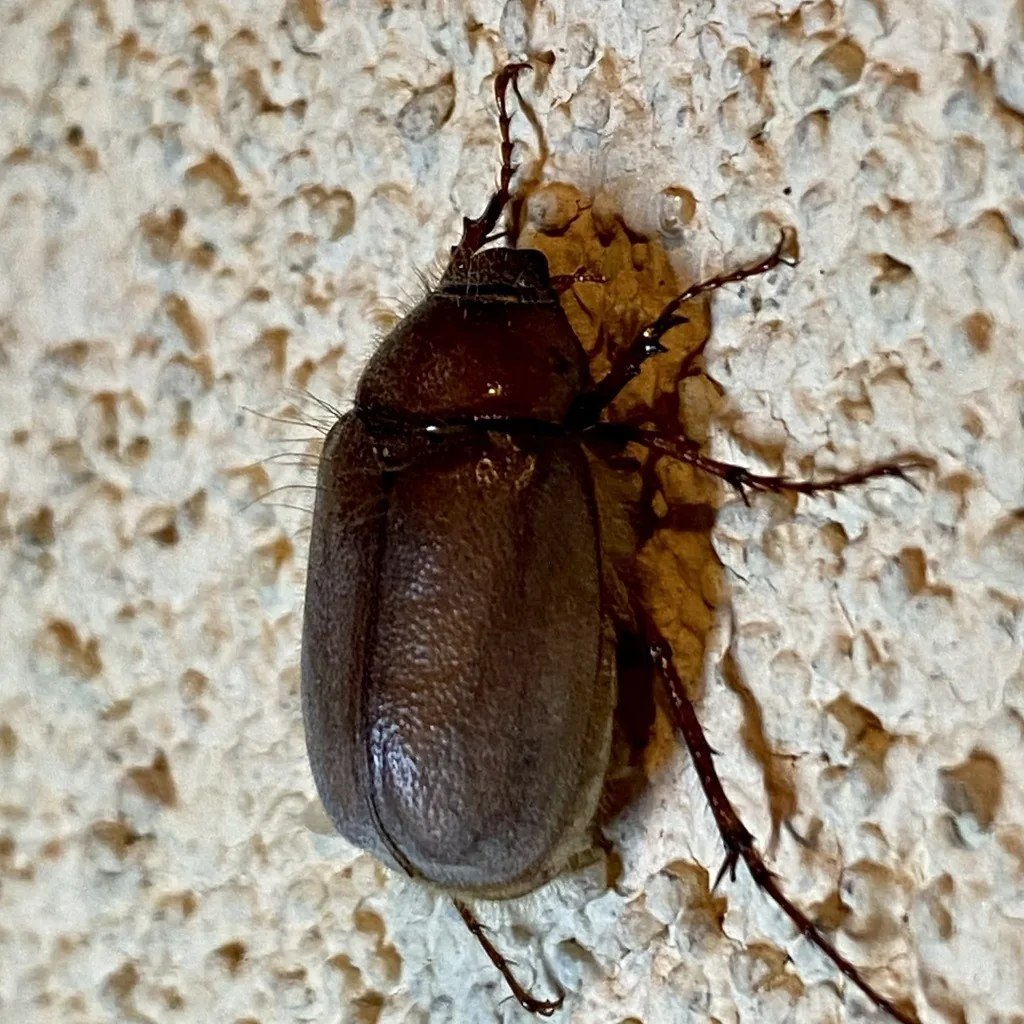
- Adults are stout, somewhat oval beetles about 1/2 to 1 inch long, ranging from light tan or reddish brown to almost black.[1][2][3]
- They fly after dusk, are drawn to lights, and are clumsy fliers that hit windows and cling to screens.[1][2]
- The grubs are cream-colored and C-shaped, with a reddish-brown or yellow-brown head and three pairs of legs, and a grayish rear end; they grow up to about 1 1/4 inches.[1][3][4]
- Under a hand lens, their grubs show two lengthwise rows of spines on the underside of the last segment, surrounded by scattered stouter spines. This raster pattern is how white grubs are told apart.[2][4]
Look-alikes
| Look-alike | How to tell them apart |
|---|---|
| Japanese beetle | Smaller and metallic green with copper wing covers, and active by day rather than at night.[2] |
| Green June beetle | A different, day-flying beetle, 0.75 to 1 inch long and forest green; its grubs usually lie stretched out on their backs and feed mainly on decaying organic matter rather than turf roots.[2] |
Where it lives
Found throughout the United States; more than 200 species occur across North America.[2][1]
Biology and life cycle
Most species take two to three years to complete one generation, spending most of that time in the soil as grubs. In Wisconsin all species have three-year cycles except Phyllophaga tristis, which takes two.[2][1][3][4]
Adults emerge in late spring and early summer, mate, and females burrow into the soil to lay eggs singly in cells; the eggs are white and spherical and hatch in a few days.[1][2][3]
Flight timing varies by species. An Oklahoma light-trap study collected 20 Phyllophaga species, most peaking in May and June but some flying as early as mid-April and others as late as September.[5]
Young grubs first feed on organic matter and then on roots, growing larger and more destructive through three stages. Most of the cycle is spent as a third-stage grub, and Utah State says second-year larvae do most of the damage.[3][1][2]
Grubs move deeper in the soil in fall to overwinter and come back up to feed in spring.[3][4]
Generations overlap, so adults appear every year, but some places see a much larger flight every third year.[1]
Grubs of different species look so alike that researchers in Oklahoma and Mexico have used DNA barcodes to match larvae to adult species.[5][6]
Damage and signs
- Grubs chew roots, so turf yellows and wilts like drought stress, then forms spongy, loose patches that peel up easily from the soil.[1][3][2]
- Populations above about seven grubs per square foot can strip turf of its roots completely.[2]
- Skunks, raccoons, turkeys and birds may dig up turf to eat the grubs.[1][3]
- Besides turf, they damage ornamentals, Christmas trees, cranberries and some vegetable and field crops. Grubs can kill small plants, while larger plants with bigger root systems tolerate them better.[1]
- Adults chew holes in the leaves of trees and shrubs such as oaks, but this is infrequent and localized and rarely needs control.[1][3]
Health risk
Extension sources describe May and June beetles as plant pests: the harm is root feeding by the grubs and occasional leaf feeding by adults. None of the sources here reports a health risk to people or pets.[1][3][2]
Control
Prevention
Keep plants vigorous with proper watering and fertilizing to lessen the impact of grub damage.[1][3]
Before treating, cut three sides of a 12-inch square of sod, fold it back and count the grubs in the top 1 to 3 inches of soil in several spots. Clemson's usual treatment threshold for these grubs is four to five per square foot.[2][3]
Biological control
Biopesticides containing insect-killing nematodes or Beauveria fungus spores can suppress grubs. Milky spore is not an option here: NC State says it works only against Japanese beetle grubs.[3][7]
Pesticides
If needed, a preventive neonicotinoid or anthranilic diamide insecticide applied in spring targets young grubs, which are easier to kill.[3][2]
Grub products work best watered in; Wisconsin mentions about 1/4 inch of water, and NC State adds that irrigating a day or two before helps bring grubs up from dry soil.[1][7]
Adult control is rarely warranted; where it is, contact insecticides such as carbaryl, cyfluthrin and lambda-cyhalothrin work.[1]
Why damage comes and goes
Populations tend to be local, and with a multi-year life cycle, a spot hit hard one year may not need treatment the next.[1]
Knowing the history of grub damage in your yard and checking the soil are the best ways to predict trouble.[1]
Where sources disagree
Thresholds: Clemson gives four to five May or June beetle grubs per square foot and says healthy turf generally tolerates 5 to 7 white grubs per square foot; Penn State says five to ten per square foot is often used for curative treatment, depending on the species.[2][4]
Life cycle: Penn State and Wisconsin describe a three-year cycle (two for P. tristis), while Clemson and Utah State give two to three years.[4][1][2][3]
Grub size: Wisconsin says up to 1 1/4 inches, while Utah State gives 1/8 to 1 inch.[1][3]
Common questions
- Are June bugs and May beetles the same thing?
- Yes. May beetles, June beetles and June bugs are common names for the same large genus of scarab beetles, Phyllophaga, with more than 200 species in North America.[1][2]
- Should I spray the June bugs at my porch light?
- Usually not. Adult leaf feeding is infrequent and minor, so control focuses on grubs, and only in lawns with a history of damage.[1]
- Will milky spore control June beetle grubs?
- No. NC State says milky spore works only against Japanese beetle grubs. For May and June beetle grubs, Utah State lists nematode or Beauveria products for suppression.[7][3]
Sources
- University of Wisconsin-Madison Extension, “May/June Beetles (XHT1240).” hort.extension.wisc.edu/articles/mayjune-beetles/ (accessed 2026-11-11)
- Clemson Cooperative Extension Home & Garden Information Center, “White Grub Management in Turfgrass (HGIC).” hgic.clemson.edu/factsheet/white-grub-management-in-turfgrass/ (accessed 2026-11-11)
- Utah State University Extension, “May/June Beetles (IPM, turf pests).” extension.usu.edu/planthealth/ipm/notes_orn/list-turf/ar_may-june-beetles (accessed 2026-11-11)
- Penn State Extension, “White Grubs in Home Lawns.” extension.psu.edu/white-grubs-in-home-lawns (accessed 2026-11-11)
- Journal of Economic Entomology, via PubMed, “Doskocil et al. (2008), Species composition and seasonal occurrence of Phyllophaga infesting intensely managed Bermudagrass in Oklahoma.” pubmed.ncbi.nlm.nih.gov/18950045/ (accessed 2026-11-11)
- Frontiers in Insect Science, via PubMed, “Guzman-Franco et al. (2024), A DNA-based approach to infer species diversity of larvae and adults from the white grub genus Phyllophaga.” pubmed.ncbi.nlm.nih.gov/39574960/ (accessed 2026-11-11)
- NC State Extension, “White Grubs in Turf.” content.ces.ncsu.edu/white-grubs-in-turf (accessed 2026-11-11)
- iNaturalist, “Phyllophaga taxon page (order and family).” www.inaturalist.org/taxa/84629 (accessed 2026-10-06)