On this page
How to identify it
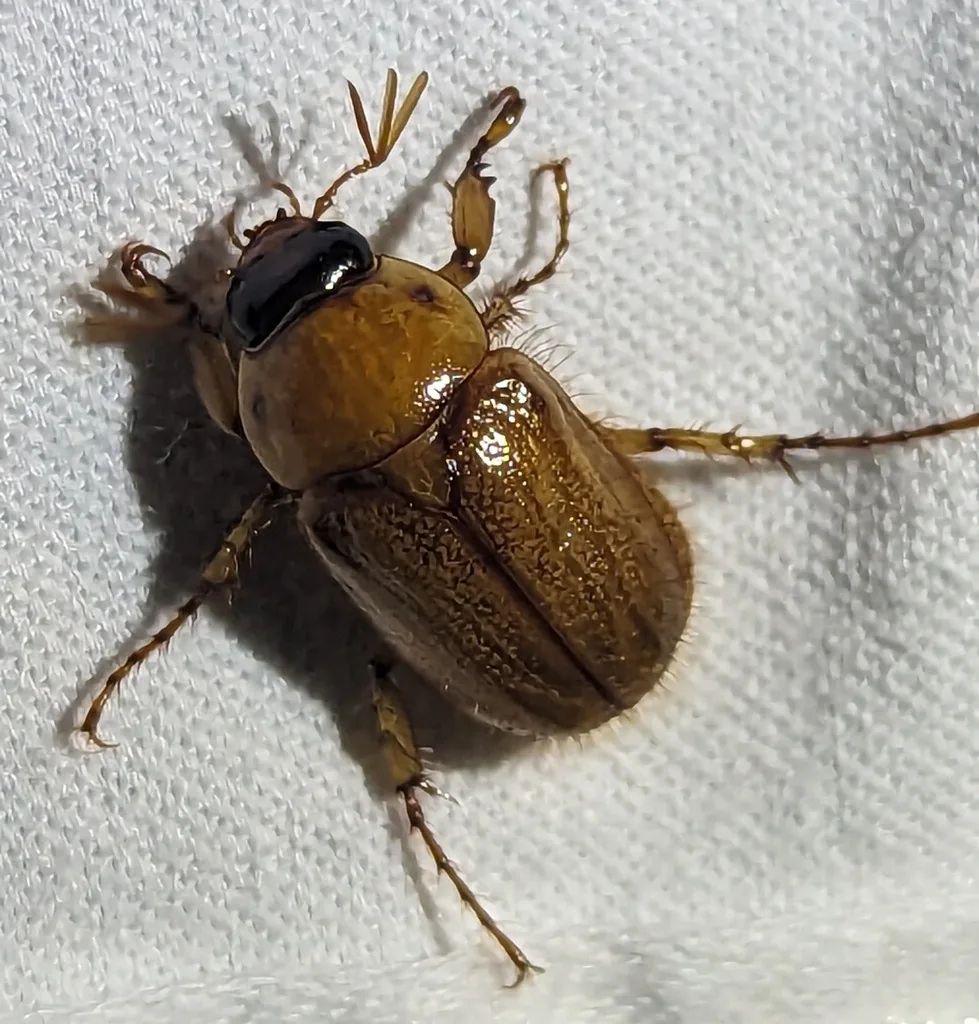
- Adults are about 1/2 inch long. Ohio State describes them as dull, dark yellow-ocher with darker brownish-black markings on the head; Clemson describes the southern masked chafer as shiny, light red-brown with a chocolate brown head.[1][3]
- The northern masked chafer has conspicuous hair on the thorax and wing covers, while the southern masked chafer is sparsely haired.[1]
- Grubs are C-shaped and white with a brownish head and legs, reaching about 1 inch when full grown. Clemson notes they are white when they hatch and turn gray after feeding.[1][2][3]
- Under a hand lens, the spines on the underside of the grub's tail end (the raster) are scattered with no distinct rows; Clemson counts 25 to 30 coarse, hooked spines on the southern masked chafer.[1][2][3]
- Telling northern from southern masked chafers is difficult without a taxonomist; for the grubs, Ohio State says the mouthparts must be dissected.[1]
Look-alikes
| Look-alike | How to tell them apart |
|---|---|
| Japanese beetle grubs | Japanese beetle grubs have two short rows of raster spines that converge into a V; masked chafer spines are scattered.[2][3] |
| May and June beetle grubs | May and June beetle grubs have two parallel rows of raster spines and a longer life cycle: Clemson gives 2 to 3 years, and Georgia says most take two years, some one and some three. Masked chafers take one year.[2][3] |
| Oriental beetle grubs | The grubs look much alike, so check the raster pattern with a magnifier. Clemson and NC State describe the oriental beetle as a newer turf grub still expanding its range in the Southeast.[2][3][4] |
Where it lives
The northern masked chafer occurs from Maine to Nebraska in cool-season lawns; the southern masked chafer is common in southern states and is spreading into the lower Midwest. Both are found throughout Georgia.[1][2]
Biology and life cycle
In Ohio adults emerge from mid-June into mid-July. They fly at night and are strongly drawn to lights; Georgia says they sometimes appear in great numbers near store fronts, porch lights and swimming pools.[1][2]
Mated females dig 4 to 6 inches into the soil and lay 11 to 14 eggs. With enough soil moisture the eggs swell and hatch in 14 to 18 days at 70 to 75 degrees F; Georgia gives two to three weeks and Clemson 14 to 21 days.[1][2][3]
Grubs feed on roots and organic matter, mostly just below the thatch. Georgia says they reach full size by late August, and Ohio State says third-stage grubs are common by September, when most damage happens.[1][2][3]
As soil cools in fall the grubs dig down to overwinter, most within 3 to 6 inches though some go 12 inches. They return to the root zone in late April and May, then pupate a little deeper in late May and early June.[1][2]
There is one generation a year. Clemson puts the larval stage at 10 to 11 months, the pupal stage at 15 to 21 days and adult life at 5 to 25 days.[1][2][3]
Damage and signs
- Infested turf looks drought-stressed in late summer, fall or spring, even when moisture is good, and doesn't recover after rain or watering; heavy infestations kill grass in irregular patches.[1][2]
- Damaged turf feels spongy and lifts easily, like a loose carpet, because the roots are gone.[1][2]
- Birds, skunks, raccoons, opossums and armadillos dig up infested lawns to eat the grubs, and moles may tunnel where grubs are plentiful.[1][2][3]
- Clemson says populations of 40 or more grubs per square foot are fairly common, and drought and hot weather make the damage look worse.[3]
- Damage is common under street lights, which draw the egg-laying adults. Both species also attack roots of field crops such as wheat, oats and corn.[1]
Health risk
None of these sources reports masked chafers biting or stinging. The adults don't feed, and Georgia says they are not pests themselves; the harm is to lawn roots.[1][2][3]
Control
Prevention
Check before treating: cut three sides of a 1-foot square of sod, fold it back and count grubs in the top 2 to 3 inches of soil, sampling several spots. If the soil is dry, water the day before so the grubs move up.[2][3]
Because the eggs need moisture, holding back irrigation in July and early August may cut grub survival.[1]
Replace exterior lights with yellow or sodium vapor bulbs so they attract fewer beetles during the summer flight.[1]
Biological control
Heterorhabditis nematodes are better than Steinernema at finding white grubs. Buy them freshly produced, apply right away, water them in, and keep the soil moist for three to four days; they work best on young grubs, usually in August. Ohio State notes suppliers often need a month to prepare them.[1][3]
Milky spore products sold for Japanese beetles don't work on masked chafers; NC State says that treatment is useful only against Japanese beetle grubs.[1][4]
Pesticides
Preventive grub insecticides target the newly hatched grubs. Ohio State says neonicotinoids have four to eight weeks of residual activity and fit June and July applications, while chlorantraniliprole lasts 12 to 16 weeks and can go on from April into early August.[1][3]
For grubs already feeding, carbaryl or trichlorfon can work while grubs are small, though thick thatch ties up carbaryl. Water before treating if the soil is dry and apply about 1/2 inch of water afterward to move the insecticide into the root zone.[1][2][4]
Late rescue treatments only work on grubs that are still feeding; Ohio State says fat, yellow grubs have likely stopped, and trichlorfon is the only option with some contact action then.[1]
Where sources disagree
How many grubs a lawn can take: Georgia says well-managed turf can support 10 or more masked chafer grubs per square foot without much decline; Clemson says well-managed turf may tolerate 20, stressed turf shows symptoms at 8 or more, and its general guidance gives 6 to 8 grubs per square foot as a safer treatment threshold.[2][3]
Bt products: Ohio State reports 70 percent control and better from Bacillus thuringiensis galleriae on young grubs, with heavy irrigation after application; Clemson says research on Bt for grubs has shown control to be marginal.[1][3]
Timing: Ohio State aims preventive treatments at grubs hatching from mid-July into early August; Clemson, writing for South Carolina, puts preventive applications in April through May and curative treatments in July through August.[1][3]
Adult color: Ohio State says dull dark yellow-ocher; Clemson says the southern masked chafer is shiny light red-brown.[1][3]
Common questions
- Why are skunks and raccoons tearing up my lawn?
- They may be digging for white grubs such as masked chafer larvae. Lift a square of sod and count the grubs to confirm before treating.[1][2][3]
- What are the tan beetles flying around my porch light in June and July?
- They are often masked chafers, which fly at night and are strongly drawn to lights. The adults don't feed, but their grubs eat lawn roots later in the summer.[1][2]
- Does milky spore control masked chafer grubs?
- No. The commercial milky spore strain targets Japanese beetle grubs and has no effect on masked chafers, according to Ohio State; NC State also limits it to Japanese beetle grubs.[1][4]
- How many grubs per square foot is too many?
- It depends on the lawn. Georgia and Clemson say healthy turf can carry 10 or more masked chafer grubs per square foot, and Clemson says up to 20 in well-managed turf; stressed turf shows damage at lower numbers.[2][3]
Sources
- Ohio State University Extension, “Masked Chafers (ENT-51).” ohioline.osu.edu/factsheet/ENT-51 (accessed 2026-11-11)
- University of Georgia Cooperative Extension, “White Grub Pests of Turfgrass (Circular 940).” fieldreport.caes.uga.edu/publications/C940/white-grub-pests-of-turfgrass/ (accessed 2026-11-11)
- Clemson Cooperative Extension, Home & Garden Information Center, “White Grub Management in Turfgrass (HGIC 2156).” hgic.clemson.edu/factsheet/white-grub-management-in-turfgrass/ (accessed 2026-11-11)
- NC State Extension, “White Grubs in Turf.” content.ces.ncsu.edu/white-grubs-in-turf (accessed 2026-11-11)
- iNaturalist, “Cyclocephala borealis taxon page (order and family).” www.inaturalist.org/taxa/301437 (accessed 2026-11-11)