On this page
How to identify it
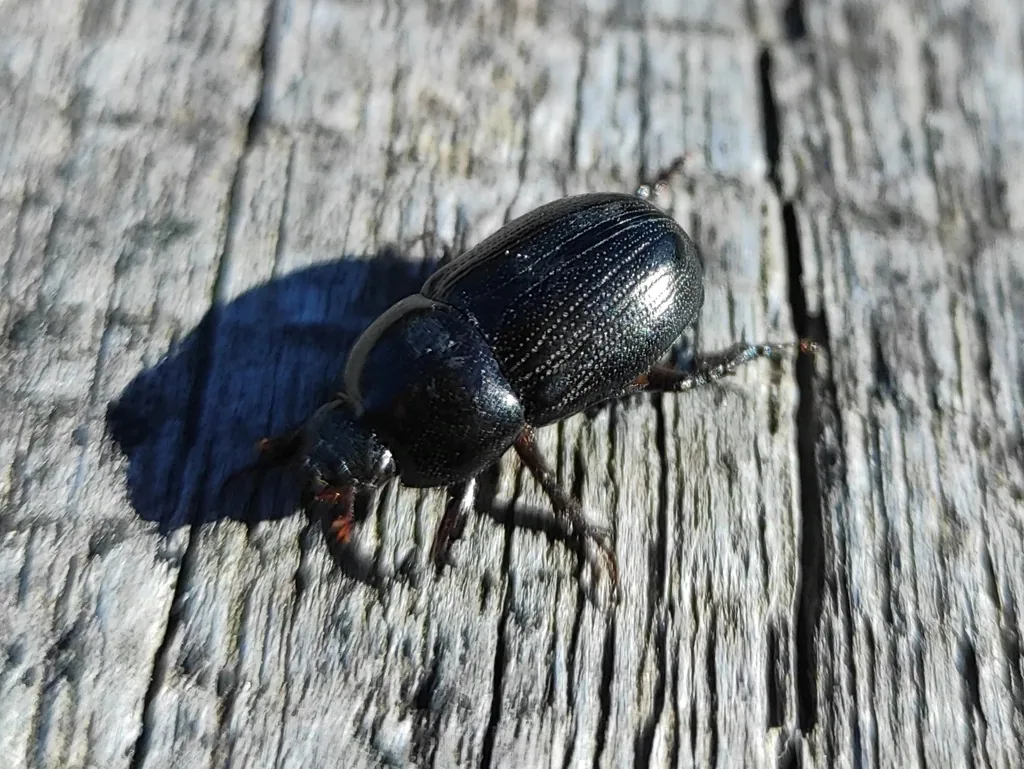
- Adults are dull black with lengthwise grooves of small punctures along the wing covers. Georgia and Kansas State give about 1/2 inch (13 mm); NC State gives about 15 mm (0.6 in).[2][3][1]
- Each front leg has four serrations that make the beetle a strong digger.[2][3]
- Larvae are C-shaped white grubs with red-orange or reddish-brown heads and six yellow legs; the third and last larval stage reaches up to 1 1/4 inches (32 mm). The bristle pattern under the tail tip is an irregular double row, somewhat like a masked chafer's.[1][2][3]
- These beetles have ears. A 1997 study found paired thin membranes on the neck, just behind the head, that respond to ultrasound between 20 and 80 kHz and set off a startle response.[4]
Look-alikes
| Look-alike | How to tell them apart |
|---|---|
| Masked chafers | Their grubs look similar under the tail; sugarcane beetle larvae are usually in the soil earlier in the year, in May.[1] |
| White grubs | Most white grubs overwinter as larvae and are controlled as young grubs. The sugarcane beetle overwinters as an adult and spends most of its life as one, and the adults do most of the lawn damage.[1][2] |
Where it lives
NC State says it was once confined to the southeastern United States but has spread north to Maryland, west into Texas and south into Florida. In 2024 Kansas State reported it damaging turf in southeast Kansas, and a two-year survey of South Carolina golf courses found it among the most abundant scarab species caught.[1][3][5]
Biology and life cycle
Adults overwinter in the soil and become active in April; in North Carolina most fly in the first two weeks of May. Females lay eggs in the soil, as many as 30 to 60 in a lifetime, and die after laying.[1][2][3]
Eggs hatch in about 8 to 10 days. Grubs live in the soil from May or June to August, feeding mostly on decaying plant matter and some roots, and it takes 15 to 20 days for an adult to emerge from the pupa.[1][2][3]
New adults appear from August or September and stay active into October, and in North Carolina into November, before overwintering. There is one generation a year.[1][2][3]
Adults feed at night and fly to lights; at dawn they walk across the turf and dig back into the soil to avoid sunlight.[2][3]
Damage and signs
- Adults attack grass stems at the soil surface, cutting them off or severing them so the plant wilts and dies. Their daytime tunnels, about 0.5 to 2 inches deep, weaken roots and leave the surface uneven.[1]
- Beetle concentrations can exceed 50 per square foot and destroy turf quickly. Damage peaks after spring emergence in April and May and after fall emergence in late September and early October, and is often worst under lights.[2][1]
- Bermudagrass and zoysia are hit hardest, but tall fescue lawns can also be damaged. Birds, armadillos, moles and raccoons digging for the beetles and grubs add to the damage.[1][3][2]
- Adults drawn to building lights have damaged asphalt roofs, door gaskets and other soft materials. It is also a long-standing pest of corn, sugarcane, sweet potato and rice.[2]
Health risk
It is a lawn and crop pest. NC State, Georgia and Kansas State describe it only as a pest of turf and crops, and Georgia adds damage to soft building materials near lights; none of them mentions bites, stings or any effect on people or pets.[1][2][3]
Control
Prevention
Turn off unnecessary lights near lawns at night. Georgia suggests sodium vapor lights or less attractive bug-light bulbs instead of mercury vapor bulbs.[1][2][3]
Keep turf vigorous with appropriate fertilizer and proper watering so it tolerates and outgrows damage; NC State specifies infrequent, deep irrigation.[1][3]
Traps and physical control
Once the adults are controlled, core-aerate damaged bermudagrass or zoysia to spur regrowth from rhizomes, or resod severe damage.[2]
Biological control
Parasitic flies and wasps, thief ants, fire ants, predatory mites and the fungus Metarhizium anisopliae attack sugarcane beetles, though few are sold for use.[1]
Pesticides
Target the adults, not young grubs. Georgia says pyrethroids such as bifenthrin (Talstar) and lambda-cyhalothrin (Scimitar) are effective against adult sugarcane beetles, and EPA's product system lists Talstar TC Flowable and Scimitar GC as active registrations with lawn and turf uses. NC State says timing matters more than the product: treat spring adults soon after they emerge. Georgia advises applying late in the day and drenching the affected area.[2][1][3][6][7]
NC State also lists carbaryl (Sevin); EPA's product system lists Sevin XLR Plus as an active registration with lawn and turf uses. The National Pesticide Information Center says bifenthrin is highly toxic to fish and small aquatic organisms and very highly toxic to bees.[1][8][9]
Where the sources disagree
Scientific name: NC State calls it Euetheola rugiceps; Georgia and Kansas State use E. humilis. GBIF lists both as separate accepted species.[1][2][3][10][11]
Adult size: Georgia and Kansas State give about 1/2 inch (13 mm); NC State gives about 15 mm (0.6 in).[2][3][1]
Watering: NC State recommends infrequent, deep irrigation and Kansas State proper irrigation to keep turf vigorous; Georgia lists reduced irrigation among practices that may make turf less attractive to adults.[1][3][2]
Larval period: NC State says larvae reach full growth in about two months; Georgia says they pupate about 75 days after hatching.[1][2]
Common questions
- What are the black beetles digging in my bermudagrass?
- If they are dull black, about half an inch long and come to porch lights, they are likely sugarcane beetles, which damage lawns as adults.[1][2][3]
- Why do grub treatments not stop them?
- Most of the damage comes from adults, which overwinter in the soil and attack the grass in spring and fall, so control has to target the adults.[1][3]
- When should I treat for sugarcane beetles?
- In spring, when overwintered adults first appear. They are more numerous, do more damage and are easier to kill than later adults.[1][3]
Sources
- NC State Extension, “Sugarcane Beetles in Turf (PDIC Factsheet).” content.ces.ncsu.edu/sugarcane-beetles-in-turf (accessed 2026-11-13)
- University of Georgia Cooperative Extension, “Sugarcane Beetle: An Emerging Insect Pest in Georgia Turfgrass (Circular 1257, reviewed July 2026).” fieldreport.caes.uga.edu/publications/C1257/sugarcane-beetle-an-emerging-insect-pest-in-georgia-turfgrass/ (accessed 2026-11-13)
- Kansas State University Turf and Landscape Newsletter, “Sugarcane Beetle Causing Damage to Turfgrass in SE Kansas (Cloyd, 2024).” blogs.k-state.edu/turf/sugarcane-beetle-causing-damage-to-turfgrass-in-se-kansas/ (accessed 2026-11-13)
- Journal of Experimental Biology, via PubMed, “A tympanal hearing organ in scarab beetles (Forrest et al. 1997).” pubmed.ncbi.nlm.nih.gov/9057310/ (accessed 2026-11-13). Cited from the PubMed abstract.
- Journal of Economic Entomology, via PubMed, “A comparison of trap types for assessing diversity of Scarabaeoidea on South Carolina golf courses (Chong and Hinson 2015).” pubmed.ncbi.nlm.nih.gov/26453727/ (accessed 2026-11-13). Cited from the PubMed abstract.
- U.S. EPA Pesticide Product and Label System, “Talstar TC Flowable (bifenthrin), EPA Reg. No. 101563-255 (product record: status, sites and pests).” ordspub.epa.gov/ords/pesticides/cswu/ppls/101563-255 (accessed 2026-11-13)
- U.S. EPA Pesticide Product and Label System, “Scimitar GC (lambda-cyhalothrin), EPA Reg. No. 100-1088 (product record: status, sites and pests).” ordspub.epa.gov/ords/pesticides/cswu/ppls/100-1088 (accessed 2026-11-13)
- U.S. EPA Pesticide Product and Label System, “Sevin XLR Plus (carbaryl), EPA Reg. No. 61842-37 (product record: status, sites and pests).” ordspub.epa.gov/ords/pesticides/cswu/ppls/61842-37 (accessed 2026-11-13)
- National Pesticide Information Center, “Bifenthrin General Fact Sheet.” npic.orst.edu/factsheets/bifgen.html (accessed 2026-11-13)
- Global Biodiversity Information Facility (GBIF), “Euetheola humilis (Burmeister, 1847) (GBIF Backbone Taxonomy).” api.gbif.org/v1/species/1076273 (accessed 2026-11-13)
- Global Biodiversity Information Facility (GBIF), “Euetheola rugiceps (LeConte, 1856) (GBIF Backbone Taxonomy).” api.gbif.org/v1/species/1076275 (accessed 2026-11-13)
- iNaturalist, “Euetheola humilis taxon page (order and family).” www.inaturalist.org/taxa/301485 (accessed 2026-11-12)