On this page
How to identify it
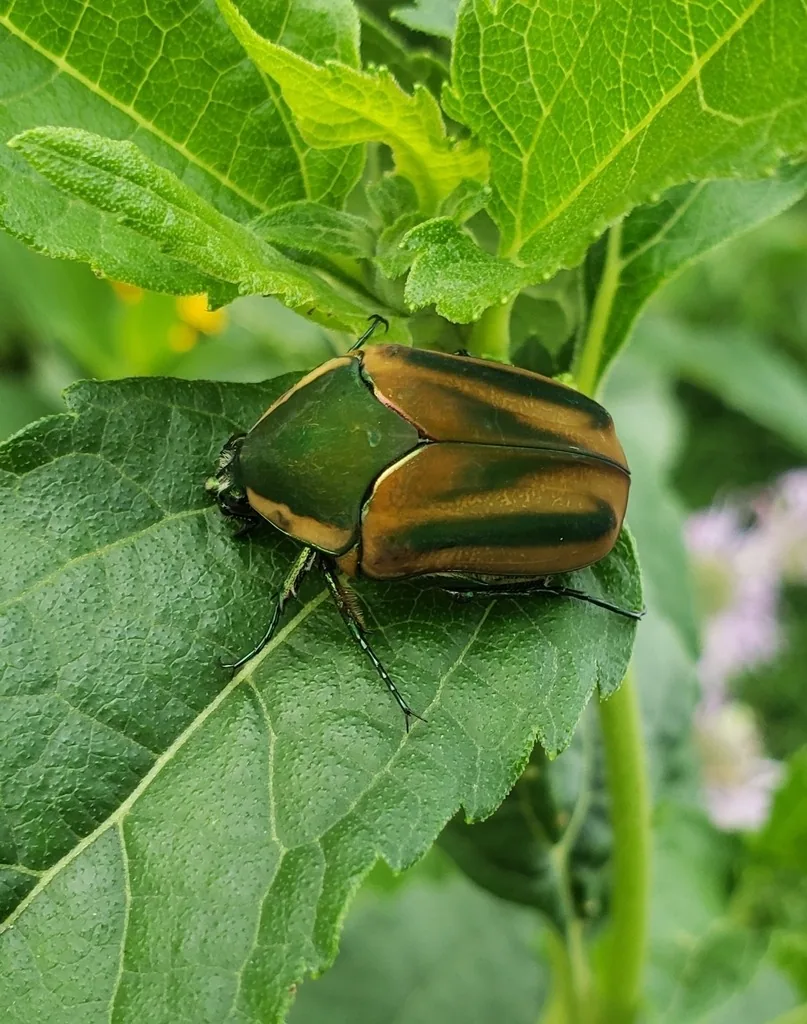
- Adults are about 3/4 inch to 1 inch long and about 1/2 inch wide, with a velvety green to dull brown back and a shiny metallic green or gold underside.[3][2][4]
- The wing covers range from solid green to green with bronze or tan streaks, edged with a bronze-to-yellow band. Penn State notes a small, flat horn on the head.[1][2][3][4]
- Grubs are cream-colored with tan heads and short legs, and crawl on their backs with their legs in the air. Sizes differ: about 2 inches in NC State's and Kentucky's accounts, 1 1/2 inches in Penn State's, and well over 1 inch in Ohio State's.[3][2][4][1]
- Adults fly by day, buzzing loudly about 2 to 3 feet above the lawn and often circling the same patches of grass; Penn State compares the sound to a bumble bee.[1][4]
Look-alikes
| Look-alike | How to tell them apart |
|---|---|
| Japanese beetle | Japanese beetle grubs usually injure turf more. The adults differ in their jaws: Japanese beetles bite through intact grape skins, while green June beetles' blunt, spoon-shaped jaws generally can't.[1][5] |
| May and June beetles (Phyllophaga) | Green June beetles are often just called June beetles or June bugs, but their metallic green color and upside-down-crawling grubs set them apart.[3][2][4] |
| Masked chafers | Masked chafer grubs do more turf damage. Green June beetle grubs are much larger and live in open vertical burrows, 10 to 12 inches deep in Ohio State's account and about 6 to 12 inches in Penn State's.[1][4] |
Where it lives
A native scarab that turns up every summer in lawns, gardens and fruit plantings in states such as North Carolina, Kentucky and Ohio. Penn State cites a range from Connecticut and southeastern New York to Florida and west into Texas, Oklahoma and Kansas.[1][2][3][4]
Biology and life cycle
There is one generation a year. Grubs overwinter in the soil and pupate in late spring; adults emerge in July and August in NC State's and Kentucky's accounts, and Ohio State says they always show up in July there.[2][3][1][4]
Before pupating, the third-stage grub builds a protective case of soil bound with a sticky secretion. Adults develop in 2 to 3 weeks (NC State) or 16 to 18 days (Penn State).[2][4]
Mated females dig into the soil and lay 10 to 30 eggs in a walnut-sized ball of soil, favoring moist, organic soil. The eggs hatch in 10 to 15 days.[2][4]
In a 2001 Auburn University study, females laid far more eggs in soil treated with broiler litter, cow manure or hay than in untreated soil, and the grubs were drawn to those fertilizers.[6]
Grubs feed mostly on decaying organic matter in thatch and the root zone, and come out at night or after heavy rain, sometimes crossing driveways and sidewalks in large numbers.[2][1][4]
Adults have soft, spoon-shaped jaws suited to ripe fruit and oozing sap rather than leaves.[1][5]
Damage and signs
- Adults chew holes in soft, ripe fruit such as figs, grapes, peaches and apples, which earns them the name fig-eater. NC State says they can also skeletonize tree leaves, while Ohio State's entomologist reports never seeing them eat leaves.[2][3][4][1]
- In Kentucky they are a serious pest of grapes at harvest, drawn to clusters as the berries soften and sweeten. Research there found they mostly can't bite into intact berries and feed where Japanese beetles have broken the skin; yeasts in those wounds give off fermentation odors that draw more green June beetles.[3][5][7]
- In lawns, grubs push up small mounds of loose soil that look like earthworm castings (Penn State says often 2 to 3 inches across) and leave thumb-wide burrows; their tunneling can uproot young grass seedlings. Penn State says drought-stressed grass mowed very short is damaged most easily.[2][4]
- Sources weigh the turf damage differently: Ohio State calls the grubs generally a nuisance that seldom injures turf as much as Japanese beetles or masked chafers, while Penn State says home lawns in parts of Pennsylvania suffer severe, extensive injury.[1][4]
- They are most common in older lawns and pastures with high-organic soils or manure-based fertilizers.[2][1][6]
Health risk
Adults feed on ripe fruit and the grubs on organic matter in the soil. Kentucky, Ohio State and Penn State treat it only as a fruit and turf pest and don't mention any risk to people or pets.[3][1][4]
Control
Prevention
Confirm the grubs before treating: earthworms also make mounds, but theirs are made of distinct pellets. Penn State suggests digging a few 1-square-foot samples 2 to 4 inches deep, and NC State says that if there is no sign of turf damage from the grubs' tunneling, no action is really necessary.[4][2][1]
Reduce thatch, for example with core aeration, and go easy on heavy compost, manure or other organic fertilizer, which can draw egg-laying beetles.[1][2][6]
Keep the lawn healthy so it can hide and recover from grub tunneling, and overseed thinned areas in fall.[4]
Keep them out
Protect ripening grapes and berries with netting or row covers whose holes are small enough to keep the beetles out; in a University of Kentucky blackberry trial, fine-mesh netting cut green June beetle numbers on the canes.[3][8]
Biological control
The blue-winged wasp, Scolia dubia, digs through the soil to find green June beetle grubs, paralyzes them and lays an egg on each, and helps reduce beetle numbers.[3][1][4]
Penn State lists insect-parasitic nematodes (Steinernema and Heterorhabditis species) as a nonchemical curative option for white grubs; check the expiration date and water them in as the label directs.[4]
Pesticides
NC State says that, unlike other white grubs, these grubs can be killed by an insecticide residue left on the soil surface and not watered in, because the grubs come up and contact it, and that late summer is a good time while grubs are small and near the surface. Penn State says curative treatments are best made late in the day, when grubs move to the surface. Both warn of dead, smelly grubs on the lawn afterward. Use only a product whose label lists the site and pest.[2][4]
Where the sources disagree
Grub size: NC State and Kentucky say mature grubs reach 2 inches; Penn State says 1 1/2 inches; Ohio State says well over 1 inch.[2][3][4][1]
Leaf feeding: NC State says adults can skeletonize foliage; Ohio State's entomologist says he has never seen them feed on leaves.[2][1]
Turf damage: Ohio State calls the grubs generally a nuisance pest that seldom injures turf as much as Japanese beetles or masked chafers; Penn State says lawns in parts of Pennsylvania often suffer severe and extensive injury.[1][4]
Burrow depth: Ohio State says grubs burrow 10 to 12 inches down; Penn State says the burrows average 6 to 12 inches.[1][4]
Pupation: NC State says grubs begin to pupate by May, Kentucky says in June, and Penn State from May through June; adults develop within 2 to 3 weeks (NC State) or 16 to 18 days (Penn State).[2][3][4]
Common questions
- Why are big white grubs crawling across my driveway?
- They are likely green June beetle grubs, which leave their burrows at night or after heavy rain and crawl on their backs across pavement.[1][2][4]
- Why do green June beetles swarm over one lawn but not the next?
- They seek turf with lots of organic matter, such as thatch, to lay eggs in, which may explain why they concentrate on certain lawns. Field tests show females prefer soil treated with manure or other organic fertilizers.[1][6]
- Will the big blue-black wasps flying over my lawn sting?
- They are usually blue-winged wasps hunting green June beetle grubs. Ohio State says the low-flying ones are mostly males looking for mates, which have no stinger, and that the females, which can sting, are not aggressive.[1][4]
Sources
- Ohio State University Extension, “Big Buzzing Green June Beetles are Cruising Ohio Lawns (Buckeye Yard & Garden onLine, July 5, 2024).” bygl.osu.edu/node/2388 (accessed 2026-11-13)
- NC State Extension, “Green June Beetle in the Landscape (PDIC Factsheet, reviewed May 6, 2023).” content.ces.ncsu.edu/green-june-beetle-1 (accessed 2026-11-13)
- University of Kentucky Entomology, “ENTFACT-227: Green June Beetle on Grapes (revised January 2026).” entomology.mgcafe.uky.edu/ef227 (accessed 2026-11-13)
- Penn State Extension, “Green June Beetle.” extension.psu.edu/green-june-beetle (accessed 2026-11-13)
- Environmental Entomology, via PubMed, “Hammons DL, Kurtural SK, Potter DA (2008), Japanese beetles facilitate feeding by green June beetles (Coleoptera: Scarabaeidae) on ripening grapes, Environmental Entomology 37(2):608-614.” pubmed.ncbi.nlm.nih.gov/18419935/ (accessed 2026-11-13). Cited from the PubMed abstract.
- Journal of Economic Entomology, via PubMed, “Brandhorst-Hubbard JL, Flanders KL, Appel AG (2001), Oviposition site and food preference of the green June beetle (Coleoptera: Scarabaeidae), Journal of Economic Entomology 94(3):628-633.” pubmed.ncbi.nlm.nih.gov/11425016/ (accessed 2026-11-13). Cited from the PubMed abstract.
- Proceedings of the National Academy of Sciences, via PubMed, “Hammons DL, Kurtural SK, Newman MC, Potter DA (2009), Invasive Japanese beetles facilitate aggregation and injury by a native scarab pest of ripening fruits, Proceedings of the National Academy of Sciences 106(10):3686-3691.” pubmed.ncbi.nlm.nih.gov/19234133/ (accessed 2026-11-13). Cited from the PubMed abstract.
- Insects, via PubMed, “Kuesel R, Scott Hicks D, Archer K, et al. (2019), Effects of fine-mesh exclusion netting on pests of blackberry, Insects 10(8):249.” pubmed.ncbi.nlm.nih.gov/31416215/ (accessed 2026-11-13). Cited from the PubMed abstract.
- Global Biodiversity Information Facility (GBIF), “Cotinis nitida (Linnaeus, 1764) (GBIF Backbone Taxonomy).” api.gbif.org/v1/species/1077495 (accessed 2026-11-13)
- iNaturalist, “Cotinis nitida taxon page (order and family).” www.inaturalist.org/taxa/118538 (accessed 2026-11-11)