On this page
How to identify it
- Scoliids are big, stout-bodied wasps with hair visible on the abdomen. Missouri gives adult lengths of 3/4 to 2 inches, depending on species. UF/IFAS says the largest reach about 5 cm (2 in) long, with a wingspan to 6 cm (2 1/3 in).[1][2][4]
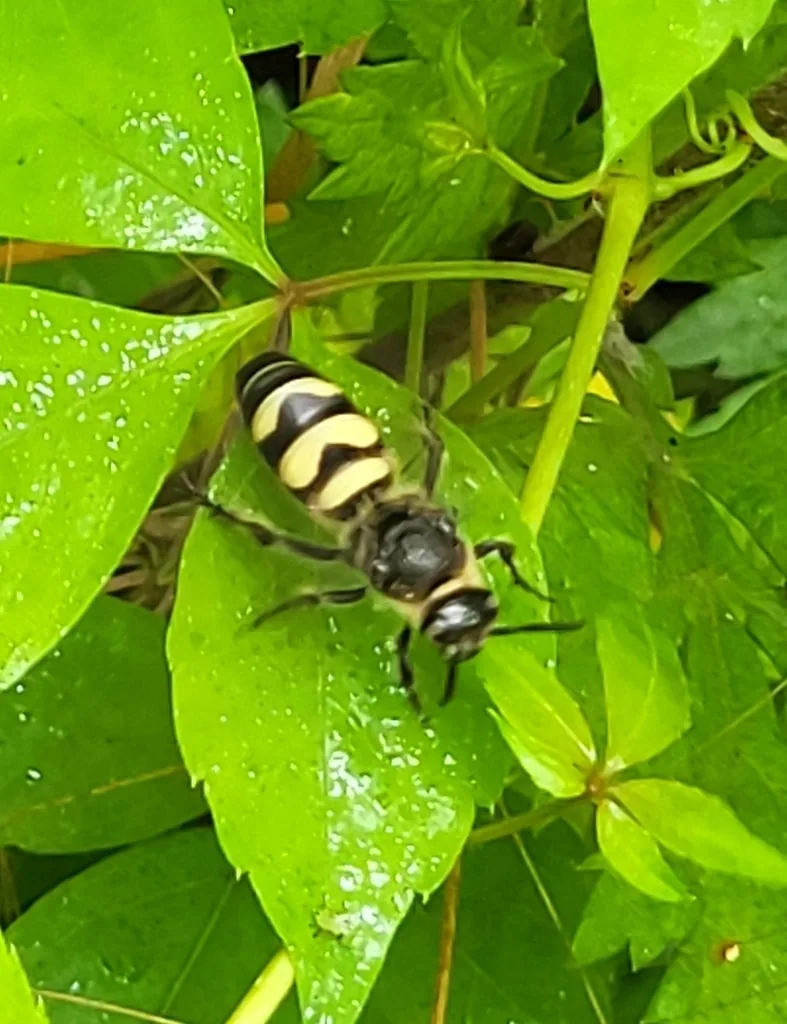
- Bodies are usually black or dark, often metallic or with a bluish sheen, and marked with yellow, white, orange or red. The exact pattern helps identify the species, though in some species males and females look very different.[1][2]
- The outer half to two-thirds of each wing carries fine, roughly parallel lengthwise wrinkles.[1]
- They tend to hold the body in a bent, curled posture. The family name comes from the genus Scolia, from a root meaning bent or crooked, as in scoliosis.[1]
- Males have noticeably longer antennae than females, with 13 antennal segments to the female's 12, and seven abdominal segments to her six. Males also have a retractable, three-pronged plate at the tip of the abdomen.[4]
- In the group UF/IFAS covers under Campsomeris, which includes some of Florida's largest wasps, males usually show a faint metallic blue sheen on the black parts of the abdomen.[4]
Look-alikes
| Look-alike | How to tell them apart |
|---|---|
| Cicada killer | Dielis plumipes in particular is easily mistaken for a cicada killer. Fine wrinkles on the outer part of the wings and hair on the body are scoliid traits.[1] |
| Spider wasps and thread-waisted wasps | These families can have similar colors. Hair on the abdomen, thorax and legs and a typically bent-over posture help separate scoliids from them.[1] |
| Mason wasps | The double-banded scoliid looks like a mason wasp, but it is hairy like other scoliids and is usually seen visiting flowers.[1] |
Where it lives
Missouri's conservation department puts the family at about 20 species in North America north of Mexico, most of them in the Southwest, Florida and other desert, tropical or subtropical areas; a 2026 checklist of the Americas counts 24 species in the United States. Scoliids occur statewide in Missouri, where several, including the blue-winged wasp, are common. GBIF's public U.S. records since 1990 for the family (about 42,000) come from 40 states on the map, most from Florida, North Carolina and Virginia. UF/IFAS counts 20 species and numerous subspecies in five genera north of Mexico; eight species in three genera (Scolia, Trielis and Campsomeris in its usage) occur in Florida, while Triscolia and Crioscolia are limited to the West.[1][6][7][4]
Biology and life cycle
A female flies low over the soil hunting for grubs. When she detects one she digs down, either making her own tunnel or following the grub's, stings it on the throat to paralyze it and lays an egg on it. In some species she digs deeper first and makes a chamber for the grub and her egg. UF/IFAS adds that she digs with her jaws first and then her front and middle legs, and either lays the egg on the underside of the grub or moves it deeper into the soil and hollows out a small chamber around it first.[2][1][3][4]
A stung grub never recovers. It looks dead at first, but after a day or so may feebly move its legs, and it can stay alive for a long time as fresh food for the wasp larva. Not every stung grub receives an egg, UF/IFAS notes, but none of them recovers.[2][4]
The wasp larva eats the grub over a few weeks, then pupates in the soil. Winter is passed underground, apparently as a mature larva or a pupa, and the new adult digs its way out the next summer.[1][3]
The grubs they use include those of the nonnative Japanese beetle, native May beetles (June bugs) and the green June beetle; NC State calls them very important natural enemies of green June beetle grubs.[1][2][3]
Adults feed on nectar and pollen. In Missouri they are seen mostly from July through September, and in North Carolina from June to October, peaking in August. Clemson lists garlic chives, goldenrod, mountain mint and rattlesnake master among favorite nectar plants.[1][2][3]
Scoliids often cruise just above lawns in loose figure-eight patterns during mating flights. Where they spend the night differs by source and species: Missouri describes males of some species sleeping in groups curled around plant stems, while NC State says the wasps burrow into the soil at night. UF/IFAS says a dozen or so males may skim the soil surface at once in irregular figure eights, often unnoticed until your eye gets used to them.[2][1][4]
At least some scoliids have more than one generation a year: a 2026 study of a Texas species, Dielis tejensis, found it does, and that its females had long been confused with Dielis plumipes.[5]
Damage and signs
Health risk
Males cannot sting. Females can, but they are not aggressive: Missouri says they sting only if mishandled, Clemson says they are usually too busy hunting egg sites, and NC State goes further, saying there is no record of anyone having been stung. If a sting does happen, MedlinePlus says most can be treated at home by washing the site with soap and water and applying ice wrapped in a cloth, 10 minutes on and 10 off. Call 911 for trouble breathing, swelling of the face or mouth, or throat tightness, which can signal a severe allergic reaction.[1][3][2][8]
Control
Prevention
No control is needed for the wasps. NC State says no control measures seem needed; if grubs have been a problem in the lawn, manage the grubs instead.[2]
Biological control
Leave them be: scoliids are natural enemies of white grubs, including Japanese beetle and May beetle grubs, and adults visiting flowers also help pollinate plants. Clemson urges identifying lawn wasps before reaching for pest control.[1][2][3]
Common scoliids in the eastern United States
Blue-winged wasp (Scolia dubia): a large, fuzzy rusty patch on the rear of the abdomen with two yellow spots, a shiny black head and thorax, and dark blue wings. NC State calls it one of the most common scoliids in North Carolina and gives it as over 1/2 inch long; Missouri says it has a wide range in North America. Clemson calls the same species the two-spotted scoliid. UF/IFAS gives a body length of 20 to 25 mm and a range covering most of the United States; the yellow spots are sometimes faint or missing.[1][2][3][4]
Double-banded scoliid (Scolia bicincta): two cream-colored bands across the front half of the abdomen. UF/IFAS gives 15 to 20 mm and a range throughout the eastern United States; the bands are sometimes broken into spots.[1][4]
Scolia nobilitata: small for a scoliid, just over 1/2 inch, with reddish legs and dark wings. Females have two or three pairs of yellow or orange spots on the front of the abdomen; males vary and are often banded with yellow. Missouri describes a wide distribution in the United States. UF/IFAS gives 10 to 15 mm and a range from the Atlantic coast to Colorado and Arizona.[1][4]
Pygodasis quadrimaculata (formerly Campsomeris): very large, like a huge, black-legged Scolia nobilitata. Females carry four large yellow spots on the abdomen, while males are often banded. It occurs in the eastern United States. UF/IFAS, which still lists it under Campsomeris, gives 15 to 35 mm, calls the female's four spots stable, and says males vary from two spotted segments to four banded ones; it ranges through most of the southeastern United States.[1][4]
Dielis plumipes (formerly Campsomeris): a very large, heavy, hairy wasp with amber wings and cream or yellow bands on the abdomen. Missouri says it might easily be mistaken for a cicada killer. A 2026 study found that some Texas females long identified as the subspecies D. plumipes fossulana belong to a separate species, Dielis tejensis. UF/IFAS gives 15 to 25 mm for the Florida form, which occurs throughout the lower Southeast; the species as a whole covers almost all of the eastern United States in three subspecies.[1][5][4]
UF/IFAS lists three more Florida species: Trielis octomaculata hermione, 10 to 15 mm with white spots, along the Atlantic coast into Florida; Campsomeris trifasciata, 10 to 15 mm, in southern Florida and most of the Greater Antilles; and the uncommon Campsomeris fulvohirta, 15 to 20 mm, in southern Florida and Cuba.[4]
Scoliids and grub control
Adults emerge after the beetles' peak season, while the grubs are still fairly close to the surface. Skunks, armadillos, moles, shrews, snakes, crows and grackles compete with the wasps for the same grubs, and probably eat some wasp larvae along with them.[1]
NC State's turf page says the wasps are often noticed flying a few inches above lawns infested with grubs, and that monitoring for white grubs may be appropriate where they appear.[2]
Scoliids have been used against white grubs elsewhere, mainly sugarcane grubs in Hawaii, the Mariana Islands and Mauritius, with results UF/IFAS describes as partially to completely successful.[4]
In the 1920s about 15,000 adults of two scoliid species were released in the northeastern United States against the Japanese beetle. They did attack its grubs in experiments but never became established.[4]
Where the sources disagree
How long the larva feeds: UF/IFAS says about one to two weeks on its grub before spinning a cocoon; the Missouri Department of Conservation says it consumes the grub over a few weeks.[4][1]
Spot color on Pygodasis quadrimaculata females: Missouri describes four large yellow ovals; UF/IFAS describes four orange spots.[1][4]
Common questions
- Are scoliid wasps dangerous?
- Not usually. Males cannot sting, and females are not aggressive; they sting only if mishandled or stepped on.[1][2]
- Why are big wasps flying low over my lawn?
- If they are scoliids, they are likely males cruising in figure-eight mating flights or females flying low in search of grubs. NC State notes that their presence means grubs are present.[2]
- How do I tell a scoliid from a cicada killer?
- Look for a hairy abdomen, thorax and legs, a bent posture, and fine wrinkles along the outer part of the wings. Missouri singles out Dielis plumipes as easily mistaken for one.[1]
- How many kinds of scoliid wasps live in Florida?
- UF/IFAS counts eight species in three genera in Florida, out of 20 species north of Mexico. Two of them, Campsomeris trifasciata and Campsomeris fulvohirta, are listed from southern Florida, the Greater Antilles and Cuba.[4]
Sources
- Missouri Department of Conservation, “Scoliid Wasps (Field Guide).” mdc.mo.gov/discover-nature/field-guide/scoliid-wasps (accessed 2026-11-14)
- NC State Extension, “Scoliid Wasps in Turf (TurfFiles; R. Brandenburg, 2017).” content.ces.ncsu.edu/scoliid-wasp-in-turf (accessed 2026-11-14)
- Clemson University Home & Garden Information Center, “Two-Spotted Scoliid Wasp: A Gentle and Valuable Garden Visitor.” hgic.clemson.edu/two-spotted-scoliid-wasp-a-gentle-and-valuable-garden-visitor/ (accessed 2026-11-14)
- University of Florida/IFAS Extension (EDIS, Featured Creatures), “Scoliid Wasps of Florida, Campsomeris, Scolia and Trielis spp., EENY-409/IN745 (E. E. Grissell).” ask.ifas.ufl.edu/publication/IN745 (accessed 2026-11-14). Uses older genus names (Campsomeris for species now placed in Pygodasis and Dielis).
- Insects, via PubMed, “Alloreferent and apparent seasonal polyphenism of Dielis tejensis, with an updated key to Nearctic Dielis species (2026).” pubmed.ncbi.nlm.nih.gov/41898957/ (accessed 2026-11-14). Cited from the PubMed abstract.
- ZooKeys, via PubMed, “Annotated checklist of Scoliidae (Hymenoptera, Scolioidea) of the Americas (Ramirez-Guillen et al. 2026).” pubmed.ncbi.nlm.nih.gov/42534605/ (accessed 2026-11-14). Cited from the PubMed abstract.
- Global Biodiversity Information Facility (GBIF), “Scoliidae: occurrence records in the U.S., 1990-2026 (GBIF occurrence search).” api.gbif.org/v1/occurrence/search?taxonKey=4351&country=US&hasGeospatialIssue=false&occurrenceStatus=PRESENT&year=1990%2C2026&facet=stateProvince&facetLimit=400&limit=0 (accessed 2026-11-14). State counts are records reported (iNaturalist research-grade, museum specimens, surveys), not abundance.
- MedlinePlus, U.S. National Library of Medicine, “Insect bites and stings (Medical Encyclopedia).” medlineplus.gov/ency/article/000033.htm (accessed 2026-11-14)
- iNaturalist, “Scoliidae taxon page (order and family).” www.inaturalist.org/taxa/51967 (accessed 2026-11-14)