On this page
How to identify it
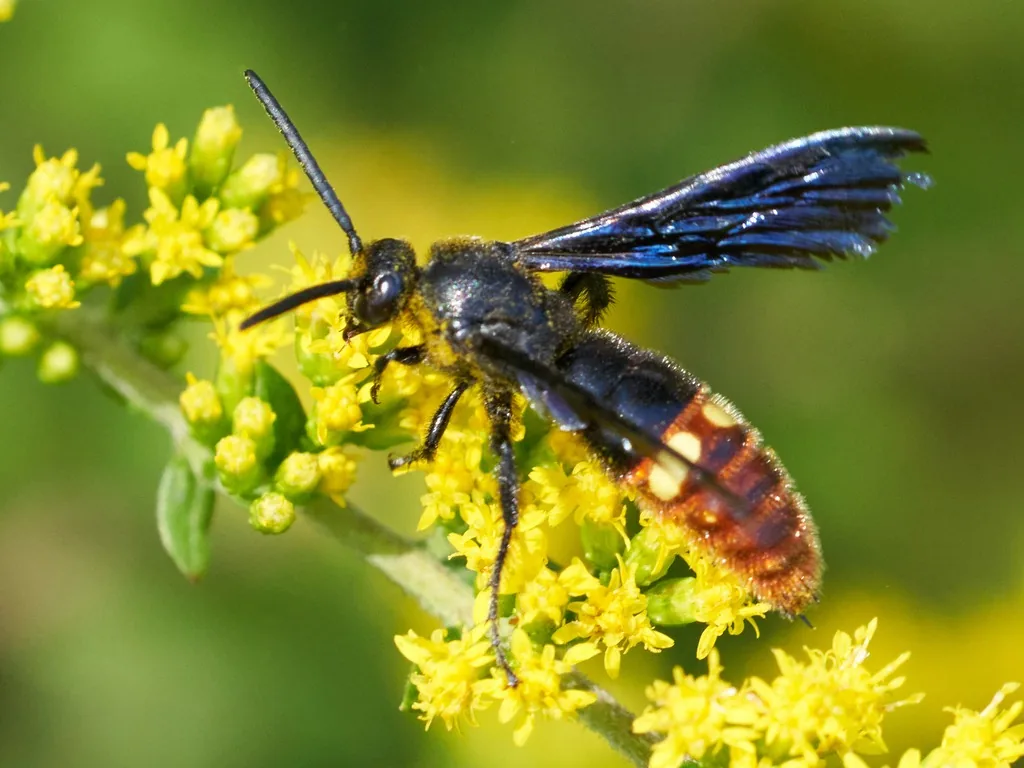
- A hairy wasp with black antennae, a shiny black head and thorax and blue-black wings. NC State gives the length as over 1/2 inch; Animal Diversity Web gives 20 to 25 mm (about 3/4 to 1 inch).[1][4]
- About midway along the abdomen are two yellow spots, one on each side; in flight they can look like a band. Animal Diversity Web notes the spots are sometimes absent.[1][4][5]
- The rear part of the abdomen is reddish brown and fuzzy, a rich rusty patch that MDC says quickly sets it apart from other large blue-black wasps.[1][5][3]
- Like other scoliids, the outer part of each wing has fine lengthwise wrinkles, and the wasp often holds its body in a bent, curled posture.[3][5]
Look-alikes
| Look-alike | How to tell them apart |
|---|---|
| Cicada killer | MDC says some large scoliids with pale abdominal bands, such as Dielis plumipes, might be mistaken for a cicada killer; the blue-winged wasp's rusty rear abdomen with two yellow spots sets it apart.[3] |
| Other scoliid wasps | The double-banded scoliid has two cream-colored bands on the front half of the abdomen instead of two yellow spots and a rusty rear.[3] |
Where it lives
MDC says it has a wide range in North America, and Animal Diversity Web describes it across most of the southern United States, from New England to Florida and beyond the Rocky Mountains. It is the most common scoliid wasp in North Carolina and is common in Missouri. GBIF holds about 17,000 U.S. records since 1990, the most from New York.[3][4][1][5][6]
Biology and life cycle
Timing varies by source and region: NC State says adults are present from June to October and most abundant in August; MDC sees most adult scoliids in July through September; Animal Diversity Web says breeding falls between April and November, depending on location.[1][3][4]
Adults are active by day and are often seen hovering a few inches above lawns; males fly in groups of about a dozen, in figure-eight patterns that ADW describes as a mating dance.[1][4]
A female digs through the soil or follows grub tunnels, stings and paralyzes a grub, and lays an egg on it. Sometimes females sting grubs without laying eggs.[1][2][4]
Sources differ on how fast the larva grows: NC State says it consumes the grub in about two weeks, ADW says it feeds for about a week before spinning a cocoon, and MDC says over the course of a few weeks.[1][4][3]
NC State and Clemson say the larva spends fall and winter in its cocoon in the soil and a new generation of adults appears the following summer; ADW says it likely overwinters as a pupa, but also reports adults emerging after about 3 weeks.[1][2][4]
Adults feed on nectar and are often seen on goldenrod, mountain mint and other flowers in late summer.[1][2][3]
Damage and signs
Health risk
They are not aggressive and generally do not attack people. Males cannot sting; females can, but rarely if ever do, and MDC says only if mishandled.[1][2][3][4]
Control
Prevention
No control is needed or recommended; wasps flying low over a lawn are often a sign of white grubs, especially green June beetle grubs.[1][2]
Biological control
Their presence is a sign that natural grub control is already at work, and the adults also help pollinate flowers.[2][3]
If you are stung
For an ordinary sting, MedlinePlus advises washing the site with soap and water, applying ice wrapped in a washcloth for 10 minutes on and 10 minutes off, and taking an antihistamine or using an anti-itch cream if needed.[7]
Call 911 for signs of a severe reaction, such as trouble breathing, swelling of the face or mouth, or throat tightness. NIOSH says people with a history of severe reactions should carry their emergency allergy medicine and wear a medical ID bracelet or necklace.[7][8]
Common questions
- Why are wasps flying low over my lawn?
- In late summer they are often blue-winged scoliid wasps searching for beetle grubs in the soil, or males looking for females.[1][2]
- Do blue-winged wasps sting?
- Rarely, if ever. Only females can sting, they are not aggressive, and control isn't recommended.[1][2][3]
- Should I spray them?
- No. They help control June beetle and Japanese beetle grubs and pollinate flowers.[1][2][3]
Sources
- NC State Extension, “Blue-winged Wasp (PDIC Factsheet).” content.ces.ncsu.edu/blue-winged-wasp (accessed 2026-11-11)
- Clemson Cooperative Extension, Home & Garden Information Center, “Two-Spotted Scoliid Wasp: A Gentle and Valuable Garden Visitor.” hgic.clemson.edu/two-spotted-scoliid-wasp-a-gentle-and-valuable-garden-visitor/ (accessed 2026-11-11)
- Missouri Department of Conservation, “Scoliid Wasps (Field Guide).” mdc.mo.gov/discover-nature/field-guide/scoliid-wasps (accessed 2026-11-11)
- Animal Diversity Web, University of Michigan Museum of Zoology, “Scolia dubia (blue-winged wasp).” animaldiversity.org/accounts/Scolia_dubia/ (accessed 2026-11-11)
- Missouri Department of Conservation, “Blue-Winged Wasp (Field Guide).” mdc.mo.gov/discover-nature/field-guide/blue-winged-wasp (accessed 2026-11-11)
- Global Biodiversity Information Facility (GBIF), “Scolia dubia: U.S. occurrence records since 1990 by state (GBIF occurrence search).” api.gbif.org/v1/occurrence/search?taxonKey=1309715&country=US&hasGeospatialIssue=false&occurrenceStatus=PRESENT&year=1990%2C2026&facet=stateProvince&facetLimit=400&limit=0 (accessed 2026-11-11)
- MedlinePlus, U.S. National Library of Medicine, “Insect bites and stings (Medical Encyclopedia).” medlineplus.gov/ency/article/000033.htm (accessed 2026-11-11)
- CDC National Institute for Occupational Safety and Health (NIOSH), “Insects and Scorpions at Work.” www.cdc.gov/niosh/outdoor-workers/about/insects-and-scorpions.html (accessed 2026-11-11)
- iNaturalist, “Scolia dubia taxon page (order and family).” www.inaturalist.org/taxa/1129479 (accessed 2026-10-06)