On this page
How to identify it
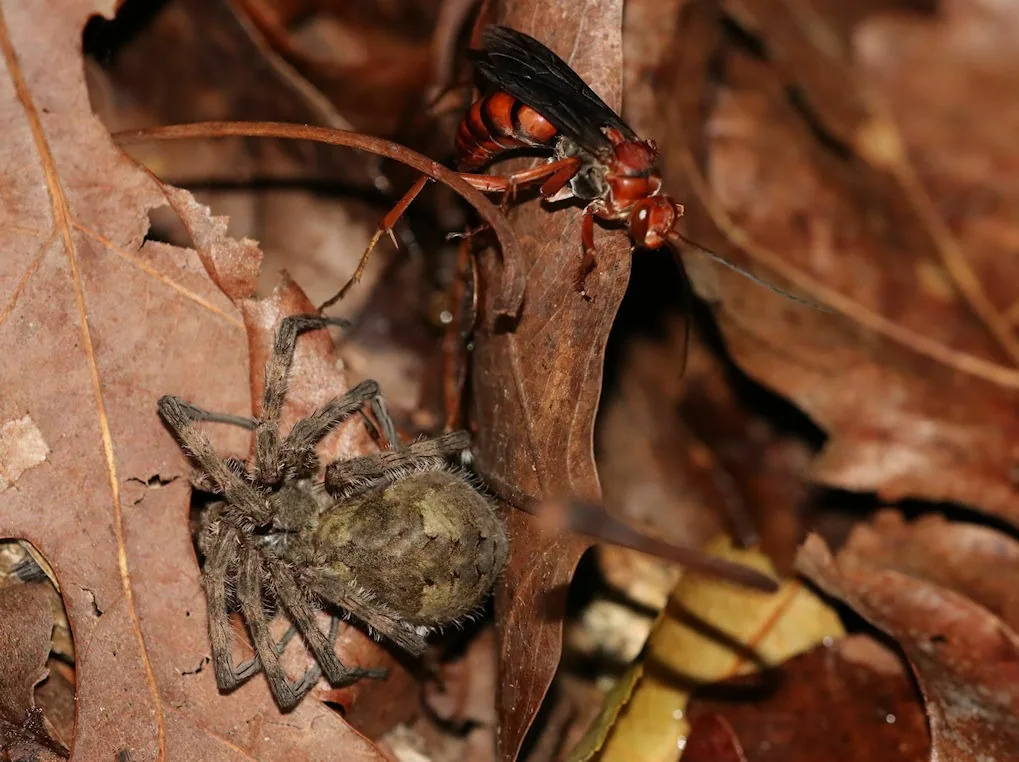
- The rusty spider wasp is up to about an inch long with a rusty orange body and iridescent blue wings.[1]
- Spider wasps in general are slender with long, spiny legs. Iowa State calls them medium-sized, about 1/2 inch; MDC calls them large. Most are dark (black, shiny blue-black or brownish), some have yellow bands or orange or rust markings, and the wings are smoky, amber or dark.[2][3]
- They run about on the ground, constantly flicking their wings; the long, spiny hind legs often dangle in flight. Females' antennae are curled or spiraled.[2][3][4]
- A close look at the hind leg helps: two prominent spines at the outer end of the tibia, and the hind femur, stretched back, usually reaches past the tip of the abdomen.[3]
Look-alikes
| Look-alike | How to tell them apart |
|---|---|
| Mydas flies | Harmless flies that copy the coloring, shape and flight of spider wasps. MDC lists them as one of the edible, harmless insects protected by looking like spider wasps.[3] |
| Velvet ants | MDC notes the red-and-black spider wasp Psorthaspis sanguinea can be mistaken for a velvet ant; it hunts on the ground in wooded areas.[3] |
| Tarantula hawks | Very large spider wasps in the genera Pepsis and Hemipepsis that specialize in tarantulas and are most numerous in the desert Southwest.[3] |
Where it lives
A diverse family with about 300 species in North America, living in many habitats; ground-digging species favor loose, workable soil. Spider wasps are common in Iowa, and the rusty spider wasp is seen around structures and yards in South Carolina.[4][3][2][1]
Biology and life cycle
A female paralyzes a spider with her sting, drags it backward to a nest, lays one egg on it and closes the nest; the larva feeds on the spider.[1][2][3][4]
Nests vary by species. Many dig shallow burrows, some build mud cells or reuse old mud dauber cells, and others use beetle holes, old mole or mouse burrows, or the spider's own retreat. Some snip off the spider's legs to make it easier to carry.[3][2][4]
The sources describe the rusty spider wasp's nest differently: Clemson says shallow burrows in the ground, covered with soil once provisioned, while MDC says females nest in rock piles or cracks in rock walls and foundation stones.[1][3]
Prey size varies too. Clemson says rusty spider wasps take wolf spiders and fishing spiders up to five times their size; MDC says that because each larva gets only one spider, the spiders are generally about the size of the adult wasp.[1][3]
Most species take free-living hunters such as wolf, crab and jumping spiders and tarantulas; others take orbweavers or grass spiders. Records keep growing: a 2020 paper reported new or unusual hosts for 133 species and subspecies.[3][5]
The larva saves the spider's vital organs for last, keeping it fresh. It then spins a silk cocoon; MDC says most species overwinter there, while WSU says the adult may emerge the same season or overwinter.[3][4]
Adults drink flower nectar and sometimes juice from overripe fruit or aphid honeydew. Males wait near nesting females to mate; MDC says they hold territories and chase off rivals but cannot sting.[1][3][4]
Indoors, they are usually accidental invaders looking for winter shelter in late summer and fall, or nesting in rotted wood.[2]
Health risk
Females can sting if handled or threatened, but they are solitary, don't defend a nest and rarely sting people or pets. Males have no stinger.[1][2][3]
Control
Prevention
No special control is needed outdoors; give them space and watch the show.[1][2]
Traps and physical control
Ones found indoors can be swatted or removed.[2]
If you are stung
Spider wasp venom is mainly for paralyzing prey, but the largest species, the tarantula hawks, are known for extremely painful defensive stings.[6]
For an ordinary sting, MedlinePlus advises washing the site with soap and water, applying ice wrapped in a washcloth for 10 minutes on and 10 minutes off, and taking an antihistamine or using an anti-itch cream if needed.[7]
Call 911 for signs of a severe reaction, such as trouble breathing, swelling of the face or mouth, or throat tightness. NIOSH says people with a history of severe reactions should carry their emergency allergy medicine and wear a medical ID bracelet or necklace.[7][8]
Common questions
- What is the orange wasp dragging a spider?
- Probably a rusty spider wasp taking a paralyzed wolf or fishing spider to its nest.[1]
- Do spider wasps sting people?
- Rarely; they are solitary and sting only if handled or threatened.[1][2][3]
- Why is there a spider wasp in my house?
- Usually it wandered in by mistake looking for a winter hiding place, most often in late summer and fall.[2]
Sources
- Clemson Cooperative Extension, Home & Garden Information Center, “Rusty Spider Wasp.” hgic.clemson.edu/rusty-spider-wasp/ (accessed 2026-11-11)
- Iowa State University Extension and Outreach (Yard and Garden), “Spider Wasp.” yardandgarden.extension.iastate.edu/encyclopedia/spider-wasp (accessed 2026-11-11)
- Missouri Department of Conservation, “Spider Wasps (Field Guide, family Pompilidae).” mdc.mo.gov/discover-nature/field-guide/spider-wasps (accessed 2026-11-11)
- Washington State University Extension, “Pompilidae: Spider Wasps (Hortsense).” hortsense.cahnrs.wsu.edu/fact-sheet/pompilidae-spider-wasps/ (accessed 2026-11-11)
- Zootaxa, via PubMed, “New and unusual host records for North American and South American spider wasps (Kurczewski et al. 2020).” pubmed.ncbi.nlm.nih.gov/33311100/ (accessed 2026-11-11)
- Toxins, via PubMed, “A short review of the venoms and toxins of spider wasps (Hymenoptera: Pompilidae) (Dashevsky et al. 2021).” pubmed.ncbi.nlm.nih.gov/34822528/ (accessed 2026-11-11)
- MedlinePlus, U.S. National Library of Medicine, “Insect bites and stings (Medical Encyclopedia).” medlineplus.gov/ency/article/000033.htm (accessed 2026-11-11)
- CDC National Institute for Occupational Safety and Health (NIOSH), “Insects and Scorpions at Work.” www.cdc.gov/niosh/outdoor-workers/about/insects-and-scorpions.html (accessed 2026-11-11)
- iNaturalist, “Tachypompilus ferrugineus taxon page (order and family).” www.inaturalist.org/taxa/147347 (accessed 2026-10-06)