On this page
How to identify it
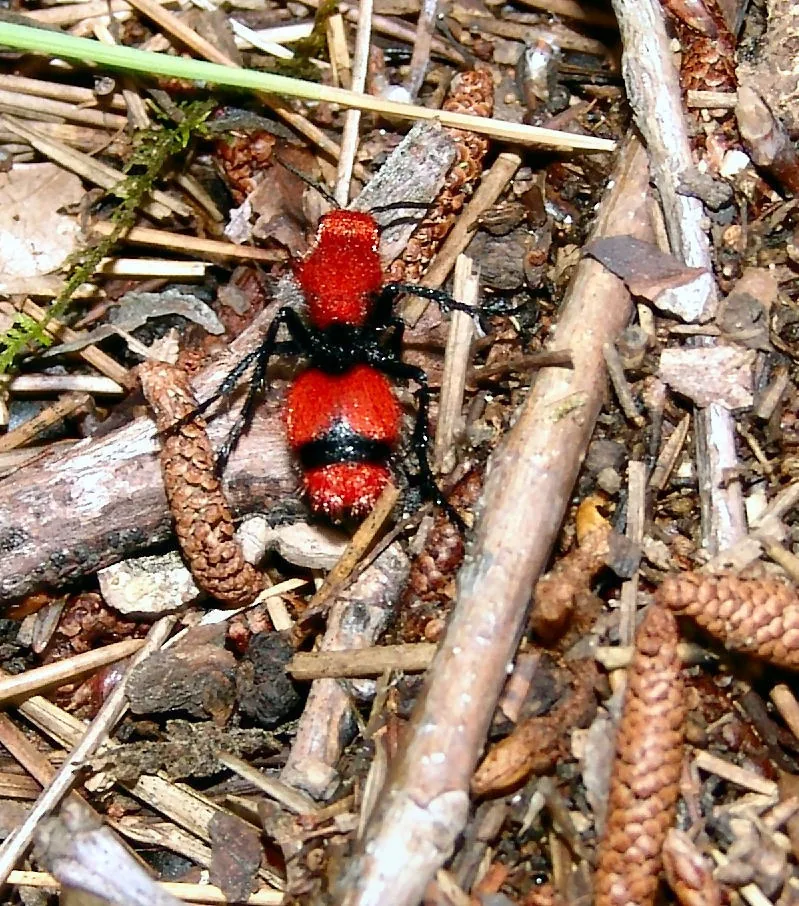
- Females are wingless and covered in dense, velvety hair, usually black or brown boldly marked with red, orange or yellow; the legs are often blackish.[1][2][3]
- The eastern velvet ant is the largest and most often seen species, about 3/4 inch to 1 inch long, black with bright red-orange hair.[2][4][3]
- Males have wings and look more like ordinary wasps; they are harmless.[1][2][3]
- Velvet ants are very hard-bodied and tough to crush. Some squeak when trapped or disturbed by rubbing two abdominal segments together, often as a warning before they sting.[1][2][4][3]
- UF/IFAS adds that in females the thorax segments are fused, and most have a "felt line" of dense, flat-lying hairs along the side of the second abdominal segment. Males have three thorax segments and, in Florida, large wings.[5]
Look-alikes
| Look-alike | How to tell them apart |
|---|---|
| Ants, including fire ants | True ants are social insects that live in colonies; velvet ants are solitary wasps, usually seen running alone. UF/IFAS gives a physical check too: every ant has one or two small knobs (petiole nodes) at the narrow waist, and female velvet ants lack them.[3][1][5] |
| Cicada killer | A large winged, ground-nesting wasp; the eastern velvet ant is a wingless parasite that searches out cicada killer burrows to lay its eggs.[4][3] |
Where it lives
North America's 21 daytime-active velvet ant genera hold 361 named species. They are more common in the Southwest but are found throughout the Southeast, with 41 species in South Carolina alone; they live where their hosts nest, mostly in open, dry, sunny, sandy places. Worldwide, UF/IFAS counts about 8,000 species in about 230 genera and subgenera, with fifty species in seven genera in Florida.[6][2][3][5]
Biology and life cycle
Velvet ants are solitary parasites, mostly of ground-nesting bees and wasps; a few attack beetles and flies. Females find host nests and lay eggs on or in the developing young, which the velvet ant larva then eats. UF/IFAS says they mostly attack mature larvae or pupae of other solitary bees and wasps, but have also been seen targeting non-feeding stages of flies, beetles, moths and cockroaches, and even some social bees and wasps; the velvet ant larva feeds on the host from the outside.[1][2][3][5]
A female often forces her way into a host nest and may stay inside for several days.[3]
They spend the winter inside the host's nest before becoming adults, and there is usually one generation a year.[1][4]
Adults feed on flower nectar. In South Carolina they are common from about May through September, often in late afternoon.[2][3]
Bright colors and the warning squeak tell predators to stay away; Mississippi State adds a repellent secretion and a long, flexible stinger, so few animals eat them.[2][4]
Their venom is mostly peptides; two kinds cause most of the pain and can also kill other insects such as honey bees.[7]
Males and females can differ so much in color and size that matching the sexes of one species is hard. In Florida, males are often heavier than females: one study found heavier males in seven of 13 species.[5]
Damage and signs
Health risk
Only females sting. They aren't aggressive; stings happen when one is stepped on with bare feet, sat on, rolled on in the grass or picked up, and because they travel alone, multiple stings are unlikely. Venom research rates the pain as extreme but the venom's lethality as very low; the real danger is an allergic reaction.[1][4][3][8][9]
Control
Prevention
Teach children not to pick up velvet ants, and wear shoes in sunny, sandy, open areas such as lawns where they are active. UF/IFAS says no control measures are necessary.[1][4][3][5]
Traps and physical control
Carefully move a stray velvet ant to another spot, or leave it alone if it isn't bothering anyone; never pick one up by hand.[2][3]
Pesticides
Their extremely tough outer covering means neither insecticides nor swatting control them very well.[2][1]
First aid for a velvet ant sting
Wash the sting with soap and water, then ice it, wrapped in a cloth, 10 minutes on and 10 minutes off.[10][9]
For mild symptoms, MedlinePlus says an oral antihistamine such as diphenhydramine may be used, and creams can reduce itching. Watch the site over the next few days for signs of infection.[10][9]
Have someone stay with the person to watch for an allergic reaction. Anyone with a history of severe sting reactions should carry their prescribed epinephrine.[11][10]
Call 911 for trouble breathing or wheezing, swelling of the face or mouth, or throat tightness or difficulty swallowing. Poison Help, 1-800-222-1222, can advise on anything else.[9][10]
Where sources disagree
Host of the eastern velvet ant: Mississippi State says it hunts cicada killer and other large ground-nesting wasp nests; Missouri's conservation department says it parasitizes bumble bee nests and that other velvet ants attack cicada killers.[4][3]
Which sex is fuzzy: Clemson says both males and females are covered in velvety hair; Texas A&M describes the wingless females as the fuzzy ones and the males as more wasp-like.[2][1]
Number of species: UF/IFAS cites about 435 species in North America, mostly in arid southern and western areas; the 2015 study above counts 361 named species in North America's 21 daytime-active genera.[5][6]
Common questions
- Can a cow killer really kill a cow?
- No. The nickname refers to the painful sting; Clemson says there is nothing to indicate any cow has ever been killed by one, and Missouri cites a 1996 study finding the venom less toxic than that of harvester ants or honey bees. UF/IFAS says some species are called "mule killers" for the same reason, and that they are not aggressive.[2][3][8][5]
- Are velvet ants ants or wasps?
- Wasps. The females are wingless and fuzzy, which makes them look like ants, but they belong to the wasp family Mutillidae.[1][3]
- Why doesn't stepping on a velvet ant kill it?
- Velvet ants have unusually hard bodies that resist crushing, one of several defenses that also include a long stinger and a warning squeak.[4][1]
- Why do so many velvet ants look alike?
- Many North American species share similar warning color patterns. A study of 21 daytime genera found nearly all species fall into eight mimicry rings, groups of stinging species that share a warning look.[6]
Sources
- Texas A&M AgriLife Extension Service, “Velvet Ants (ENT-3004).” citybugs.tamu.edu/factsheets/biting-stinging/wasps/ent-3004/ (accessed 2026-11-14)
- Clemson Cooperative Extension, Home & Garden Information Center, “Velvet Ants, HGIC 2485 (revised July 18, 2022).” hgic.clemson.edu/factsheet/velvet-ants/ (accessed 2026-11-14)
- Missouri Department of Conservation, “Velvet Ants (Field Guide).” mdc.mo.gov/discover-nature/field-guide/velvet-ants (accessed 2026-11-14)
- Mississippi State University Extension Service, “Bug's Eye View: Eastern Velvet Ant, Vol. 5, No. 22 (2019).” extension.msstate.edu/newsletters/bugs-eye-view/2019/eastern-velvet-ant-vol-5-no-22 (accessed 2026-11-14)
- University of Florida/IFAS Extension (Featured Creatures), “Velvet Ants, Mutillidae, EENY-378/IN717.” ask.ifas.ufl.edu/publication/IN717 (accessed 2026-11-14)
- Current Biology, via PubMed, “North American velvet ants form one of the world's largest known Mullerian mimicry complexes (Wilson et al. 2015).” pubmed.ncbi.nlm.nih.gov/26294178/ (accessed 2026-11-14)
- Cellular and Molecular Life Sciences, via PubMed, “Venom chemistry underlying the painful stings of velvet ants (Hymenoptera: Mutillidae) (Jensen et al. 2021).” pubmed.ncbi.nlm.nih.gov/33970306/ (accessed 2026-11-14)
- Toxins, via PubMed, “Pain and Lethality Induced by Insect Stings: An Exploratory and Correlational Study (Schmidt 2019).” pubmed.ncbi.nlm.nih.gov/31330893/ (accessed 2026-11-14)
- MedlinePlus, U.S. National Library of Medicine, “Insect bites and stings (Medical Encyclopedia).” medlineplus.gov/ency/article/000033.htm (accessed 2026-11-14)
- MedlinePlus, U.S. National Library of Medicine, “Bee, wasp, hornet, or yellow jacket sting (Medical Encyclopedia).” medlineplus.gov/ency/article/002847.htm (accessed 2026-11-14)
- Centers for Disease Control and Prevention, NIOSH, “Insects and Scorpions at Work.” www.cdc.gov/niosh/outdoor-workers/about/insects-and-scorpions.html (accessed 2026-11-14)
- iNaturalist, “Dasymutilla occidentalis taxon page (order and family).” www.inaturalist.org/taxa/117221 (accessed 2026-11-14)