On this page
How to identify it
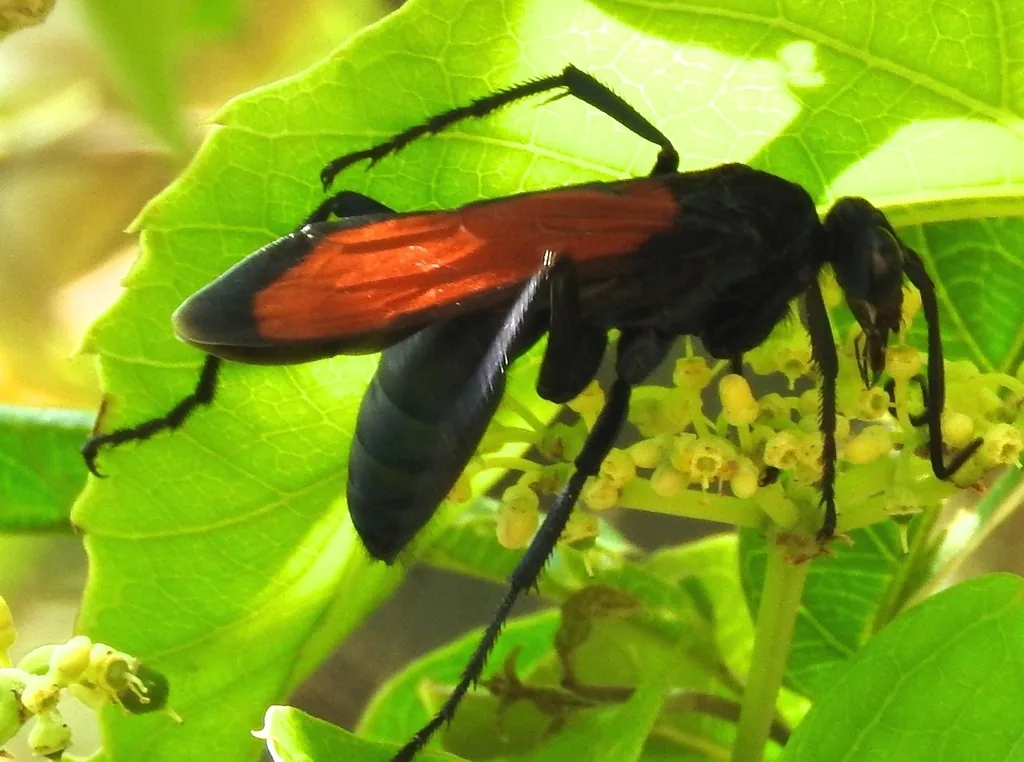
- These are big wasps, about 1/2 inch to 2 inches long; Pepsis thisbe, a common western species, reaches about 2 inches.[1][2]
- The body is metallic blue or black with an iridescent sheen, and the wings are bright orange to yellow, making them hard to miss.[1][2]
- They have long legs; males have straight antennae, while females' antennae are curled.[2][1]
Look-alikes
| Look-alike | How to tell them apart |
|---|---|
| Hemipepsis tarantula hawks | Hemipepsis ustulata is also called a tarantula hawk and has a black body and orange-brown wings with black tips; colors vary, so separating species takes a technical key.[1] |
Where it lives
Pepsis tarantula hawks occur throughout North and South America; in the United States they're mainly found in southwestern deserts and scrublands, such as southern Colorado and the Grand Canyon.[1][2]
Biology and life cycle
A female stings a tarantula, or sometimes another large spider such as a trapdoor or wolf spider, to paralyze it, then drags it to a burrow and lays a single egg on it.[1][2]
The larva feeds on the still-living spider for weeks, avoiding vital organs until late, then spins a cocoon and becomes an adult in two to three weeks.[1][2]
Adults drink nectar from flowers such as milkweed, mesquite and soapberry, and they are among the main pollinators of milkweed.[1][3]
Their venom, strong odor and hard body leave them with few predators; roadrunners are one of the few animals that eat them.[1][2][3]
Adult females live about 40 to 50 days.[1]
Fun fact: the paralysis they give a tarantula is long-term, which keeps the spider fresh for the wasp larva; researchers have barely begun to study what is in the venom.[6]
Damage and signs
- They generally don't harm homes or crops, though they have been seen feeding on grapes in California.[1]
Health risk
Only females can sting, using a stinger about 1/4 inch long. The sting is extremely painful; the National Park Service says it is reported to be the second most painful sting of any insect, and a study rating 96 stinging insects found tarantula hawk venom exceedingly painful yet extremely low in lethality. The wasps are docile and sting only when strongly provoked.[2][1][5]
Control
Prevention
Colorado State recommends no control measures, and intervention usually isn't needed; leave them alone and don't handle them.[1][2]
Don't handle them: the wasps sting only when strongly provoked, and Colorado State recommends no control measures.[2][1]
Common questions
- Are tarantula hawks dangerous to people?
- Their sting is one of the most painful of any insect, but they are docile toward people and require extreme provocation before stinging.[1]
- Can a male tarantula hawk sting?
- No. Males have no stinger; only females sting, and they use it mainly to paralyze tarantulas.[2][3]
- Why are tarantula hawks all over my milkweed?
- Adults feed on flower nectar and pollen, and milkweed is a favorite; they are important milkweed pollinators.[1][3]
- What should I do if a tarantula hawk stings me?
- For most stings, MedlinePlus advises washing the site with soap and water and placing ice wrapped in a washcloth on it for 10 minutes on and 10 minutes off. Call 911 or the local emergency number for trouble breathing, swelling anywhere on the face or in the mouth, throat tightness or feeling weak.[7]
Sources
- Colorado State University Extension, “Tarantula Hawks of Colorado.” extension.colostate.edu/resource/tarantula-hawks-of-colorado/ (accessed 2026-11-12)
- U.S. National Park Service, “Tarantula Hawk (Grand Canyon National Park, last updated September 22, 2020).” home.nps.gov/grca/learn/nature/tarantula-hawk.htm (accessed 2026-11-12)
- University of California Cooperative Extension, Central Sierra, “What Is That Huge Thing on the Milkweed? (aka Tarantula Hawk Wasp), by Master Gardener Rebecca Miller-Cripps.” www.ccfruitandnuts.ucanr.edu/sites/default/files/2024-09/402196.pdf (accessed 2026-11-12)
- iNaturalist, “Pepsis thisbe taxon page (order and family).” www.inaturalist.org/taxa/53995 (accessed 2026-11-12)
- Toxins, via PubMed, “Pain and lethality induced by insect stings: an exploratory and correlational study (Schmidt 2019).” pubmed.ncbi.nlm.nih.gov/31330893/ (accessed 2026-11-12). Cited from the PubMed abstract.
- Toxins, via PubMed, “A short review of the venoms and toxins of spider wasps (Hymenoptera: Pompilidae) (Dashevsky and Rodriguez 2021).” pubmed.ncbi.nlm.nih.gov/34822528/ (accessed 2026-11-12). Cited from the PubMed abstract.
- MedlinePlus, U.S. National Library of Medicine, “Insect bites and stings (Medical Encyclopedia).” medlineplus.gov/ency/article/000033.htm (accessed 2026-11-12)