On this page
How to identify it
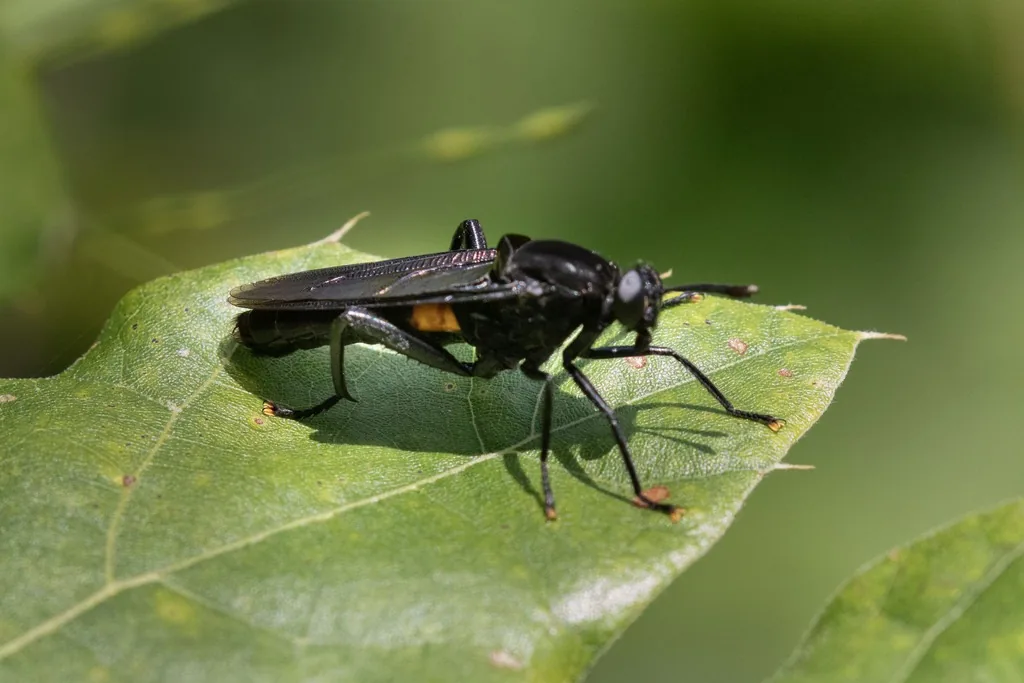
- Most are about 1 inch long, ranging from 1/4 to 1 1/4 inches. The University of Arkansas Arthropod Museum gives 1 to 1.5 inches for Mydas clavatus, and Clemson describes one at about 1 1/2 inches.[1][2][4]
- Many are black, dark or tan with red, orange or yellow bands. Mydas clavatus has smoky wings and an orange mark on the top and sides of the second abdominal segment.[1][2]
- Like all true flies they have one pair of wings, and unlike most flies they have clubbed antennae.[1]
- Mydas clavatus acts like a spider wasp as well as looking like one: it seems to hover with its legs trailing behind, and after landing it may arch its abdomen and jab the tip down in a mock sting.[2][3]
Look-alikes
| Look-alike | How to tell them apart |
|---|---|
| Robber flies | A related group of large bee and wasp mimics, but robber flies lack clubbed antennae and differ in wing veins.[1] |
| Spider wasps | Mydas flies mimic blue-black spider wasps and other spider wasps with an orange or red spot on the abdomen. Count the wings: wasps have four, flies two.[1][2] |
Where it lives
About 80 species live in North America, with the most in dry areas such as the desert Southwest. Mydas clavatus and others occur in the East in grasslands, woodlands and forests; M. clavatus is widely distributed across the eastern United States and southernmost Ontario and is common in Arkansas.[1][2]
Biology and life cycle
Larvae live in soil or rotting wood, and most species probably spend at least a year as larvae. Mydas clavatus larvae are found in decaying stumps and logs, where they eat scarab beetle grubs.[1][2]
Adults are short-lived and feed on flower nectar and pollen. In prairies they often visit rattlesnake master, and one caught at the South Carolina Botanical Garden was covered in pollen.[1][4][3]
Adults were long assumed to be predators, but they lack mandibles, and their mouthparts and flower visits point to nectar feeding.[2]
Males probably hold territories: they patrol home ranges and chase off other males, and in many species they wait at good egg-laying sites for females.[2][1]
Damage and signs
Health risk
Harmless. They have no stinger and can't bite, even when they fake a sting.[1][3][2]
Control
Prevention
No control is needed. These harmless flies are seen less often than other flies, and their larvae feed on beetle grubs.[1][3]
Where sources disagree
Size: about 1 inch for most species and up to 1 1/4 inches (Missouri Department of Conservation), against 1 to 1.5 inches for Mydas clavatus (University of Arkansas Arthropod Museum) and about 1 1/2 inches for one Clemson specimen.[1][2][4]
Adult diet: the Virginia Museum of Natural History says adults feed only on pollen and nectar, while the Missouri Department of Conservation says they apparently do and the Arkansas museum says the evidence tends to point that way.[3][1][2]
Common questions
- Is the big black wasp with an orange band a Mydas fly?
- It may be. Count the wings and check for clubbed antennae: Mydas flies have two wings and wasps four.[1][2]
- Do Mydas flies sting?
- No. They are harmless wasp mimics with no stinger, and they can't bite.[1][3]
- Do Mydas flies eat other insects?
- The larvae do: they eat beetle grubs in soil and rotting wood. Adults appear to live on nectar and pollen.[1][2][3]
Sources
- Missouri Department of Conservation, “Mydas Flies (Field Guide).” mdc.mo.gov/discover-nature/field-guide/mydas-flies (accessed 2026-11-11)
- University of Arkansas Arthropod Museum, “Mydas fly (Mydas clavatus).” arthropod.uark.edu/mydas-fly/ (accessed 2026-11-11)
- Virginia Museum of Natural History, “At first glance ... (Mydas clavatus, #BenInNature, July 5, 2020).” www.vmnh.net/article/at-first-glance/7-5-2020 (accessed 2026-11-11)
- Clemson Cooperative Extension Home & Garden Information Center, “Meeting a Mydas Fly (HGIC, July 2024).” hgic.clemson.edu/meeting-a-mydas-fly/ (accessed 2026-11-11)
- iNaturalist, “Mydas clavatus taxon page (order and family).” www.inaturalist.org/taxa/123516 (accessed 2026-10-06)