On this page
How to identify it
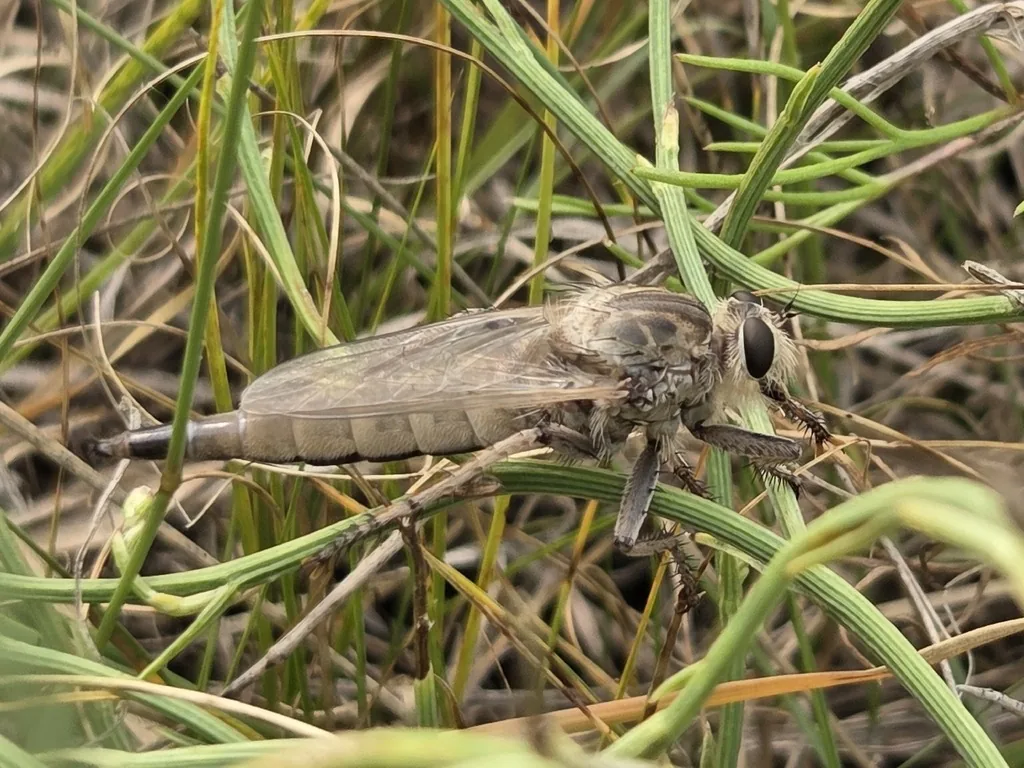
- Adults are bristly or hairy flies with a long, slender, tapering abdomen and a humpbacked look; most are gray, brown or black. The face often looks bearded.[1][2]
- The top of the head dips down between the two large compound eyes, with three tiny simple eyes in that hollow.[2]
- The legs are long, spiny and strong for grabbing prey, and the mouthpart is a pointed, knifelike beak for stabbing. Many make a loud buzz in flight.[2][1][3]
- The Missouri Department of Conservation gives a body length of mostly ½ to ¾ inch, with some species reaching 1¼ inches.[2]
- Some species are stout and fuzzy and look very much like bumble bees.[2][3][1]
Look-alikes
| Look-alike | How to tell them apart |
|---|---|
| Bumble bees | Bee-mimicking robber flies, such as Laphria, are true flies: they have only one pair of wings (the second pair is reduced to tiny knobs called halteres), very large eyes and short antennae. Bees have two pairs of wings.[2][3] |
| Damselflies | Some robber flies are so long and slender that they resemble damselflies, but they still have only one pair of wings.[2] |
Where it lives
More than 1,000 species live in North America (over 7,000 worldwide), and nearly 100 have been recorded in the Upper Midwest. Most are found in open places such as fields, grasslands, woodland openings and sunny pond edges, and they are most common in semi-arid regions.[1][3][2]
Biology and life cycle
Adults strike from a perch, stab the prey and inject saliva that immobilizes it, then return to the perch to suck out the liquefied meal.[2][3]
Laboratory work on venom from a large Australian robber fly found that injecting it into blowflies caused rapid paralysis followed by death.[4]
Prey includes butterflies, wasps, bees, dragonflies, grasshoppers, beetles and other flies. At least 6 North American species feed mainly on grasshoppers, and one species is known to prey on Japanese beetles.[1][2]
Proctacanthus milbertii, sometimes called the Missouri bee killer, actually eats mostly grasshoppers and moths; honey bees make up only about 4% of its diet.[1]
Females lay eggs on plants, soil, bark or wood. As a general rule, species that hunt from the ground lay eggs in soil and those that hunt from plants put eggs into stems or flowers.[1][2]
Larvae live in soil or decaying wood and feed on insect eggs and soft-bodied insects such as small grubs. They overwinter as larvae, and the common species take one to three years to develop.[1][2]
Adults live about three months and are seen through the summer. Males are territorial.[1]
Damage and signs
- They feed fairly indiscriminately, so they also take honey bees and other pollinators. In Texas, Saropogon dispar visits apiaries; more than 700 were destroyed in one bee yard over three days.[1]
Health risk
Robber flies do not go after people, but a large one that is mishandled can bite. Researchers who studied robber fly venom found it activates mammalian pain-sensing nerve cells, which fits reports of a painful bite when they are handled. For an ordinary insect bite, MedlinePlus advises washing the site with soap and water and applying ice wrapped in a cloth, 10 minutes on and 10 minutes off; call 911 for trouble breathing or swelling of the face or mouth.[2][4][5]
Control
Prevention
No control is needed. Their larvae and adults eat many pest insects, putting them in the same beneficial group as lady beetles and lacewings.[2][1]
Traps and physical control
Do not pick them up with bare hands. If one lands on you, brush it off gently instead of slapping it.[2][4]
Biological control
Adults need sugar as well as protein before laying eggs, so nectar flowers such as goldenrod or Queen Anne's lace may help encourage them. They have not been used in biological control programs.[1]
What is in robber fly venom
A 2018 study found robber fly venom is made mostly of peptides and non-enzymatic proteins rather than digestive enzymes, with most of it falling into ten toxin families the authors named Asilidins. One of these peptides acted as a neurotoxin that helps immobilize prey.[6]
A separate 2018 study of the giant Australian assassin fly Dolopus genitalis identified 122 polypeptides in its venom and concluded it is used both to subdue prey and to deter predators.[4]
Common questions
- Do robber flies bite people?
- Only when handled or trapped. Their venom affects pain nerves, so a bite from a large species can be painful. Wash it with soap and water and use a wrapped ice pack.[4][2][5]
- Are robber flies good to have in the garden?
- Mostly yes. They eat many pest insects, and their larvae feed on grubs and insect eggs in soil, though adults also catch some bees.[1][2]
- Why does a robber fly look like a bumble bee?
- Some species, such as Laphria, mimic bumble bees, which may lead predators to treat them as something that can sting.[3][2]
Sources
- University of Wisconsin-Madison Division of Extension, Wisconsin Horticulture, “Robber Flies, Asilidae (reviewed February 2025).” hort.extension.wisc.edu/articles/robber-flies-asilidae/ (accessed 2026-11-11)
- Missouri Department of Conservation, “Robber Flies (Field Guide).” mdc.mo.gov/discover-nature/field-guide/robber-flies (accessed 2026-11-11)
- Mississippi Entomological Museum, Mississippi State University, “The Robber Flies, Order Diptera, Family Asilidae (fact sheet 36, September 2023).” mississippientomologicalmuseum.org.msstate.edu/MIMS/FactSheets/36_Asilidae.pdf (accessed 2026-11-11)
- Toxins, via PubMed Central, “Buzz Kill: Function and Proteomic Composition of Venom from the Giant Assassin Fly Dolopus genitalis (Walker et al. 2018).” pmc.ncbi.nlm.nih.gov/articles/PMC6266666/ (accessed 2026-11-11)
- MedlinePlus, U.S. National Library of Medicine, “Insect bites and stings (Medical Encyclopedia).” medlineplus.gov/ency/article/000033.htm (accessed 2026-11-11)
- Toxins, via PubMed, “A Dipteran's Novel Sucker Punch: Evolution of Arthropod Atypical Venom with a Neurotoxic Component in Robber Flies (Drukewitz et al. 2018).” pubmed.ncbi.nlm.nih.gov/29303983/ (accessed 2026-11-11)
- iNaturalist, “Proctacanthus milbertii taxon page (order and family).” www.inaturalist.org/taxa/61644 (accessed 2026-10-06)