On this page
How to identify it
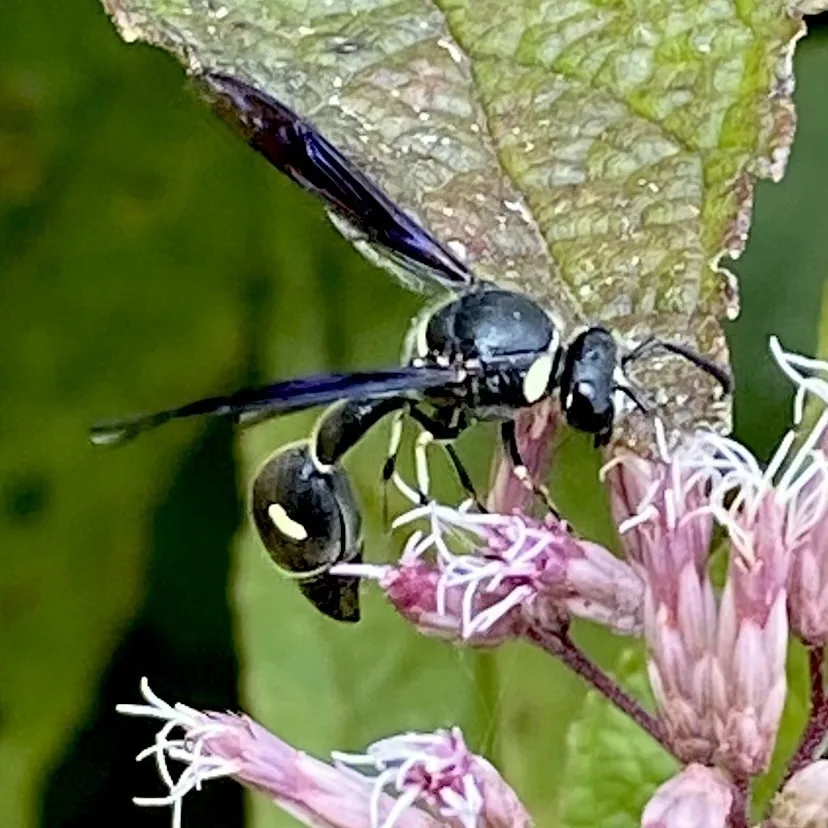
- The fraternal potter wasp (Eumenes fraternus) is small, under an inch long, and delicate-looking: shiny black with a scattering of white markings and a distinctive, elongated abdominal segment.[2]
- Most potter and mason wasps are black or brown with yellow or white markings.[3]
- The nest is the giveaway: a small mud urn, about half an inch across in one Clemson find, attached to the underside of a leaf or tucked into a crevice or cavity. When the young wasp is grown it chews a round hole in the side to get out. UF/IFAS says that although many wasps make mud nests, the jug-like pots of Eumenes are not easily confused with other species' nests, and jug-shaped nests found around the home are almost certainly theirs.[2][1][7]
- UF/IFAS gives Eumenes adults as 13 to 17 mm (1/2–2/3 in) long. The first abdominal segment is long and stalk-like, widening gradually toward the rear from where it joins the thorax.[7]
- Of Florida's two Eumenes, E. fraternus is black with a few pale yellowish-white markings, while E. smithii is black with extensive reddish-orange markings, UF/IFAS says.[7]
Look-alikes
| Look-alike | How to tell them apart |
|---|---|
| Mud dauber wasps | Mud daubers are in different families and are usually larger and slenderer. Their exterior mud nests, some shaped like organ pipes, are stocked with spiders; potter wasps build small mud pots and stock them with caterpillars.[1] |
| Paper wasps | Paper wasps live in small groups in papery nests hanging under eaves or from branches in bushes and trees. Potter wasps live alone and nest in mud pots or existing cavities.[3][2] |
| Zethus wasps | Another genus of potter wasps that UF/IFAS says could easily be confused with Eumenes. In Zethus the second abdominal segment is more stalk-like, and the rear edge of a small cell in the forewing (the second submarginal cell) is cut off squarely rather than pointed.[7] |
Where it lives
Clemson describes the fraternal potter wasp as widespread in North America; Washington State University notes that potter and mason wasps make up most of the species in the wasp family Vespidae. UF/IFAS says eight species and 10 subspecies of Eumenes are known north of Mexico. E. fraternus occurs from about the 100th meridian eastward in the U.S. and Canada; E. smithii lives in the southern states from Mississippi eastward and North Carolina southward, and its subspecies belfragei from Mexico north through eastern Texas, Oklahoma and Kansas, east to Missouri and Arkansas.[2][3][7]
Biology and life cycle
The female mixes soil with water and saliva in her jaws and shapes the urn, a job that took one to two hours and many trips for supplies in the nest Clemson describes. She lays a single egg inside and stocks the urn with about a dozen paralyzed caterpillars, often inchworms, or other soft-bodied insects, then seals it.[2]
The larva eats the stored prey, and after about three weeks of growing and pupating, the adult chews its way out.[2]
A female may build up to twenty nests in a lifespan of a few months. In South Carolina potter wasps are active from March to November with two or three generations a year, and the last generation spends the winter in the nest as a pupa.[2]
Some potter and mason wasps skip the pot and nest in ready-made holes, such as nail holes, drill holes and beetle emergence holes in outdoor furniture, walling off the cells with mud.[1][3]
Adults feed on nectar from many kinds of flowers and carry pollen between them.[3][2]
UF/IFAS, citing a standard handbook, says adults fly from June to October, visiting flowers and gathering moth and beetle larvae, and that the egg hangs from a slender thread attached to the top or side of the pot.[7]
In a study of five Japanese Eumenes species, the wasps collected water first and mixed it with dry soil, carrying mud pellets in their jaws. Several hundred trips went into one pot, and some females spent as long as nine days stocking it with stung caterpillars, often more than an hour per prey, before sealing it with mud and leaving to start another.[7]
In Kansas, two pots of E. fraternus joined by a shared wall were found on a dogwood limb in March, and the adults emerged in May.[7]
Males have been found resting at night in groups of two to 10 on plants, 1 to 4 inches below the tips of stems and twigs, heads up and holding on with their jaws and legs.[7]
Damage and signs
Health risk
Potter wasps are solitary and rarely provoked enough to sting. It is the social yellowjackets and hornets that defend their nests with painful stings. People who are allergic to venom can still have a serious reaction to any sting.[2][3][5]
Control
Prevention
Usually best left alone: the caterpillars they take make them valuable to gardeners. Planting nectar sources such as fleabane, mountain mint, boneset, goldenrod and rattlesnake master feeds the adults.[2]
If small potter or mason wasps are nesting in holes in outdoor wooden furniture and you don't want them there, clean the item and seal the holes with wood putty or polyurethane.[1]
Traps and physical control
If a nest must go, UF/IFAS says it can be scraped off with any blade-like object. Only immature wasps live in the mud nests, so there is no danger of a sting from them.[7]
If you're stung
For a sting, wash the spot with soap and water, then put ice wrapped in a washcloth on it for 10 minutes and off for 10 minutes, repeating as needed. An antihistamine or an anti-itch cream can help, and over the next several days watch for signs of infection such as increasing redness, swelling or pain.[4]
Call 911 if a stung person has trouble breathing or wheezing, swelling of the face or mouth, throat tightness or trouble swallowing, feels weak or turns blue. People who are allergic to venom can have anaphylaxis, a life-threatening reaction that needs emergency care; if they carry an emergency allergy kit, use it.[4][5]
Where the sources disagree
Season: Clemson says potter wasps are active in South Carolina from March to November; UF/IFAS, citing a handbook, gives adult flight from June to October.[2][7]
Common questions
- What are the little mud jugs on my house?
- Small urn-shaped mud nests are the work of potter wasps. Each holds one egg or developing wasp and its supply of paralyzed caterpillars.[2][1]
- Will a potter wasp sting me?
- It's unlikely. Potter wasps live alone and are rarely provoked enough to sting.[2][3]
- Should I get rid of potter wasps?
- Usually not. They hunt caterpillars and other soft-bodied insects that feed on plants, and Clemson calls them beneficial creatures to have in the garden.[2][1]
- Can I knock a potter wasp nest off my house?
- Yes. UF/IFAS says an occasional nest that must be removed can be scraped off with any blade-like object, and since only immature wasps are inside, there is no danger of a sting.[7]
Sources
- Clemson Cooperative Extension Home & Garden Information Center, “Potter and Mason Wasps.” hgic.clemson.edu/potter-and-mason-wasps/ (accessed 2026-11-11)
- Clemson Cooperative Extension Home & Garden Information Center, “Garden Artist and Pest Controller: The Potter Wasp.” hgic.clemson.edu/?p=40613 (accessed 2026-11-14)
- Washington State University HortSense, “Vespidae: Paper Wasps, Yellowjackets, Hornets and Potter Wasps.” hortsense.cahnrs.wsu.edu/fact-sheet/vespidae-paper-wasps-yellowjackets-hornets-and-potter-wasps/ (accessed 2026-11-11)
- MedlinePlus, U.S. National Library of Medicine, “Insect bites and stings (Medical Encyclopedia).” medlineplus.gov/ency/article/000033.htm (accessed 2026-11-11)
- U.S. Centers for Disease Control and Prevention, “Insects and Scorpions at Work (NIOSH).” www.cdc.gov/niosh/outdoor-workers/about/insects-and-scorpions.html (accessed 2026-11-11)
- iNaturalist, “Eumenes fraternus taxon page (order and family).” www.inaturalist.org/taxa/133765 (accessed 2026-11-11)
- University of Florida IFAS Extension, Featured Creatures, “Potter Wasps of Florida, Eumenes spp. (EENY-403/IN726; E. E. Grissell).” ask.ifas.ufl.edu/publication/IN726 (accessed 2026-11-14)