On this page
How to identify it
- Potter and mason wasps belong to the wasp family Vespidae but form their own subfamily, Eumeninae. Mud daubers are in different families.[1]
- Like other potter and mason wasps it lives alone, not in a colony, and visits flowers for nectar.[2][3]
- The easiest clue is what it does: a wasp going in and out of a small hole in wood or a hollow reed, then sealing the entrance with mud.[1][2][3]
- It is fairly small: UF/IFAS gives an adult body length of 7 to 14 mm (0.28 to 0.55 inch), with forewings just under 1 cm (0.39 inch) long in males and slightly longer in females.[4]
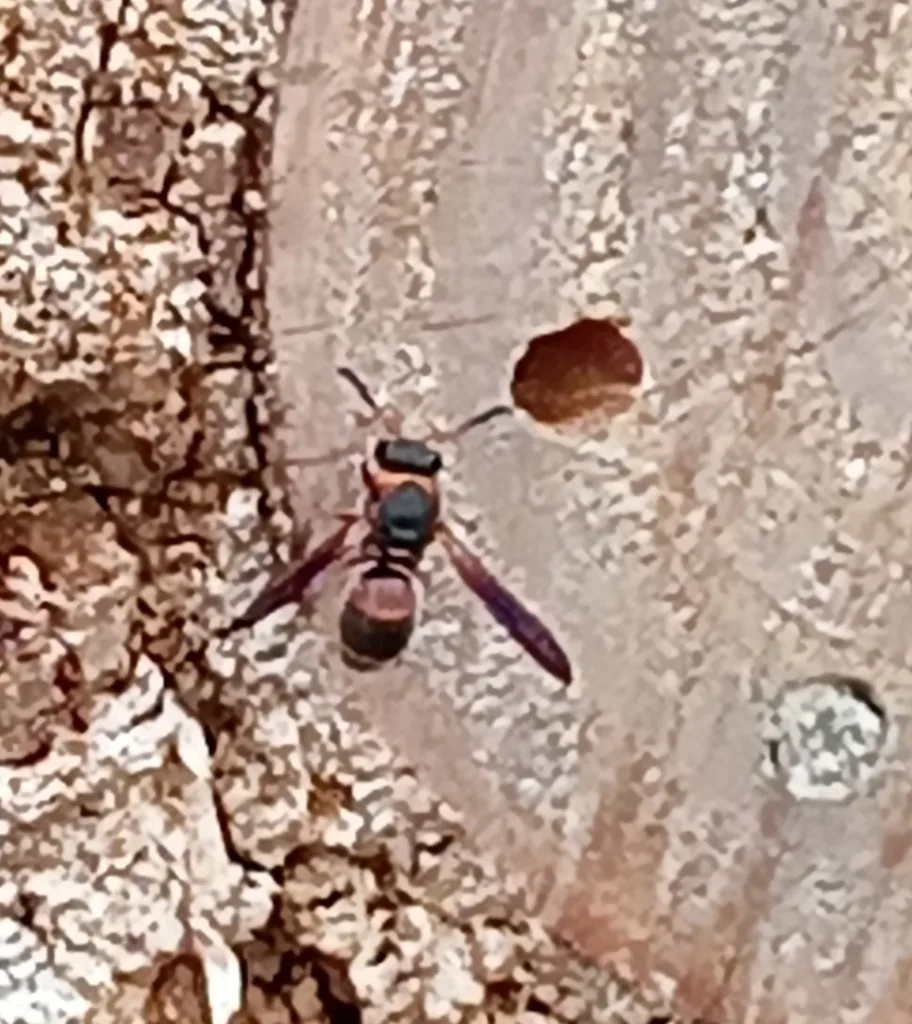
- It is banded in black and dull rusty red, which forms a red triangle seen from the side and a red horseshoe on the thorax just behind the head seen from above. UF/IFAS says the head is completely black behind the eyes, which separates it from similar red-and-black Florida wasps that have a red spot there.[4]
- Males have yellow markings on the head, most obviously a yellow clypeus, the shield-shaped plate on the face; females' faces are dull red and black. Males also have 10 antennal segments (flagellomeres) instead of the 11 typical of females.[4]
Look-alikes
| Look-alike | How to tell them apart |
|---|---|
| Mud dauber wasps | Mud daubers belong to different families, are usually larger and slenderer, and often build exposed mud nests, some shaped like organ pipes, which they stock with spiders.[1] |
| Potter wasps | Close relatives in the same subfamily. Many build small mud pots in crevices or cavities and stock them with caterpillars.[1][2] |
| Other red-and-black wasps | UF/IFAS says this color combination is common among Florida wasps, but the red and black mason wasp's head is entirely black behind the eyes, where other species have a red spot.[4] |
Where it lives
It is documented in north-central Florida, where it was the most common species nesting in reed trap nests at eight farm sites. UF/IFAS says it is most commonly reported from the southeastern United States, from the coasts of Florida to North Carolina and west to eastern Texas, with rare sightings farther north blamed on storms or human transport. Most of the 45 described Pachodynerus species live in the New World tropics.[3][4]
Biology and life cycle
Potter and mason wasps nest in ready-made holes such as nail holes, drill holes and the emergence holes of wood-boring beetles, building their brood chambers with mud or sand. UF/IFAS says this species reuses the old nests of other wasps, in Florida especially those of the potter wasp Zeta argillaceum, and nests around buildings in keyholes and wooden fence cavities; any fairly straight, narrow tube from half an inch to five inches long will do.[1][2][4]
Each chamber is stocked with paralyzed caterpillars, or sometimes other insect larvae, as food for the larva that hatches there. In a Florida study, this species' prey was caterpillars (Lepidoptera).[2][1][3]
At eight farm sites in north-central Florida, it was the most common species nesting in bamboo-reed trap nests, emerging from 24.6% of occupied reeds; each occupied reed produced 1 to 7 adults, 2.8 on average.[3]
Adults forage on many kinds of flowers for nectar and move pollen as they go. UF/IFAS lists saw palmetto and wildflowers among its nectar and pollen sources.[2][4]
The female plugs the deepest point of the cavity with aggregated sand and grit, lays one egg hung from the ceiling by a thin stalk, stocks the cell with seven to ten paralyzed caterpillars and seals it with another plug, repeating until the cavity is full. A nest holds one to eight provisioned cells, four on average, sometimes with empty cells between them, and ends with an empty vestibular cell and a thick, durable sand plug at the entrance.[4]
Female eggs go toward the inside of the nest and male eggs toward the entrance, so the males, which develop slightly faster, can leave first. The inner face of each plug is smooth and concave and the outer face rough and convex, which tells emerging adults which way to chew out.[4]
After feeding, larvae take about seven days (males) or seven to 10 days (females) to begin pupating in a delicate, semitransparent silk cocoon 10 to 17 mm long. Males spend about 18 to 28 days in the cocoon and females 19 to 33 days.[4]
It has multiple broods and is active year-round except for one to three of the coldest months, when it goes dormant. Females hunt live caterpillars by day; recorded prey include fall armyworm, corn earworm, cabbage looper, black cutworm, European corn borer, pickleworm and strawberry leafroller.[4]
Damage and signs
- No damage. Potter and mason wasps don't eat wood; they use old beetle holes, nail holes and other cavities and prey on plant-feeding caterpillars, some of them garden pests. On north-central Florida golf courses, UF/IFAS reports it was the most abundant species colonizing nest boxes in flowering habitats, where predation of fall armyworm on maintained turf rose by 50%, and plantings of five and nine native wildflower species increased its numbers and fall armyworm control.[1][4]
Health risk
Clemson notes that potter wasps, its close relatives, are solitary and rarely provoked enough to sting; it is the social yellowjackets and hornets that defend their nests with painful stings. People who are allergic to venom can still have a serious reaction to any sting.[5][2][6]
Control
Prevention
If they nest in outdoor wooden furniture and you don't want them there, clean the item and seal the holes with wood putty or polyurethane to remove the nest sites.[1]
Biological control
In most situations they are beneficial, preying on plant-feeding insects; where they nest in a natural setting, Clemson's advice is to leave them be and watch.[1]
To attract it, UF/IFAS suggests nest boxes of hollow reeds or wooden blocks drilled with holes 3/16 to 1/4 inch (4.8 to 6.4 mm) across and half an inch to five inches deep, near flowering plants. In a north-central Florida study, boxes set simply in turfgrass were colonized at higher rates than those in wildflower plantings.[4]
If you're stung
For a sting, wash the spot with soap and water, then put ice wrapped in a washcloth on it for 10 minutes and off for 10 minutes, repeating as needed. An antihistamine or an anti-itch cream can help, and over the next several days watch for signs of infection such as increasing redness, swelling or pain.[7]
Call 911 if a stung person has trouble breathing or wheezing, swelling of the face or mouth, throat tightness or trouble swallowing, feels weak or turns blue. People who are allergic to venom can have anaphylaxis, a life-threatening reaction that needs emergency care; if they carry an emergency allergy kit, use it.[7][6]
Where sources disagree
Nest plugs: Clemson describes potter and mason wasps building their brood chambers with mud or sand, while UF/IFAS says this species seals its cells and nest entrance with plugs of aggregated sand and grit.[1][4]
Common questions
- Are the small wasps going in and out of holes in my bench eating the wood?
- No. Potter and mason wasps don't eat wood; they nest in holes that are already there, such as old beetle holes, and hunt caterpillars.[1]
- Are these the wasps nesting in my bee hotel?
- They may be. Bamboo reeds like the ones homeowners put out for bees and wasps are where this species was most often found in the Florida study, and its young are fed caterpillars.[3][2]
- How can I tell the red and black mason wasp from other red-and-black wasps?
- Look behind the eyes. UF/IFAS says this wasp's head is completely black there, while similar Florida wasps have a red spot. From above, the red forms a horseshoe on the thorax just behind the head, and males have a yellow face plate.[4]
Sources
- Clemson Cooperative Extension Home & Garden Information Center, “Potter and Mason Wasps.” hgic.clemson.edu/potter-and-mason-wasps/ (accessed 2026-11-11)
- Washington State University HortSense, “Vespidae: Paper Wasps, Yellowjackets, Hornets and Potter Wasps.” hortsense.cahnrs.wsu.edu/fact-sheet/vespidae-paper-wasps-yellowjackets-hornets-and-potter-wasps/ (accessed 2026-11-11)
- Insects, via PubMed Central, “Trap Nesting Wasps and Bees in Agriculture: A Comparison of Sown Wildflower and Fallow Plots in Florida (Campbell et al. 2017).” pmc.ncbi.nlm.nih.gov/articles/PMC5746790/ (accessed 2026-11-11)
- University of Florida IFAS Extension (EDIS), “Red and Black Mason Wasp (suggested common name), Pachodynerus erynnis (Lepeletier), EENY-760/IN1293 (K. Laplante, W. Hobbs and A. Dale; Featured Creatures).” ask.ifas.ufl.edu/publication/IN1293 (accessed 2026-11-14)
- Clemson Cooperative Extension Home & Garden Information Center, “Garden Artist and Pest Controller: The Potter Wasp.” hgic.clemson.edu/?p=40613 (accessed 2026-11-11)
- CDC, National Institute for Occupational Safety and Health, “Insects and Scorpions at Work.” www.cdc.gov/niosh/outdoor-workers/about/insects-and-scorpions.html (accessed 2026-11-11)
- MedlinePlus, U.S. National Library of Medicine, “Insect bites and stings (Medical Encyclopedia).” medlineplus.gov/ency/article/000033.htm (accessed 2026-11-11)
- iNaturalist, “Pachodynerus erynnis taxon page (order and family).” www.inaturalist.org/taxa/338573 (accessed 2026-11-11)