On this page
How to identify it
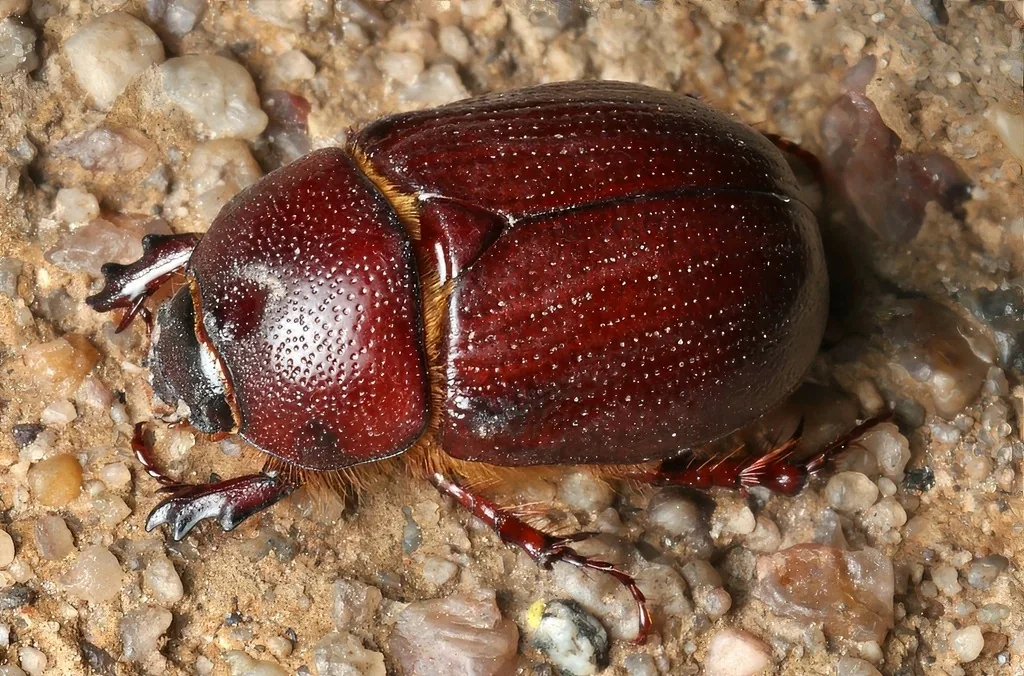
- Adults are reddish brown, rarely shiny black, and about 1/2 inch (11.5 to 16.5 mm) long; the High Plains handbook gives 1/2 to 2/3 inch and calls them dark reddish brown to black.[1][2][6]
- They look like a June bug or May beetle but darker.[5]
- Under magnification the section behind the head is pitted, with a small bump near its front edge and a shallow dent just behind the bump. The front legs have three teeth on the outer edge, and the wing covers have rows of furrows with punctures.[2][6]
- The grubs are white to bluish larvae up to 1-1/4 inches long with a dark head.[1]
- Name: the genus has been treated as both Tomarus and Ligyrus, so the beetle appears as Tomarus gibbosus and Ligyrus gibbosus (and older Texas guides use Bothynus gibbosus). A 2022 revision found Tomarus was not a natural group and split it, restoring Ligyrus as a separate genus.[2][7][5]
Where it lives
Native and widespread across the United States, and common throughout the Texas High and Rolling Plains. The genus ranges from Canada to Argentina and the West Indies.[2][5]
Biology and life cycle
The carrot beetle has a one-year life cycle. Adults spend the winter in the soil and come out in spring.[2]
Adults are active at night and fly to lights. Fun fact: in the Texas Rolling Plains, light traps catching 10,000 carrot beetles in a single night in May and August are not uncommon.[2][1][5]
The grubs feed on root systems, while adults burrow into the soil to chew on roots and stems slightly below the surface and also feed above ground.[2][1][5]
Damage and signs
- In gardens it attacks flowers such as dahlia, iris, lily and sunflower. Foliage yellows and wilts, and plants may be stunted, fall over or die. Stems or leaves at the base of the plant may be chewed.[1]
- Root pruning gives sunflowers a drought-stressed look and they may die; damage can happen at any stage of growth, and sunflowers in the Texas Rolling Plains have been severely damaged.[5]
- It is also a pest of crops including sugar beets, carrots, potatoes, corn, cotton and sunflowers.[2][6]
- Damage to golf course turf was first reported in 2016.[3][2]
Health risk
UC IPM, Texas A&M AgriLife and the Western Australia fact sheet describe it only as a plant pest and list no health risk to people.[1][5][2]
Control
Prevention
Keep adults away from plantings. They fly at night and are drawn to lights, so limit outdoor lights near the garden.[1][2]
Sanitation
Clear out decaying plant material around garden plants, because it shelters the adults.[1]
Pesticides
Sprays are not a good answer: Texas A&M AgriLife says no effective control method has been found for the carrot beetle in sunflowers, and the High Plains handbook says it mostly feeds on roots and there is no known insecticide control method.[5][6]
Common questions
- Why did my sunflowers suddenly wilt and fall over?
- Carrot beetles chewing on roots and stems just below the soil can make plants yellow, wilt, fall over or die; in sunflowers the root pruning looks like drought stress.[1][2][5]
- Does the carrot beetle only attack carrots?
- No. Despite the name, it feeds on many plants, including dahlias, irises, lilies, sunflowers, sugar beets, potatoes, corn and cotton.[1][2]
- Why do I see these beetles at my porch light?
- Adults are active at night and are attracted to lights; Texas light traps can catch thousands in one night.[2][1][5]
Sources
- UC Statewide IPM Program, “Carrot Beetle (Home and Landscape).” ipm.ucanr.edu/home-and-landscape/carrot-beetle (accessed 2026-11-12)
- Department of Primary Industries and Regional Development, Western Australia, “Tomarus gibbosus fact sheet, Scarab Pests to Australia Lucid key (Brumley, Scanlon and Szito, 2020).” keys.lucidcentral.org/keys/v3/exotic_scarab_pests/key/lucid_key_to_scarabs/Media/Html/entities/tomarus_gibbosus.htm (accessed 2026-11-12)
- University of Kentucky (Larson, Giese and Potter), “First report of carrot beetle (Tomarus gibbosus) damage to golf course turf (Crop, Forage and Turfgrass Management 2:188, 2016).” scholars.uky.edu/en/publications/first-report-of-carrot-beetle-tomarus-gibbosus-damage-to-golf-cou/ (accessed 2026-11-12)
- iNaturalist, “Ligyrus gibbosus taxon page (order and family).” www.inaturalist.org/taxa/1430438 (accessed 2026-11-12)
- Texas A&M AgriLife Research and Extension Center at San Angelo, “Sunflower Production Guide.” sanangelo.tamu.edu/agronomy/agronomy-publications/sunflower-production-guide/ (accessed 2026-11-12)
- Kansas State University, Colorado State University, University of Nebraska and University of Wyoming Cooperative Extension, “High Plains Sunflower Production Handbook (MF2384).” varietytesting.tamu.edu/wp-content/uploads/sites/17/legacy-files/sunflower/otherpublications/MF2384.pdf (accessed 2026-11-12)
- Zootaxa (2022), via PubMed, “Cladistic analysis reveals polyphyly of Tomarus (Coleoptera: Scarabaeidae: Dynastinae): new classification and taxonomic review.” pubmed.ncbi.nlm.nih.gov/37045362/ (accessed 2026-11-12). Cited from the PubMed abstract.