On this page
How to identify it
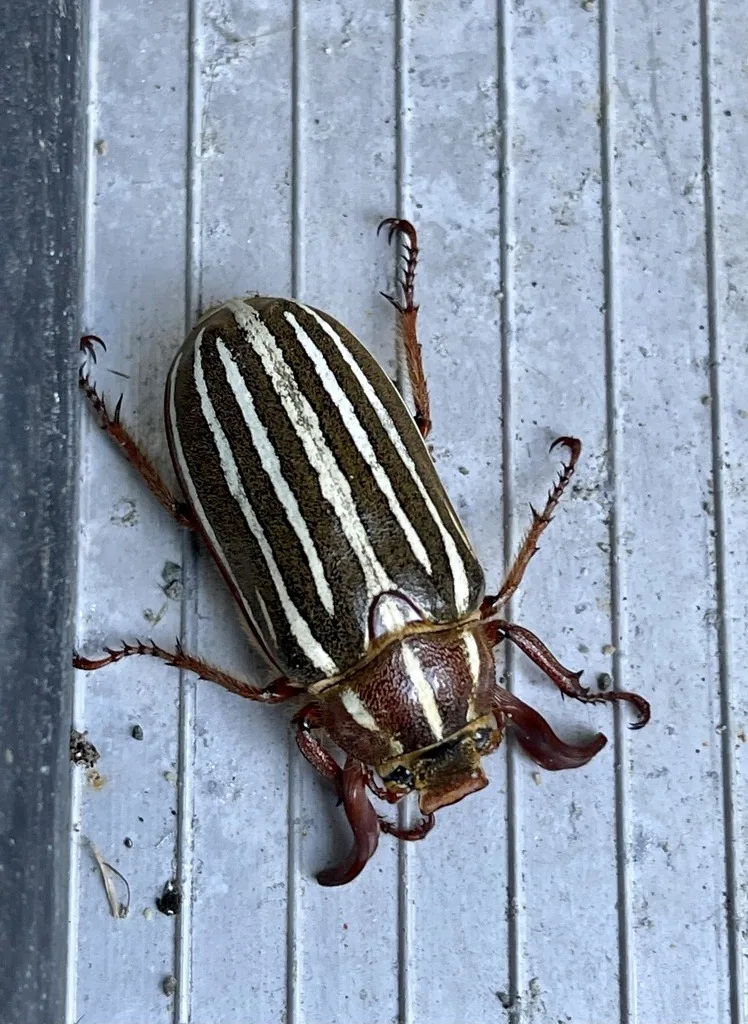
- Adults are 22 to 30 mm long; UC IPM puts them at about 1 inch. In Colorado, this beetle and its close Polyphylla relatives are the largest scarab beetles.[3][4]
- Adults are brown with lengthwise white lines on the back. The wing covers carry ten stripes, which give the beetle its name.[4][1]
- Males have large, fan-like antennae that can open and spread; females have much smaller antennae.[3][1]
- When disturbed, adults can hiss loudly by forcing air out of their spiracles (breathing pores), and males may fan out their antennae at the same time.[3]
- The larvae are cream-colored white grubs with a brown head, about 2 inches long when grown; Colorado State says a full-grown grub can have the circumference of a 50-cent piece.[4][3]
Look-alikes
| Look-alike | How to tell them apart |
|---|---|
| May and June beetles (Phyllophaga) | Ten-lined June beetle grubs tend to be more tightly curled and stiffer-bodied than Phyllophaga grubs, and the adults have bold white stripes.[3][4] |
| Other Polyphylla species | Colorado has two similar large June beetles: P. diffracta has lined wing covers but more diffuse, less consistent striping, and P. hammondi tends to be browner with fainter stripes. In California and Nevada, P. sobrina also occurs alongside the ten-lined June beetle.[3][1] |
Where it lives
Found in sandy soils west of the Rocky Mountains and near their eastern slopes, in the U.S. and Canada. In Colorado it is widely distributed, most common east of the Rockies including the San Luis Valley, and more common where soils are lighter and sandier; UC IPM also notes the grubs prefer sandy soils.[1][3][4]
Biology and life cycle
Colorado State says adults usually fly from late June through early August in Colorado. UC IPM says adults emerge from late June through September in California, and WSU says males come to lights from June through September. Males are strongly attracted to lights; females fly poorly and are rarely caught at lights.[3][4][1]
Males are seen flying in the evening in midsummer and hide in tree canopies and under debris during the day.[4]
Females release a sex pheromone that males track with their large antennae. WSU says females often mate and then lay about a dozen large (4 mm), oval, cream-colored eggs in the soil near where they emerged, while UC IPM says females of this species are reported to mate in trees and may then disperse.[1][4]
The grubs feed on roots, move deep into the soil in fall and return toward the surface in spring. The larger grubs are commonly more than 8 inches below the surface. There are three larval instars.[3][4][1]
Sources give different lengths for the life cycle. UC IPM says development from egg to adult takes 2 years in California orchards; WSU says two or three seasons in California and up to four years at some northern sites; Colorado State says adults emerge in the spring of the third season after the eggs were laid.[4][1][3]
Damage and signs
- In yards, grubs chew roots of grasses, perennials, trees and shrubs, but injury is usually slight. On rare occasions they badly damage the roots of woody plants, most often pines.[3]
- Adults feed on the leaves of trees and shrubs and notch leaf edges, but the feeding is rarely noticeable and is not important.[3][4]
- In California almond orchards, the grubs can severely injure and kill mature trees. Infestations are localized, are often first noticed when a clump of trees declines and dies, and spread slowly to neighboring trees.[4]
- In new hybrid poplar plantings, grubs strip bark from the buried part of cuttings down to the wood. WSU also lists grub feeding on almond, apple, cherry, prune, walnut and stone fruits in California and on cane fruits, vegetables, berries and row crops.[1]
Health risk
Colorado State says that despite their size and hissing display, the beetles are harmless.[3]
Control
Prevention
The beetles at your porch lights don't need treatment; Colorado State notes the species causes little plant injury in most settings.[3]
Traps and physical control
If groups of young plants look yellow, shriveled or stunted, dig and sift about a cubic foot of soil next to the stem to check for grubs and root or bark damage before acting.[1]
Biological control
Scoliid wasps, insect-killing nematodes and tachinid flies attack the grubs or adults, but UC IPM says these natural enemies don't greatly increase beetle deaths, and WSU found no evidence that they control the beetle in poplars.[4][1]
Pesticides
Grubs are hard to reach because the larger ones live more than 8 inches down, where insecticides don't move. In orchards, UC IPM says the only proven control is removing infested trees (plus one or two healthy trees around them) and fumigating the soil before replanting; WSU reports an imidacloprid soil drench can be effective in commercial poplar plantings. Use only products labeled for the site.[4][1]
Common questions
- Why does this beetle hiss?
- Hissing is a defense: the beetle forcefully pushes air out of its spiracles, the breathing pores along its body, often while males fan their antennae.[3]
- Is the ten-lined June beetle the same as a June bug?
- It is one kind of June beetle, and WSU lists June bug, watermelon beetle and hissing beetle as common names. It belongs to the genus Polyphylla, not to Phyllophaga, the genus of the common May and June beetles.[1][3]
- Are the big grubs in my sandy soil ten-lined June beetle grubs?
- They may be. Ten-lined June beetle grubs are cream-colored with a brown head, about 2 inches long when grown, and more tightly curled and stiffer than other large white grubs.[4][3]
Sources
- Washington State University Extension, “Tenlined June Beetle (FS272E, Insect Pest Management in Hybrid Poplars Series, June 2017).” wpcdn.web.wsu.edu/wp-ecommerce/uploads/sites/2/product-4217-sku-FS272E.pdf (accessed 2026-11-11)
- iNaturalist, “Polyphylla decemlineata taxon page (order and family).” www.inaturalist.org/taxa/1699434 (accessed 2026-11-11)
- Colorado State University, Department of Agricultural Biology, “Tenlined June Beetle (Colorado Insect of Interest; W. Cranshaw).” webdoc.agsci.colostate.edu/bspm/arthropodsofcolorado/Tenlined-June-Beetle1.pdf (accessed 2026-11-11)
- University of California Statewide IPM Program, “Tenlined June Beetle (UC IPM Pest Management Guidelines: Almond, UC ANR Publication 3431; text updated 08/17).” ipm.ucanr.edu/agriculture/almond/tenlined-june-beetle/ (accessed 2026-11-11)