On this page
How to identify it
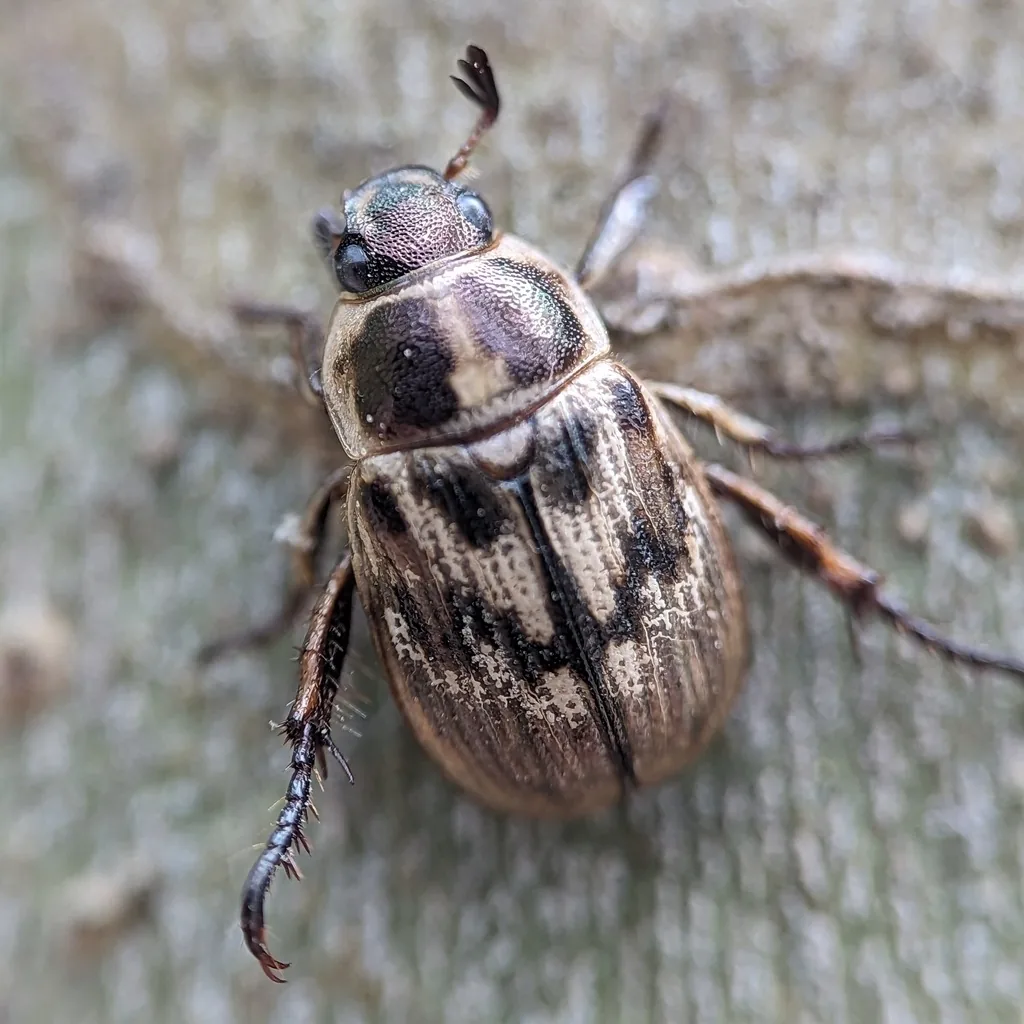
- Adults are stout, oval beetles, straw-colored to brownish black, usually with symmetrical triangular black marks on the thorax. Penn State describes them as tan with brown markings and smaller than a Japanese beetle; Tennessee State as mottled metallic brown and black.[10][1][2]
- Color and markings vary so much that the species can be hard to recognize, and EFSA notes that many occurrences may go unreported for that reason.[10]
- Grubs are dirty white, soft-bodied and C-shaped with a brown head and six legs. Full-grown oriental beetle grubs are about 1 to 1 1/4 inches long.[3][2][10]
- Under a hand lens, the raster (the pattern of hairs under the tip of the abdomen) shows two parallel rows of dark spines, 11 to 15 in each row, and the anal opening is a crosswise slit rather than V- or Y-shaped. Some related grubs have similar patterns.[2][10][1]
Look-alikes
| Look-alike | How to tell them apart |
|---|---|
| Japanese beetle | Japanese beetle adults are metallic green with copper-brown wing covers and a row of white hair tufts along each side; oriental beetle adults are tan to straw-colored with brown or black markings and are smaller.[7][1][10] |
| Other white grubs | All white grubs start out small and white and look alike. The raster pattern and the shape of the anal slit tell the species apart, and Penn State suggests examining ten to fifteen grubs, or more.[1][3] |
| Asiatic garden beetle | Asiatic garden beetle adults are velvety, cinnamon- to chestnut-brown and about 3/8 inch long, roughly the size and shape of a coffee bean, with lightly iridescent wing covers that don't quite cover the tip of the abdomen.[8][9] |
Where it lives
Probably native to Japan or the Philippines, it reached Hawaii in 1908 and arrived in the mainland United States from Japan, likely in nursery stock; it was first detected in Connecticut in 1920. Tennessee State says it now occurs through the Northeast, mid-Atlantic and Midwest, Penn State says it is slowly spreading south and west, and NC State and Clemson describe it as relatively new in western North Carolina and the Southeast. GBIF holds about 21,000 US records since 1990 from 22 states, counting the District of Columbia, most from New York, Massachusetts and Pennsylvania.[10][2][1][5][6][17]
Biology and life cycle
Adults emerge toward the end of June and are around for about 2 months. They are weak fliers, active mainly in the evening, and feed little, though some feed on flower petals in June.[10][2][1]
From early July to early September, females burrow into the soil and lay eggs singly, about 1 to 9 inches (2.5 to 23 cm) deep. EFSA gives up to 63 eggs per female, with a probable field average around 25.[10]
Grubs feed on roots through late summer and fall, move 20 to 42 cm (roughly 8 to 16 inches) down from mid-October to spend the winter, return to the surface toward the end of April, feed until early June and then pupate. There are three larval instars.[10]
Females also lay eggs in nursery container mixes, where grubs can badly damage the roots of potted trees and shrubs. The beetle mainly spreads in shipments of nursery stock.[2][10]
Damage and signs
- Grubs feed on grass roots within about 2.5 cm of the soil surface. Early signs are thinning, yellowing and wilting despite adequate moisture, then scattered dead patches that grow and merge; infested turf feels spongy and can be rolled back like a carpet.[10][3]
- Damage shows in late summer and fall and again in spring. Penn State notes that root damage done in September and October often isn't noticed until April or May.[1][3][10]
- Skunks, raccoons, armadillos, crows and moles digging for grubs can tear up turf and add significant damage.[3][6]
- EFSA describes it as the major white grub in ornamental nurseries and blueberries as well as a turf pest.[10]
Health risk
Oriental beetle grubs harm the roots of turf and ornamental plants and the adults feed very little; none of these sources reports a bite, sting or other harm to people.[2][10][1]
Control
Prevention
Keep turf vigorous. Among cool-season grasses, tall fescue generally tolerates grub damage better than Kentucky bluegrass, creeping bentgrass or perennial ryegrass.[10]
Traps and physical control
In August to early September, cut square-foot pieces of sod in several spots and count grubs. Tennessee State gives a turf threshold of 10 oriental beetle grubs per square foot; Penn State uses five to ten grubs per square foot for white grubs in general, depending on species.[2][3]
Male beetles can be lured to traps baited with the female sex pheromone, which is useful for detecting and monitoring adults rather than for control.[2][10]
Biological control
Milky disease products are effective only against Japanese beetle grubs, not oriental beetles. Of the nematodes sold for grubs, Heterorhabditis bacteriophora loses effectiveness as oriental beetle grubs grow, while Steinernema scarabaei worked about equally on second and third instars and was the most effective biological product in a Cornell laboratory comparison.[1][11][12]
Pesticides
Preventive products go on before grubs appear. UMass notes that neonicotinoid labels say to apply while females are laying eggs, and that imidacloprid applied before early June may not last long enough to control late-summer grubs.[4]
Curative treatments work best on small grubs feeding near the surface, in Pennsylvania from August through mid-September. Pyrethroids bind to organic matter as they move into soil and don't control grubs, so check that the label lists grubs.[3][1]
What research has tested
Wax pellets releasing the female sex pheromone, spread on turf to confuse males, cut trap catches by at least 90% for 36 days and reduced grub numbers by 69% in a Rutgers field trial.[13]
In commercial blueberries, mating disruption worked at 50 or more pheromone dispensers per hectare but failed at 25.[14]
In a Cornell laboratory comparison of 18 control products against four turf grub species, oriental beetle grubs were the most susceptible overall.[12]
Field applications of a Bt toxin from the strain Buibui (Bacillus thuringiensis serovar japonensis) controlled oriental beetle grubs in fall, but spring applications did not.[15]
Where sources disagree
Adult size: Tennessee State gives 0.3 to 0.4 inch; EFSA gives 13.5 mm (a little over 1/2 inch) long.[2][10]
Life cycle: EFSA says it usually takes one year in the northeastern U.S., though some grubs spend two winters in the soil; Tennessee State gives a one- or two-year cycle; a Korean golf course study found every beetle completed one generation a year.[10][2][16]
Tennessee: the EPPO distribution list in the EFSA report includes Tennessee, but a 2014 Tennessee State trapping survey of 16 nursery and sod farm sites did not find it in the state's nursery-growing areas.[10][2]
Imidacloprid timing: Tennessee State recommends granular imidacloprid in late summer or early fall to kill newly hatched grubs, while UMass says neonicotinoid labels call for application while females are laying eggs.[2][4]
Common questions
- Are the grubs in my lawn Japanese beetles?
- Not necessarily. In parts of the Northeast most lawn grubs are oriental beetles; checking the raster pattern with a hand lens tells them apart.[1][2]
- Will milky spore work on oriental beetle grubs?
- No. Penn State says milky disease is effective only on Japanese beetle grubs.[1]
- Do beneficial nematodes work on oriental beetle grubs?
- Results depend on the nematode. Heterorhabditis bacteriophora works less well on larger grubs, while Steinernema scarabaei performed well on second and third instars in research trials; nematodes need moist soil.[11][12][1]
Sources
- Penn State Extension, “Not All Grubs Are Alike (updated March 17, 2025).” extension.psu.edu/not-all-grubs-are-alike (accessed 2026-11-11)
- Tennessee State University Cooperative Extension, “Oriental Beetle (Disaster Education Resource Team, February 2016).” www.tnstate.edu/extension/documents/DERT_Oriental%20beetle%20with%20Figures.pdf (accessed 2026-11-11)
- Penn State Extension, “White Grubs in Home Lawns.” extension.psu.edu/white-grubs-in-home-lawns (accessed 2026-11-11)
- UMass Extension Turf Program, “Current Insecticide Approaches for White Grub Control.” www.umass.edu/agriculture-food-environment/turf/fact-sheets/current-insecticide-approaches-for-white-grub-control (accessed 2026-11-11)
- NC State Extension, “White Grubs in Turf.” content.ces.ncsu.edu/white-grubs-in-turf (accessed 2026-11-11)
- Clemson Cooperative Extension, Home & Garden Information Center, “White Grub Management in Turfgrass.” hgic.clemson.edu/factsheet/white-grub-management-in-turfgrass/ (accessed 2026-11-11)
- University of Kentucky Entomology, “Japanese Beetles in the Urban Landscape (EF451).” entomology.mgcafe.uky.edu/ef451 (accessed 2026-11-11)
- UNH Cooperative Extension, “Asiatic Garden Beetle [fact sheet].” extension.unh.edu/resource/asiatic-garden-beetle-fact-sheet (accessed 2026-11-11)
- UMass Extension Landscape, Nursery and Urban Forestry Program, “Asiatic Garden Beetle.” www.umass.edu/agriculture-food-environment/landscape/fact-sheets/asiatic-garden-beetle (accessed 2026-11-11)
- European Food Safety Authority, EFSA Journal (full text via PubMed Central), “Pest categorisation of Exomala orientalis (EFSA Panel on Plant Health, 2020).” pmc.ncbi.nlm.nih.gov/articles/PMC7448047/ (accessed 2026-11-11). EU risk-assessment report; its US state list comes from the EPPO Global Database.
- Journal of Economic Entomology, via PubMed, “Effect of white grub developmental stage on susceptibility to entomopathogenic nematodes (Koppenhofer and Fuzy 2004).” pubmed.ncbi.nlm.nih.gov/15666735/ (accessed 2026-11-11). Cited from the PubMed abstract.
- Pest Management Science, via PubMed, “Variation in the laboratory susceptibility of turf-infesting white grubs to biological, biorational and chemical control products (Morales-Rodriguez et al. 2010).” pubmed.ncbi.nlm.nih.gov/19742452/ (accessed 2026-11-11). Cited from the PubMed abstract.
- Environmental Entomology, via PubMed, “Pellet formulations of sex pheromone components for mating disruption of oriental beetle in turfgrass (Koppenhofer et al. 2008).” pubmed.ncbi.nlm.nih.gov/19036191/ (accessed 2026-11-11). Cited from the PubMed abstract.
- Journal of Economic Entomology, via PubMed, “Optimization of pheromone deployment for effective mating disruption of oriental beetle in commercial blueberries (Rodriguez-Saona et al. 2009).” pubmed.ncbi.nlm.nih.gov/19449647/ (accessed 2026-11-11). Cited from the PubMed abstract.
- Journal of Economic Entomology, via PubMed, “Susceptibility of four species of turfgrass-infesting scarabs to Bacillus thuringiensis serovar japonensis strain Buibui (Bixby et al. 2007).” pubmed.ncbi.nlm.nih.gov/17972638/ (accessed 2026-11-11). Cited from the PubMed abstract.
- Journal of Economic Entomology, via PubMed, “Life history and spatial distribution of oriental beetle in golf courses in Korea (Choo et al. 2002).” pubmed.ncbi.nlm.nih.gov/11942767/ (accessed 2026-11-11). Cited from the PubMed abstract.
- Global Biodiversity Information Facility (GBIF), “Anomala orientalis: US occurrence records since 1990 by state (GBIF occurrence search API).” api.gbif.org/v1/occurrence/search?taxonKey=5875148&country=US&hasGeospatialIssue=false&occurrenceStatus=PRESENT&year=1990%2C2026&facet=stateProvince&facetLimit=400&limit=0 (accessed 2026-11-11). State counts are records reported (iNaturalist research-grade, museum specimens, surveys), not abundance.
- iNaturalist, “Exomala orientalis taxon page (order and family).” www.inaturalist.org/taxa/359401 (accessed 2026-11-11)