On this page
How to identify it
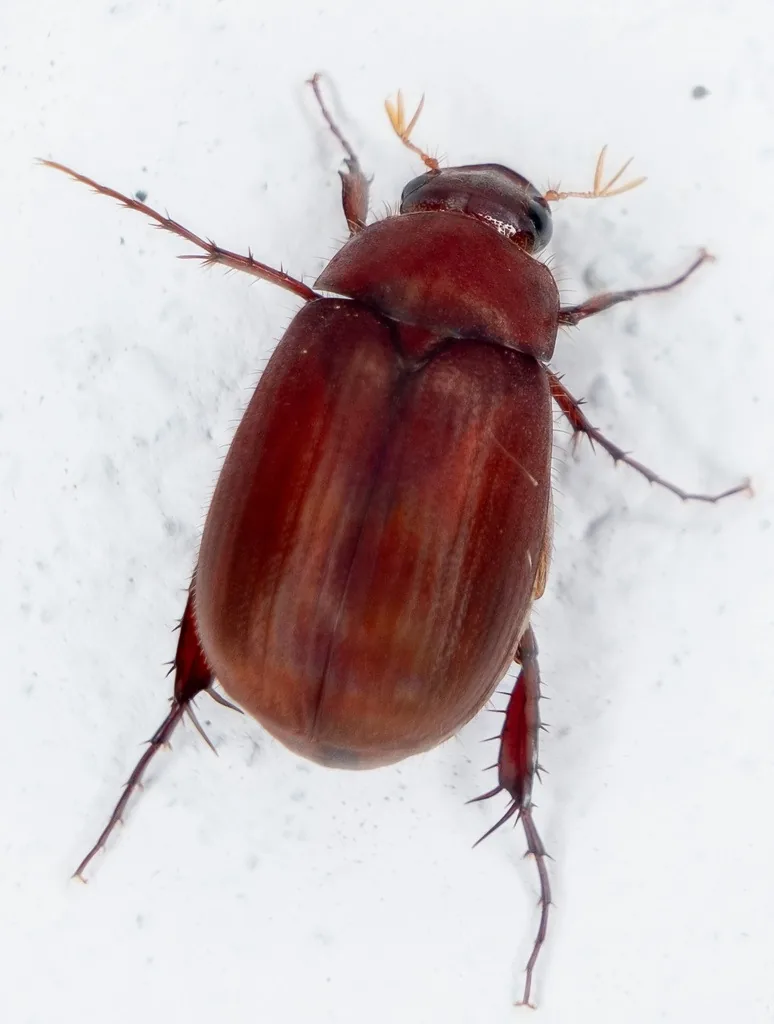
- Adults are about 3/8 inch long, velvety and cinnamon-brown, roughly the size and shape of a coffee bean.[2][1]
- The chestnut-brown wing covers are lightly iridescent, and the tip of the abdomen sticks out slightly past them.[1]
- Grubs are C-shaped and white with a brown head and six legs, with a single row of curved spines across the underside of the last segment; telling them from other white grubs requires close inspection.[2][1]
Look-alikes
| Look-alike | How to tell them apart |
|---|---|
| Japanese beetle | Similar in shape but slightly larger; Japanese beetles skeletonize leaves, while Asiatic garden beetles leave ragged damage starting at leaf edges.[1] |
| May and June beetles | May and June beetles are much bigger brown scarabs; the Asiatic garden beetle is only about 3/8 inch long, about the size and shape of a coffee bean, and velvety cinnamon-brown.[2][1] |
Where it lives
Native to Japan and China, it was found in New Jersey around 1921-1922 and is now established in the Northeast, including Massachusetts and New Hampshire; it has also been introduced in parts of Florida.[1][2]
Biology and life cycle
There is one generation a year in the Northeast; grubs overwinter 8 to 17 inches deep, deeper than most similar grubs.[1]
Grubs pupate in May and June, and adults emerge at night from late June into July; they are most abundant in July and August and some remain active into October.[1][2]
Adults hide in the soil or ground litter by day and feed at night, flying between plants when it's above about 70 degrees F and crawling when it's cooler.[1]
Females lay clusters of eggs 1 to 2 inches deep in the soil, up to about 60 eggs over several weeks; eggs hatch in about 10 days to two weeks.[1][2]
Damage and signs
- Adults feed on more than 100 kinds of plants, including vegetables, herbs, fruit, trees, shrubs and flowers such as asters, dahlias, mums and roses.[1][2]
- Heavy feeding can strip leaves down to the midribs, especially on favored hosts like butterfly bush, rose, dahlia, aster and chrysanthemum.[1]
- Grubs feed on roots of weeds, grasses, ornamentals and garden plants; they are usually minor lawn pests but can cause noticeable damage when numerous.[1][2]
- In Connecticut greenhouse tests, Asiatic garden beetle grubs cut strawberry root weight by 20% over 12 weeks, though their chewing did not make black root rot worse.[3]
- Because adults are attracted to light, they may become numerous at doors, windows and other brightly lit spots at night.[1][2]
Health risk
Asiatic garden beetles are plant feeders that do not bite, sting or carry disease; the beetles at lighted windows and doors are a nuisance rather than a health threat.[1][2]
Control
Keep them out
Spun-bonded fabric row covers can protect garden beds, unless grubs already overwintered in the soil beneath them.[2][1]
Sanitation
Clean up the garden in fall by removing, tilling under or composting weeds, tall grasses and plant debris.[2][1]
Traps and physical control
Handpick beetles at night with a flashlight; they drop when disturbed, so hold a bowl of soapy water under the foliage before touching the plant.[2][1]
A homemade light trap, an outdoor-safe bulb hung about 6 inches above a pan of soapy water on the ground, catches adults; place it away from favored plants.[1][2]
Biological control
For grubs in lawns, insect-killing nematodes are an option. In Rutgers lab tests, Steinernema scarabaei killed third-instar Asiatic garden beetle grubs more readily than second instars, while results for other grubs and nematode species varied, so match the nematode to the grub. A Bacillus thuringiensis strain (serovar japonensis Buibui) tested in turf worked best on oriental beetle grubs and least well on Asiatic garden beetle grubs.[4][5]
Pesticides
Chemical control is rarely needed for the grubs in lawns. UMass says the adults are not known to be resistant and lists active ingredients labeled for adults on ornamentals, including bifenthrin, clothianidin, cyantraniliprole, cyfluthrin, dinotefuran, imidacloprid and lambda-cyhalothrin. Do not put systemic insecticides such as neonicotinoids on plants in bloom; in Massachusetts only licensed applicators may apply neonicotinoids to trees and shrubs.[2][1]
Common questions
- What are the small brown beetles on my screen door at night?
- In the Northeast, they may be Asiatic garden beetles, which are strongly attracted to light and can gather in large numbers on windows and screen doors in summer.[2][1]
- Why can't I find what's eating my plants during the day?
- Asiatic garden beetles feed at night and hide in the soil by day; check plants after dark with a flashlight.[1][2]
- Will grub killer for Japanese beetles also kill Asiatic garden beetle grubs?
- Not always as well. Asiatic garden beetle grubs overwinter deeper, 8 to 17 inches down, and in a turf trial a Bt grub product worked better on oriental and Japanese beetle grubs than on this species. Chemical control of its grubs in lawns is rarely needed.[1][5][2]
Sources
- University of Massachusetts Amherst Extension, “Asiatic Garden Beetle (Landscape, Nursery and Urban Forestry fact sheet, updated January 5, 2023).” www.umass.edu/agriculture-food-environment/landscape/fact-sheets/asiatic-garden-beetle (accessed 2026-11-12)
- University of New Hampshire Cooperative Extension, “Asiatic Garden Beetle [fact sheet].” extension.unh.edu/resource/asiatic-garden-beetle-fact-sheet (accessed 2026-11-12)
- Journal of Nematology, 2005 (LaMondia & Cowles, Connecticut Agricultural Experiment Station), via PubMed, “Comparison of Pratylenchus penetrans infection and Maladera castanea feeding on strawberry root rot.” pubmed.ncbi.nlm.nih.gov/19262852/ (accessed 2026-11-12)
- Journal of Economic Entomology, 2004 (Koppenhöfer & Fuzy, Rutgers), via PubMed, “Effect of white grub developmental stage on susceptibility to entomopathogenic nematodes.” pubmed.ncbi.nlm.nih.gov/15666735/ (accessed 2026-11-12)
- Journal of Economic Entomology, 2007 (Bixby et al., Rhode Island), via PubMed, “Susceptibility of four species of turfgrass-infesting scarabs to Bacillus thuringiensis serovar japonensis strain Buibui.” pubmed.ncbi.nlm.nih.gov/17972638/ (accessed 2026-11-12)
- iNaturalist, “Maladera formosae taxon page (order and family).” www.inaturalist.org/taxa/1260497 (accessed 2026-10-06)