On this page
How to identify it
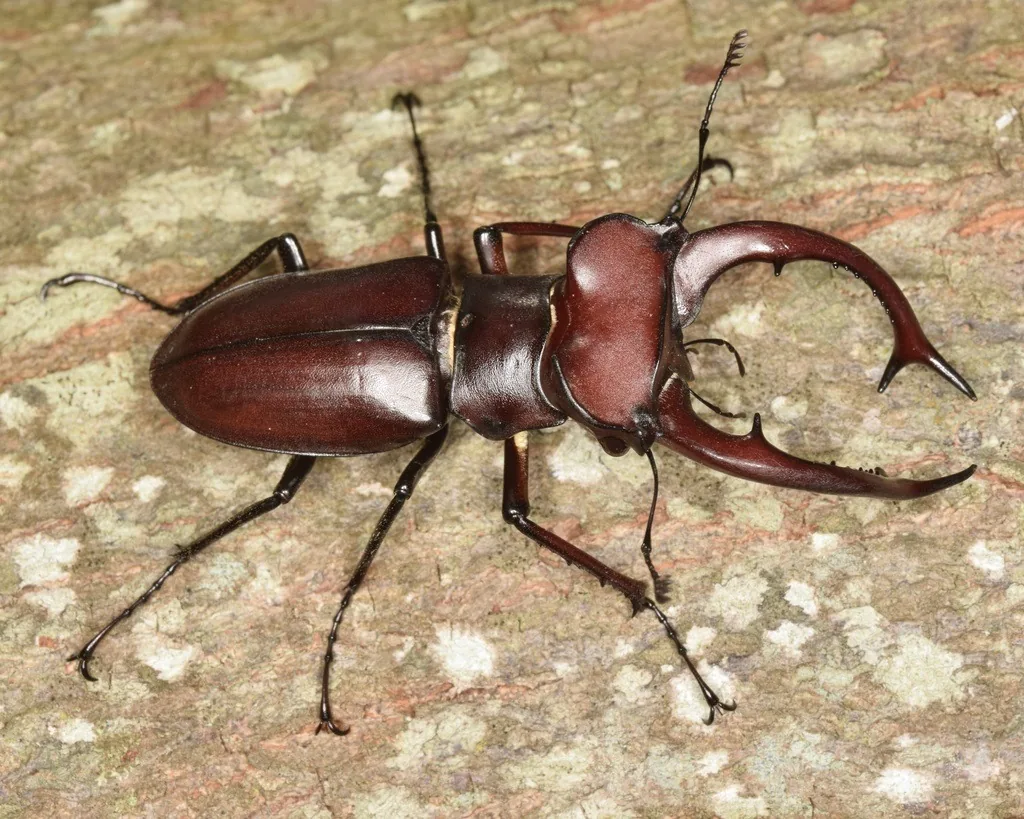
- Most are black, brownish or reddish brown, strong and elongated. Missouri gives adults as anywhere from under 1/2 inch to nearly 2 1/2 inches long, depending on species; the southwestern stag beetle of Colorado is 25 to 35 mm.[4][2]
- Males have far larger jaws than females, which makes the sexes easy to tell apart, but the females' pincers are still well developed. In the giant stag beetle (Lucanus elaphus), males reach 1 1/2 inches without the jaws and nearly 2 1/2 inches with them, and the jaws may be as long as the rest of the body.[2][4]
- The antennae end in a club whose segments fan open like leaves but cannot close tightly into a ball, and on many species they are elbowed.[4]
- The reddish-brown stag beetle (Lucanus capreolus) is about an inch long and reddish brown. Female giant stag beetles look similar but have darker legs and a smooth shield behind the head.[4]
- Larvae are pale, C-shaped grubs with a head that is often brownish or black and three pairs of legs, found in rotting wood. They look a lot like scarab beetle grubs.[2][4]
Look-alikes
| Look-alike | How to tell them apart |
|---|---|
| Scarab beetle grubs | Stag beetle grubs look much like scarab grubs, but stag beetle grubs live in rotting logs and stumps, while the grubs of most scarabs, such as May beetles, live underground and feed on roots.[4][5] |
Where it lives
Missouri counts about 40 stag beetle species in North America north of Mexico and finds them statewide. Clemson reports seven in South Carolina, with the giant stag beetle the largest; Colorado State says the giant stag beetle ranges west to Oklahoma and Nebraska but not into Colorado, where the southwestern stag beetle lives in forests of the western and southwestern part of the state. GBIF's public U.S. records since 1990 for the genus Lucanus (about 20,000) come from 37 states on the map, most from Ohio, Illinois and Massachusetts.[4][1][2][9]
Biology and life cycle
Most of the 3- to 5-year life cycle is spent as a grub in rotting wood, feeding on liquids produced as the wood decays. The giant stag beetle's larvae develop in oak stumps, and smaller Platycerus stag beetles in Colorado likely develop in rotting softwood stumps.[1][2]
Giant stag beetle larvae are common in fallen logs and other dead wood in eastern forests. In one study, the inside of dry logs sometimes heated past the temperature the larvae could tolerate, while deeper wood stayed cooler.[6]
When fully grown, the larvae pupate surrounded by wood chips. Stag beetle grubs have also turned up in deep layers of hardwood mulch on trails and playgrounds.[4]
Stag beetle grubs can make sounds. They have paired sound organs on their legs, and in a study of three species the larvae scraped a ridge on one leg against a file on another when disturbed.[7]
Adults live only a few months, mainly May to August in South Carolina and mid-July to mid-August for the southwestern species. They fly, mostly at night, and come to lights.[1][2][4]
Adults feed on tree sap where bark has been injured, and may also eat rotting fruit or aphid honeydew. Males fight for places where females feed or lay eggs.[4]
Big jaws come at a cost. In one species whose jaws are as long as its body, males spent about 40% more energy running and needed 26% more work to fly while carrying their jaws.[8]
Raccoons and woodpeckers dig the grubs out of rotting logs; birds, bats, skunks and frogs eat the adults; and some flies and wasps parasitize the larvae.[4]
Damage and signs
Health risk
Clemson calls them harmless: the males' jaws are for fighting other males, not biting people. Missouri adds that a stag beetle may pinch if handled, as almost any animal with jaws will in defense, but it doesn't bite people aggressively.[1][4]
Control
Prevention
No control is needed. Leave them be, or move a beetle outdoors.[1]
Adults are attracted to lights at night. Clemson says they will not hurt you, your pets or your home.[1][4]
Common questions
- Do stag beetles pinch?
- They can if you pick one up. Clemson says they are harmless and the males' jaws are for fighting rivals; Missouri says one may pinch in defense when handled but doesn't bite people aggressively.[1][4]
- Can stag beetles fly?
- Yes. Despite their bulk, adults fly, mostly at night, and come to lights.[1][2][4]
- Where do stag beetle grubs live?
- In rotting wood such as stumps and fallen logs, for 3 to 5 years, and sometimes in deep piles of hardwood mulch.[1][4]
- What do adult stag beetles eat?
- Tree sap from injured bark, and sometimes rotting fruit or aphid honeydew.[4]
Sources
- Clemson Cooperative Extension Home & Garden Information Center, “Stag Beetles.” hgic.clemson.edu/stag-beetles/ (accessed 2026-11-11)
- Colorado State University Extension (Colorado Insects of Interest, W. Cranshaw), “Southwestern Stag Beetle (Colorado Insect of Interest).” wci.extension.colostate.edu/wp-content/uploads/sites/14/2017/03/SouthwesternStagBeetle.pdf (accessed 2026-11-11)
- iNaturalist, “Lucanus taxon page (order and family).” www.inaturalist.org/taxa/60813 (accessed 2026-11-11)
- Missouri Department of Conservation, “Stag Beetles (Lucanids) (Field Guide).” mdc.mo.gov/discover-nature/field-guide/stag-beetles (accessed 2026-11-11)
- Missouri Department of Conservation, “May Beetles (June Bugs) (Field Guide).” mdc.mo.gov/discover-nature/field-guide/may-beetles-june-bugs (accessed 2026-11-11)
- Environmental Entomology, via PubMed, “Variation in larval thermal tolerance of three saproxylic beetle species (Lawhorn and Yanoviak 2022).” pubmed.ncbi.nlm.nih.gov/36346643/ (accessed 2026-11-11). Cited from the PubMed abstract.
- Arthropod Structure & Development, via PubMed, “Species-specific larval acoustic behaviour of three stag beetles (Coleoptera: Lucanidae) (Dong and Jiang 2024).” pubmed.ncbi.nlm.nih.gov/37716838/ (accessed 2026-11-11). Cited from the PubMed abstract.
- Journal of the Royal Society Interface, via PubMed, “Cost of flight and the evolution of stag beetle weaponry (Goyens et al. 2015).” pubmed.ncbi.nlm.nih.gov/25878126/ (accessed 2026-11-11). Cited from the PubMed abstract.
- Global Biodiversity Information Facility (GBIF), “Lucanus: occurrence records in the U.S., 1990-2026 (GBIF occurrence search).” api.gbif.org/v1/occurrence/search?taxonKey=3263258&country=US&hasGeospatialIssue=false&occurrenceStatus=PRESENT&year=1990%2C2026&facet=stateProvince&facetLimit=400&limit=0 (accessed 2026-11-11). State counts are records reported (iNaturalist research-grade, museum specimens, surveys), not abundance.