On this page
How to identify it
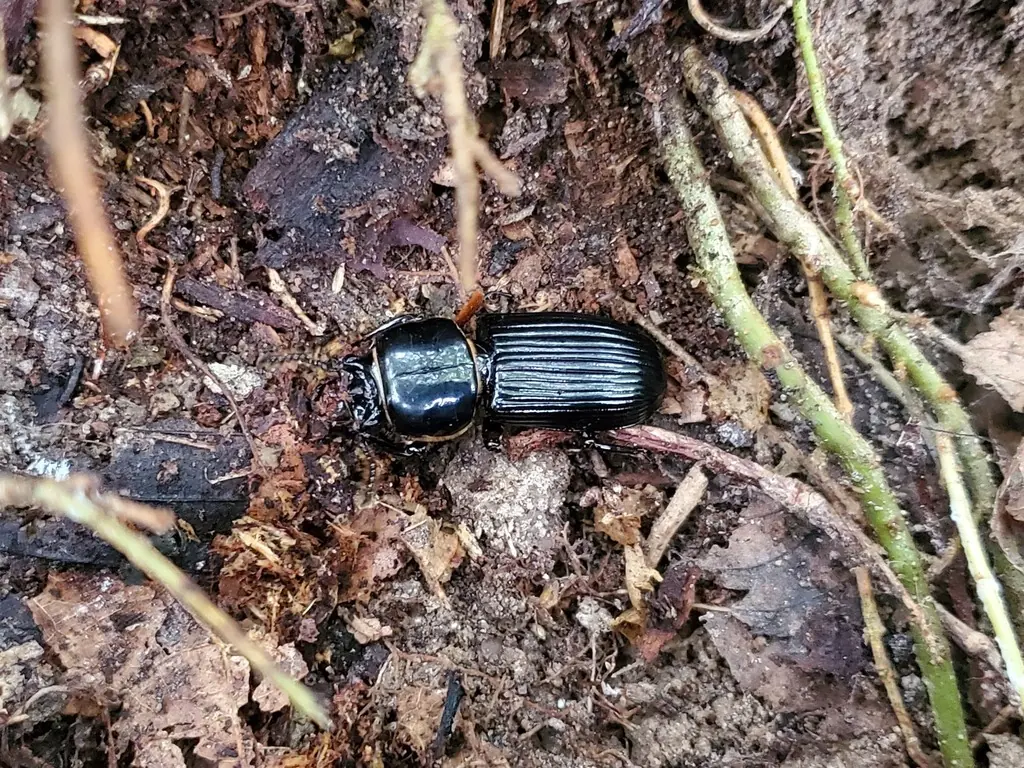
- Adults are glossy black (Clemson says dark brown to black), up to about 1 1/2 inches long, with deep grooves along the wing covers and a small horn on top of the head that curves forward.[1][2][3]
- There is one lengthwise groove on the shield behind the head. The antennae are small, comb-like and not elbowed.[3][2]
- Grubs are slender and whitish with a light brown head, living in tunnels with the adults. The hind legs are tiny and used for making sounds, so the grubs seem to have only two pairs of legs.[1][2][3]
Where it lives
A common beetle of eastern deciduous forests; in Missouri, where it is the only bess beetle species, it is found statewide. GBIF holds about 21,600 U.S. records since 1990, most from Virginia, Maryland, Texas, North Carolina and Florida. Genetic studies have found distinct lineages across the eastern United States, including two that often share the same log in the southern Appalachians.[3][4][5][6][7]
Biology and life cycle
A male and female pair up in early spring, tunnel into a decaying log and raise their young together; females lay 30 to 70 eggs, and each pair may raise 20 to 35 new beetles.[2][1]
Adults and grubs eat rotting wood and their own feces, which is enriched by microbes. NC State says the grubs probably can't chew wood on their own and depend on their parents for food; MDC says adults chew wood to soften it and give it to the larvae. Grubs reach adulthood in about three months.[1][2][3]
The beetle's gut has four main compartments with different microbes, which break the wood down in stages; the adults excrete a nutrient-rich product on which their offspring live and grow.[8]
Grubs pupate in a cell; NC State says the grub builds it from its own droppings, while Clemson says the adults cover the grub with wood shavings. Clemson says new adults come out after 2 to 4 weeks, still soft.[1][2]
New adults stay in the log until the following spring. A study found young adults stay with their family for several months, do not breed in the log they grew up in, and leave before breeding age.[1][2][9]
Adults and grubs communicate with audible squeaks. Adults rub a rough spot on the abdomen against the wing covers; grubs rub their modified hind legs against the body.[1][2][3]
Adults can fly but rarely do; they may fly to disperse, to mate or toward a light. On foot, they move faster and straighter in forest than in lawns or pastures, and at a forest-pasture edge they were 14 times more likely to head back into the forest.[3][1][4]
New arrivals are more likely to settle in large logs and in logs that already hold a pair of beetles.[10]
Damage and signs
- They break down decaying wood and logs only and are not a pest of urban structures. NC State says any eastern hardwood left touching the soil is likely to be colonized once it starts to rot, with oak and elm preferred.[1][2]
- They are valuable recyclers of dead wood. From lab feeding rates, researchers estimated that 10 adults break down about 2.4 kg of wood in a year; beetles carrying a nematode that seems to do them little harm processed wood 15 percent faster.[2][3][11]
Health risk
NC State calls betsy beetles harmless to humans, and Missouri's conservation department says that although a horned passalus can deliver a genuine pinch, it cannot harm you. NC State, Clemson and MDC don't mention any risk to pets.[1][3][2]
Control
Prevention
NC State says betsy beetles only decompose decaying wood or logs and are not a pest of urban structures, and Clemson calls bess beetles beneficial because they recycle dead wood, returning nutrients to the soil.[1][2]
To keep them out of firewood, stack it off the ground and cover it so it stays dry and does not rot.[1]
Where the name comes from
MDC says 'bess' probably came from a misreading of the French word baiser, to kiss, perhaps for the squeaking sounds or the pinch, and that led to betsy beetle and betsey bug.[3]
NC State lists other folk names, including bessbug, patent leather beetle, Jerusalem beetle, horn beetle and peg beetle.[1]
Life in the log
Family living is unusual among beetles. Both parents tend the young, and the whole family stays in its winding tunnels until the new adults leave in spring.[3][2][1]
Raccoons and woodpeckers dig grubs out of rotting logs, and birds, bats, skunks and frogs eat adults that leave the log.[3]
Where the sources disagree
Size: NC State says adults reach up to 1 1/2 inches; MDC gives about 1 1/4 to 1 1/2 inches.[1][3]
Color: NC State and MDC describe glossy or shiny black adults; Clemson says bess beetles range from dark brown to black.[1][3][2]
Grub legs: Clemson says larvae have six legs; MDC says they seem to have two pairs because the hind pair is shorter and used to make sounds, and NC State says the third pair is modified to squeak.[2][3][1]
Pupal cell: NC State says the grub builds it from fecal material; Clemson says the adults cover the larva with wood shavings to form the chamber.[1][2]
Feeding the young: NC State says the grubs probably cannot chew wood on their own and live on their parents' microbe-rich feces; MDC says adults chew wood to soften it and give it to the larvae.[1][3]
Lifespan: NC State says up to a year; MDC says apparently more than a year; Clemson says they can live in their log tunnels for several years.[1][3][2]
Common questions
- What is the big shiny black beetle in my firewood?
- Often a horned passalus (betsy beetle), which lives in decaying hardwood logs and moves into firewood that sits on the ground and starts to rot.[1][2]
- Do betsy beetles damage houses?
- NC State says no: betsy beetles only decompose decaying wood or logs and are not a pest of urban structures.[1]
- Why does the beetle squeak?
- Adults rub a rough spot on the abdomen against the wing covers; families communicate with these squeaks, and adults squeak when picked up.[1][2][3]
- Can it bite?
- It can give a real pinch if handled, but MDC says it cannot harm you.[3]
- Can I keep one?
- NC State says they are favorites with children and fairly easy to keep as long as they have moist, rotting wood.[1]
Sources
- NC State Extension, “Betsy Beetle or Horned Passalus (PDIC Factsheet).” content.ces.ncsu.edu/horned-passalus-or-betsy-beetles (accessed 2026-11-13)
- Clemson Cooperative Extension, Home & Garden Information Center, “Bess Beetles (HGIC factsheet).” hgic.clemson.edu/factsheet/bess-beetles/ (accessed 2026-11-13)
- Missouri Department of Conservation, “Horned Passalus (Field Guide).” mdc.mo.gov/discover-nature/field-guide/horned-passalus (accessed 2026-11-13)
- Environmental Entomology, via PubMed, “Habitat-specific movement and edge-mediated behavior of the saproxylic insect Odontotaenius disjunctus (Jackson et al. 2009).” pubmed.ncbi.nlm.nih.gov/19825296/ (accessed 2026-11-13)
- Global Biodiversity Information Facility (GBIF), “Odontotaenius disjunctus: U.S. occurrence records since 1990 by state (GBIF occurrence search).” api.gbif.org/v1/occurrence/search?taxonKey=6992074&country=US&hasGeospatialIssue=false&occurrenceStatus=PRESENT&year=1990%2C2026&facet=stateProvince&facetLimit=400&limit=0 (accessed 2026-11-13)
- Mitochondrial DNA Part A, via PubMed, “Phylogeography and demographic expansion in the widely distributed horned passalus beetle, Odontotaenius disjunctus (Whitaker et al. 2021).” pubmed.ncbi.nlm.nih.gov/33591237/ (accessed 2026-11-13)
- Insects, via PubMed, “Two divergent genetic lineages within the horned passalus beetle, Odontotaenius disjunctus (Garrick et al. 2019).” pubmed.ncbi.nlm.nih.gov/31167431/ (accessed 2026-11-13)
- Nature Microbiology, via PubMed, “Gut anatomical properties and microbial functional assembly promote lignocellulose deconstruction and colony subsistence of a wood-feeding beetle (Ceja-Navarro et al. 2019).” pubmed.ncbi.nlm.nih.gov/30858574/ (accessed 2026-11-13)
- Journal of Evolutionary Biology, via PubMed, “Delayed dispersal and prolonged brood care in a family-living beetle (Dillard 2017).” pubmed.ncbi.nlm.nih.gov/28981168/ (accessed 2026-11-13)
- Oecologia, via PubMed, “Mechanisms driving the density-area relationship in a saproxylic beetle (Jackson et al. 2013).” pubmed.ncbi.nlm.nih.gov/23812109/ (accessed 2026-11-13)
- Biology Letters, via PubMed, “The sicker the better: nematode-infected passalus beetles provide enhanced ecosystem services (Davis and Prouty 2019).” pubmed.ncbi.nlm.nih.gov/31039727/ (accessed 2026-11-13)
- Global Biodiversity Information Facility (GBIF), “Odontotaenius disjunctus (Illiger, 1800) (GBIF Backbone Taxonomy).” api.gbif.org/v1/species/6992074 (accessed 2026-11-13)
- iNaturalist, “Odontotaenius disjunctus taxon page (order and family).” www.inaturalist.org/taxa/122214 (accessed 2026-10-06)