On this page
How to identify it
- Wingspan is about 1 3/4 to 2 3/4 inches according to MDC, or 2 1/4 to 3 1/8 inches (5.7 to 8 cm) according to BAMONA.[1][2]
- Males are plain lemon yellow above. Females are yellow or white, with thin, irregular black wing borders and a dark spot on the forewing.[2][1]
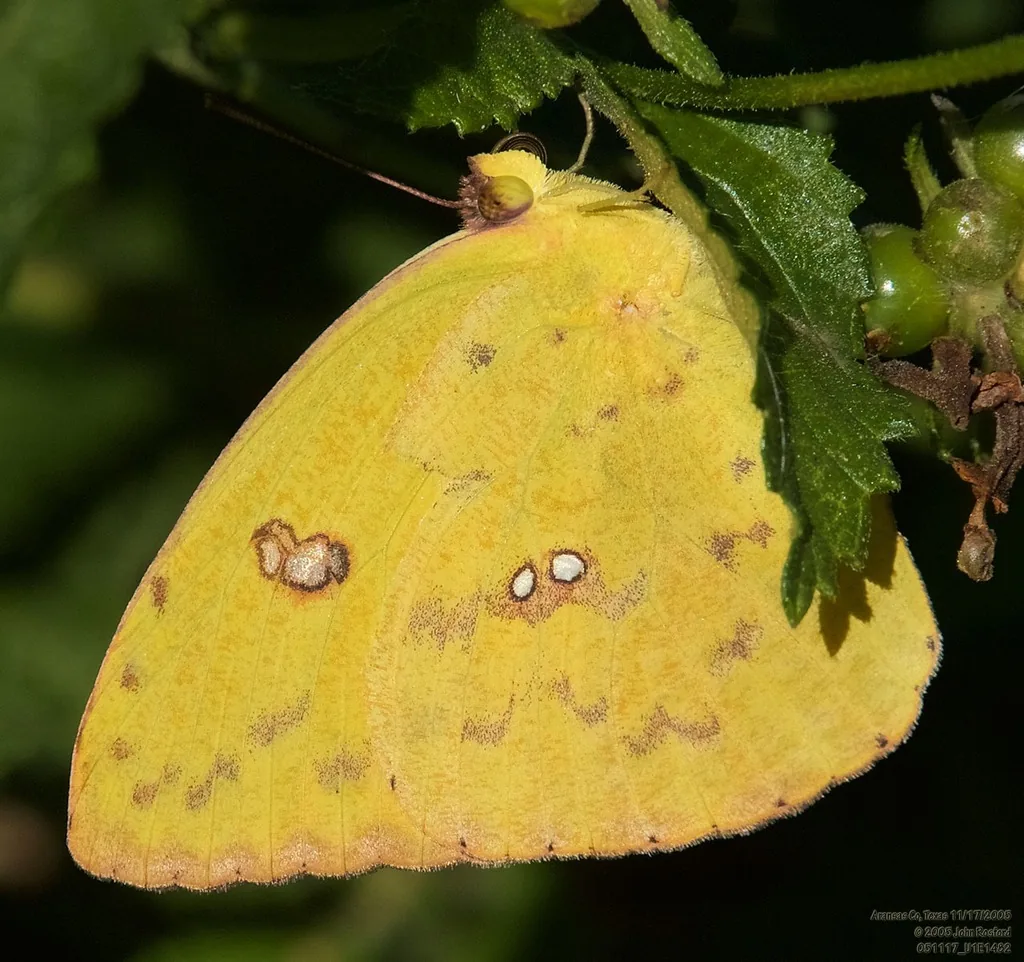
- Underneath, the hindwing of both sexes has two silver spots edged in pink, and females are usually more heavily marked below than males.[2][1]
- Caterpillars are yellowish green with black dots and a yellow line along each side. Their color and faint banding make them look like the long seedpods on their food plants.[1]
Where it lives
BAMONA says it lives year-round from Argentina north to southern Texas and the Deep South and is a regular visitor and occasional colonist in most of the eastern United States and the Southwest. MDC says it moves north each spring, can reach Canada over the summer, and flies south in late summer and fall. GBIF has about 41,400 U.S. records since 1990, most from Texas, Florida and South Carolina, and about 14,300 from Mexico.[2][1][3][4]
Biology and life cycle
Sources differ on how much it breeds in the North. MDC says it breeds as it moves north and has two or more generations a year in Missouri. BAMONA says the immigrants that reach northern states in August or September usually don't reproduce, and other southern states may have only one late-summer flight. In the Deep South it flies all year.[1][2]
U.S. records rise sharply in July and peak from August through October.[5]
Males patrol with fast flight looking for females. Eggs are laid singly on young leaves or flower buds, and caterpillars rest on the undersides of leaf stalks.[2][1]
Its long tongue lets it drink from long, tubular flowers such as trumpet vine, petunias, four o'clocks, morning glories, phlox, cardinal flower, hibiscus and lantana.[1][2]
Damage and signs
- Caterpillars eat the leaves of partridge pea, wild senna and other legumes in the Senna/Cassia group.[1][2]
- In urban Miami, caterpillars of this species and the orange-barred sulphur were found on both native and ornamental senna. Surprisingly, those on non-native plants were more likely to be killed by parasitoids.[6]
Health risk
MDC says the caterpillars graze on plants and the adults help pollinate flowers, and no cited source describes any risk to people or pets.[1][2]
Control
Prevention
MDC suggests improving habitat for it by planting partridge pea and wild senna for the caterpillars and a variety of native wildflowers for nectar.[1]
Where the sources disagree
Wingspan: MDC gives 1 3/4 to 2 3/4 inches, BAMONA 2 1/4 to 3 1/8 inches.[1][2]
Breeding in the North: MDC says it breeds as it moves north and has two or more generations a year in Missouri, while BAMONA says immigrants reaching northern states in August or September usually do not reproduce.[1][2]
Female forewing markings: MDC describes two spots near the leading edge of the forewing, BAMONA a dark spot in the forewing cell.[1][2]
Caterpillar hosts: MDC names partridge pea and wild senna, BAMONA Cassia species in the pea family, and a Miami study found caterpillars on both native and ornamental Senna, with more parasitized on the non-native plants.[1][2][6]
Common questions
- What is the big yellow butterfly flying south in fall?
- Likely a cloudless sulphur heading south. They fly rapidly southward in late summer and fall.[1]
- What do the caterpillars eat?
- Partridge pea, wild senna and other legumes.[1][2]
- Which flowers attract it?
- Long, tubular flowers such as trumpet vine, petunias, phlox, cardinal flower and lantana.[1][2]
Sources
- Missouri Department of Conservation, “Cloudless Sulphur (Field Guide).” mdc.mo.gov/discover-nature/field-guide/cloudless-sulphur (accessed 2026-11-13)
- Butterflies and Moths of North America (BAMONA), “Cloudless Sulphur, Phoebis sennae (species page).” www.butterfliesandmoths.org/species/Phoebis-sennae (accessed 2026-11-13)
- Global Biodiversity Information Facility (GBIF), “Phoebis sennae: U.S. occurrence records since 1990 by state (GBIF occurrence search).” api.gbif.org/v1/occurrence/search?taxonKey=1919653&country=US&hasGeospatialIssue=false&occurrenceStatus=PRESENT&year=1990%2C2026&facet=stateProvince&facetLimit=400&limit=0 (accessed 2026-11-13). Exact count at access: 41,392 U.S. records since 1990 (Texas 8,209; Florida 5,166; South Carolina 4,197; Alabama 2,941; Georgia 2,845; North Carolina 2,742; California 2,110; Arizona 1,758).
- Global Biodiversity Information Facility (GBIF), “Phoebis sennae: occurrence records since 1990 by country (GBIF occurrence search).” api.gbif.org/v1/occurrence/search?taxonKey=1919653&hasGeospatialIssue=false&occurrenceStatus=PRESENT&year=1990%2C2026&facet=country&limit=0 (accessed 2026-11-13). Exact counts at access: 60,673 records since 1990; United States 41,392, Mexico 14,305, Brazil 978, Colombia 723, Costa Rica 565.
- Global Biodiversity Information Facility (GBIF), “Phoebis sennae: U.S. occurrence records since 1990 by month (GBIF occurrence search).” api.gbif.org/v1/occurrence/search?taxonKey=1919653&country=US&hasGeospatialIssue=false&occurrenceStatus=PRESENT&year=1990%2C2026&facet=month&facetLimit=12&limit=0 (accessed 2026-11-13). Exact counts at access by month: Jan 633, Feb 707, Mar 1,335, Apr 1,264, May 769, Jun 898, Jul 2,878, Aug 8,352, Sep 10,496, Oct 8,777, Nov 3,199, Dec 1,245.
- Insects, via PubMed, “Pierid Butterflies, Legume Hostplants, and Parasitoids in Urban Areas of Southern Florida (Koptur et al. 2024).” pubmed.ncbi.nlm.nih.gov/38392542/ (accessed 2026-11-13)
- Global Biodiversity Information Facility (GBIF), “Phoebis sennae (Linnaeus, 1758) (GBIF Backbone Taxonomy).” api.gbif.org/v1/species/1919653 (accessed 2026-11-13)