On this page
How to identify it
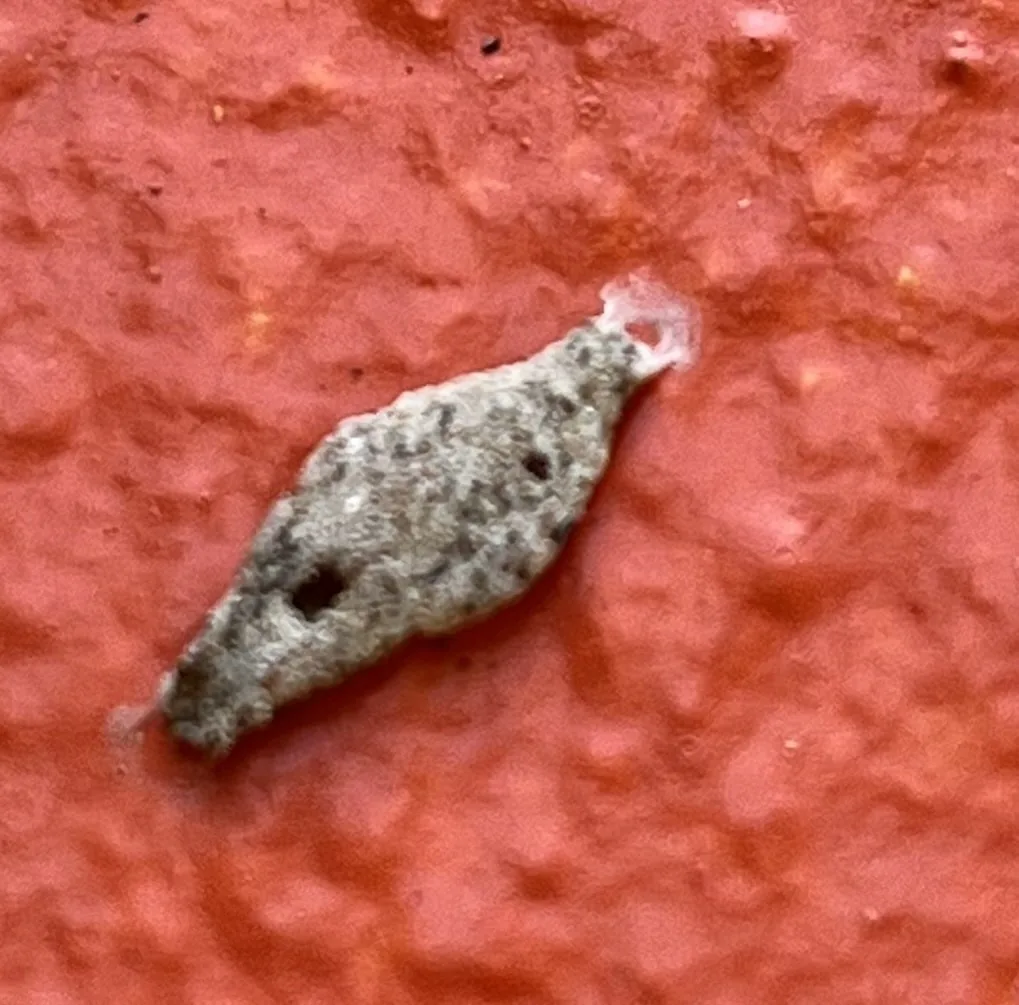
- The case is a flattened, oval, brown to gray bag about 1/2 inch long when the caterpillar is full grown. It looks like a squash or pumpkin seed and is open at both ends, so the caterpillar can turn around inside and travel either way. UF/IFAS says the case is silk-lined inside and spindle-shaped like a cantaloupe or pumpkin seed; a full-grown larva's case is 8 to 14 mm long and 3 to 5 mm wide. Both ends are identical, and when disturbed the larva seals itself in by pulling the bottom side up, which is very hard to open from outside.[1][3][2]
- The caterpillar moves by stretching its front end out, gripping the surface with its legs and jaws, and pulling the case along.[1]
- Adults are small, rarely noticed moths. Mississippi State describes them as tan to brown, about 1/4 inch long at rest, with a fringe of long hairs at the wing tips and a fuzzy head; BAMONA describes gray forewings with up to four spots and a wingspan of about 0.7 to 0.9 cm in males and 1.0 to 1.3 cm in females. UF/IFAS adds that females have a brush of long, lighter gray scales along the rear edge of the hind wings, males are smaller and thinner with a less distinct pattern, the threadlike antennae are as long as the wings, and adults rest with their wings tented over the body. Adult mouthparts are reduced, and adults do not feed.[1][4][2]
- In a study of a related Phereoeca species and another case-bearing moth, cases were built from fibers, wool, hair, grains of sand, flakes of paint and insect remains, so their color varies with what the larva picks up. UF/IFAS says household casebearer larvae add very small particles of sand, soil, iron rust, insect droppings, arthropod remains, hairs and other fibers to the outside of the case.[3][2]
- UF/IFAS describes the full-grown larva as about 7 mm long with a dark brown head and white body, except for hardened dark plates on the three segments behind the head, and three pairs of well-developed brown legs.[2]
Look-alikes
| Look-alike | How to tell them apart |
|---|---|
| Bagworms | Despite the shared nickname, the bagworm of landscapes is a tree and shrub pest whose bags, decorated with twigs and leaves, hang from branches and reach close to 2 inches. Household casebearer cases are about 1/2 inch, flat, and found on walls indoors and in garages. UF/IFAS adds that true bagworms are a different moth family, Psychidae; the household casebearer is in Tineidae, which is why its accepted common name is now household casebearer instead of plaster bagworm.[5][1][2] |
| Other case-bearing moths | UF/IFAS notes a related case-bearing moth, Praececodes atomosella, found in Gainesville and recorded across the southern U.S., and says records of the two may have been confused, so a specialist should confirm the species.[2] |
Where it lives
BAMONA gives its range as the southern United States. GBIF records since 1990 come mostly from Florida, followed by California, Texas, Alabama, Louisiana and Georgia; outside the U.S., most come from India, Brazil and Mexico. In Mississippi it is more common in the southern part of the state, apparently because it favors high humidity. A related species, Phereoeca praecox, has been reported from California. UF/IFAS says it needs high humidity to complete its development, which limits its spread. An entomologist reported it in 1957 from many parts of Florida and Louisiana, with USDA records from Mississippi and North Carolina, and assumed it might occur in coastal Alabama, Georgia, South Carolina, Texas and Virginia. In South America it is known from Brazil (state of Para) and Guyana.[4][6][7][1][3][2]
Biology and life cycle
Larvae wander just before they pupate, and that is when most infestations are noticed. Infestations often start under furniture and light fixtures, in closets and other out-of-the-way places where spider webs and dead insects collect.[1]
Heavy infestations are usually in humid places such as garages, carports and storage rooms that are not air-conditioned and have lots of spider webs.[1]
The case also serves as the pupal cocoon. Parasitic wasps attack the pupae; a 2021 study from southern India described a new chalcid wasp species reared from household casebearer pupae. To pupate, UF/IFAS says the larva climbs a vertical surface, fastens the case at both ends with silk and cuts slits to flatten one end into a valve; the pupa pushes halfway out before the moth emerges, around noon.[3][8][2]
After mating, a female may lay two hundred eggs over about a week in crevices and where walls meet floors, cementing them to debris, and then dies. UF/IFAS describes the eggs as soft, pale bluish and about 0.4 mm across.[2]
UF/IFAS says the first case is built before the larva fully hatches and is enlarged at each molt: the larva makes a silk arch, lines it with silk, extends it into a tunnel, closes it underneath and then drags it along. Later cases are widest in the middle so the larva can turn around.[2]
Most biology for this moth comes from a closely related species reared in Panama, UF/IFAS says: eggs took more than 10 days to hatch, six to seven larval stages took about 50 days, the pupa lasted an average of 15.6 days (11 to 23), and egg to adult averaged 74.2 days (62 to 86).[2]
Damage and signs
- Mississippi State says the larvae feed on spider webs and the dead insects caught in them, and also on wool and other animal fibers such as silk, feathers and accumulated hair and dandruff, but only rarely damage clothing and other fabrics. UF/IFAS says a 1957 study found old spider webs, eaten in large quantities, were its most common food in Florida, along with webs of booklice and webspinners on tree trunks and old cases of its own species. In a 1933 study the larvae would not eat cotton but ate woolen thread and cloth eagerly, so UF/IFAS calls it a potential household pest.[1][2]
- A researcher who reared a related Phereoeca species and another case-bearing moth on Réunion saw the larvae feed only on insect remains, never on the hair, cotton, bread or spider webs offered, and believed those materials are used only for building cases. He suggested that many reported food sources for these moths may be mistaken. He also found that those species did better in dry conditions than damp ones.[3]
Health risk
Mississippi State describes no health risk; the larvae only rarely damage fabrics. In Malaysia, anecdotal accounts have linked household casebearers to skin lesions and inflammation; a 2026 study said scientific evidence for that is lacking, but found bacteria on the larvae that have been associated with skin irritation or infections elsewhere.[1][9]
Control
Sanitation
Cut down on spider webs and dead insects in garages, storage rooms and under furniture, since that is where infestations start. UF/IFAS says regular cleaning, more air conditioning, fewer woolen goods and crack-and-crevice pest treatments have made it less common.[1][2]
Traps and physical control
Vacuuming and cleaning the infested area is usually all that is needed. Remove the cases and the spider webs they feed around. UF/IFAS agrees that picking off or vacuuming the cases and removing spider webs should be enough.[1][2]
Biological control
In Florida, a braconid wasp, Apanteles carpatus, which kills case-bearing moth larvae before they pupate, and an ichneumonid wasp, Lymeon orbum, have been reared from the household casebearer.[2]
Pesticides
Pyrethroid sprays such as cyfluthrin, deltamethrin, bifenthrin, cyhalothrin or permethrin labeled for the site will kill the caterpillars, but the cases and webs still have to be vacuumed or swept up. Treat infested clothing as you would for clothes moths.[1]
Where the sources disagree
What the larvae eat: UF/IFAS cites Florida studies finding old spider webs are the main food and that larvae eagerly ate wool but not cotton, while a researcher rearing a related Phereoeca species on Réunion saw larvae eat only insect remains and never the spider webs, hair or cotton offered.[2][3]
Humidity: UF/IFAS and Mississippi State tie it to humid places, while that Reunion study found the related species did better in dry conditions than damp ones.[2][1][3]
Common questions
- What are the little flat cases on my walls?
- Household casebearer larvae, also called plaster bagworms: small caterpillars in flat, seed-shaped cases open at both ends.[1]
- How do I get rid of them?
- Vacuum up the cases and clear out spider webs and dead insects. A labeled pyrethroid spray can help with heavy infestations, but you still need to remove the cases and webs.[1]
- Is a household casebearer a bagworm?
- No. UF/IFAS says it's a Tineidae moth, the same family as clothes moths; true bagworms belong to Psychidae, which is why the name plaster bagworm has given way to household casebearer.[2]
Sources
- Mississippi State University Extension, “Plaster Bagworm, Bug's Eye View Vol. 9, No. 30.” extension.msstate.edu/newsletters/bugs-eye-view/2023/plaster-bagworm-vol-9-no-30 (accessed 2026-11-11)
- University of Florida IFAS Extension (EDIS), “Household Casebearer, Phereoeca uterella Walsingham, EENY003/IN129 (J. A. Villanueva-Jimenez and T. R. Fasulo; Featured Creatures).” ask.ifas.ufl.edu/publication/IN129 (accessed 2026-11-14)
- Contributions to Entomology (peer-reviewed), “Praeacedes atomosella and Phereoeca praecox, two case-bearing moths new to the fauna of La Reunion (Bippus 2016).” doi.org/10.21248/contrib.entomol.66.2.159-163 (accessed 2026-11-11)
- Butterflies and Moths of North America (BAMONA), “Household Casebearer Moth, Phereoeca uterella (species account).” www.butterfliesandmoths.org/species/Phereoeca-uterella (accessed 2026-11-11)
- University of Missouri Extension, “The Bagworm in Missouri (G7250).” extension.missouri.edu/publications/g7250 (accessed 2026-11-11)
- Global Biodiversity Information Facility (GBIF), “Phereoeca uterella: U.S. occurrence records since 1990 by state (GBIF occurrence search).” api.gbif.org/v1/occurrence/search?taxonKey=1858283&country=US&hasGeospatialIssue=false&occurrenceStatus=PRESENT&year=1990%2C2026&facet=stateProvince&facetLimit=400&limit=0 (accessed 2026-11-11)
- Global Biodiversity Information Facility (GBIF), “Phereoeca uterella: occurrence records since 1990 by country (GBIF occurrence search).” api.gbif.org/v1/occurrence/search?taxonKey=1858283&hasGeospatialIssue=false&occurrenceStatus=PRESENT&year=1990%2C2026&facet=country&limit=0 (accessed 2026-11-11)
- Systematic Parasitology, via PubMed, “Chalcidid parasitoids of Phereoeca uterella: description of a new species and the male of Epitranus uterellophagus from southern India (Binoy et al. 2021).” pubmed.ncbi.nlm.nih.gov/34773570/ (accessed 2026-11-11)
- PLoS One, via PubMed, “Molecular identification and microbiome profiling of household casebearer, Phereoeca sp., from Malaysia: potential implications for human skin irritation (Yaakop et al. 2026).” pubmed.ncbi.nlm.nih.gov/41955218/ (accessed 2026-11-11)
- iNaturalist, “Phereoeca uterella taxon page (order and family).” www.inaturalist.org/taxa/363376 (accessed 2026-10-06)