On this page
How to identify it
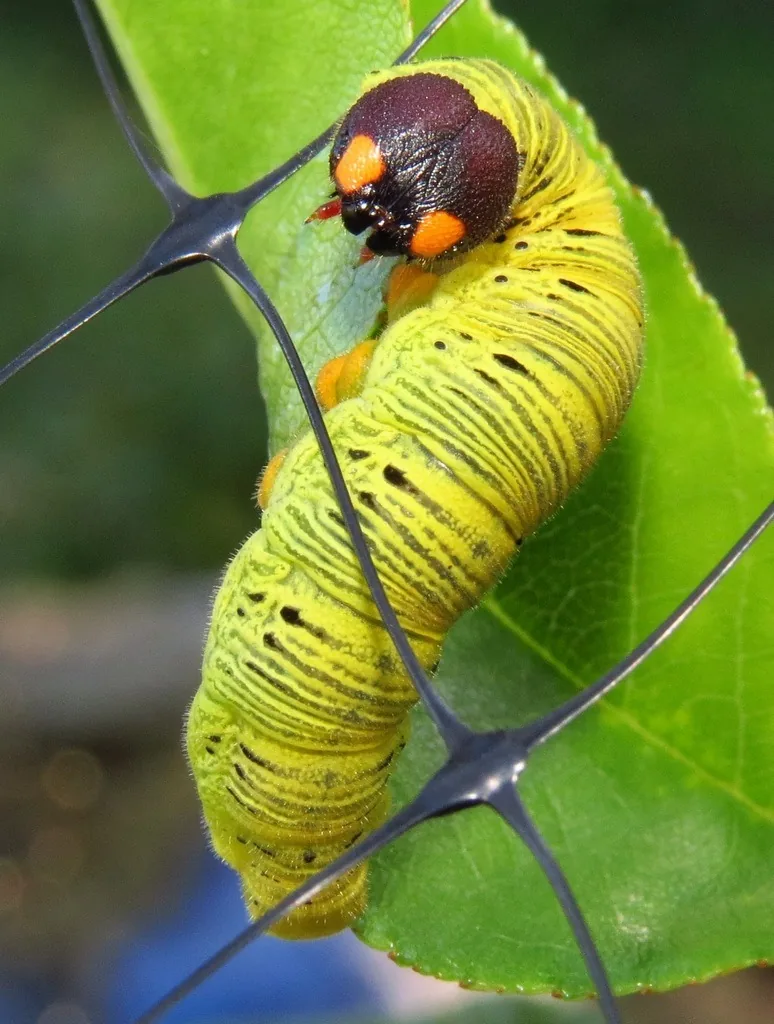
- Caterpillars grow to nearly 2 inches: yellow-green with fine dark crosslines, a narrow red-brown 'neck' and a large red-brown head with two orange eyespots.[1][2]
- Adults are dark brown-black with see-through gold spots on the forewings and a silvery-white patch or band under each lobed hindwing. The wingspan is 1-1/2 to 2-1/2 inches.[2][4]
- Like other skippers it has a stout body, relatively small wings and an antenna club with a slender tip that curves backward; it flies in a swift, bouncing, erratic way.[2]
- Young caterpillars live in a single folded leaf; older ones build a nest of several leaves tied with silk, so a folded locust or wisteria leaf is a good place to look.[4]
Look-alikes
| Look-alike | How to tell them apart |
|---|---|
| Hoary edge | The hoary edge is similar but smaller and less common, with a diffuse, frosty-looking patch under the hindwing that reaches all the way to the outer margin.[2] |
Where it lives
From extreme southern Canada through most of the continental United States except the Great Basin and west Texas, south into northern Mexico. Missouri finds it statewide in brushy fields, roadsides and city yards; BAMONA lists disturbed and open woods, foothill streams and prairie waterways. GBIF's public U.S. records since 1990 (about 87,000) come from 43 states on the map, most from Illinois, North Carolina and Ohio.[4][2][7]
Biology and life cycle
Generations differ by region and by source. BAMONA gives two broods from May to September in most of the East, one to the north and west, and three or four from February to December in the Deep South; MU Extension reports two to three a year, and Missouri's conservation department three, with adults flying from early April to mid-October.[4][1][2]
Females lay single eggs near host plants, and the newly hatched caterpillars have to find the right host themselves. MU reports caterpillars in summer and fall.[4][1]
Caterpillars eat woody and herbaceous legumes: black locust, honey locust, wisteria, false indigo, rose acacia and wild senna, and in lab studies kudzu. Larvae raised on wisteria, a poorer food than kudzu, or under temperature stress often added an extra molt but still reached normal pupal size.[1][2][4][6]
The chrysalis overwinters, usually buried under fallen leaves. In field experiments, predators took more pupae during the short 10 to 14 day summer pupal stage than over the much longer winter one, and a leaf shelter improved summer survival.[4][5]
Adults perch upside down under leaves at night and in hot or cloudy weather. Males perch on branches and tall weeds and dart out at passing butterflies. Adults visit mud puddles and flowers, almost never yellow ones; BAMONA lists everlasting pea, common milkweed, red clover, buttonbush, blazing star and thistles.[4][2]
Damage and signs
Health risk
Neither MU Extension nor Missouri's conservation department lists any risk to people or pets.[1][2]
Control
Prevention
No control is needed. Missouri lists it as a common breeding resident, and butterflies and skippers pollinate plants.[2]
Common questions
- What is the green caterpillar with orange eyes on my wisteria?
- Most likely a silver-spotted skipper caterpillar: nearly 2 inches long, yellow-green with fine dark crosslines, a narrow red-brown neck and a large rusty-brown head with two orange eyespots. Wisteria is one of its listed hosts.[1][2]
- What does the butterfly look like?
- Dark brown with see-through gold spots on the forewings and a silvery-white patch under the hindwing, with a wingspan of 1-1/2 to 2-1/2 inches.[2][4]
- Will it hurt my locust tree?
- Our sources describe no damage to locusts beyond leaf feeding. Missouri's conservation department lists it as a common native skipper whose caterpillars graze on legume foliage.[2][1]
Sources
- University of Missouri Extension (Caterpillars in Your Yard and Garden, IPM1019), “Caterpillars in Your Yard and Garden, page 38: Silverspotted skipper.” extension.missouri.edu/publications/ipm1019-38 (accessed 2026-11-11)
- Missouri Department of Conservation, “Silver-Spotted Skipper (Field Guide).” mdc.mo.gov/discover-nature/field-guide/silver-spotted-skipper (accessed 2026-11-11)
- iNaturalist, “Epargyreus clarus taxon page (order and family).” www.inaturalist.org/taxa/81559 (accessed 2026-11-11)
- Butterflies and Moths of North America (BAMONA), “Silver-spotted Skipper, Epargyreus clarus (species account).” www.butterfliesandmoths.org/species/Epargyreus-clarus (accessed 2026-11-11)
- Environmental Entomology, via PubMed, “Ecological predictors of pupal survival in a common North American butterfly (Brackley, Lill and Weiss 2022).” pubmed.ncbi.nlm.nih.gov/35866523/ (accessed 2026-11-11). Cited from the PubMed abstract.
- Environmental Entomology, via PubMed, “Host plant and thermal stress induce supernumerary instars in caterpillars (Epargyreus clarus, 2020).” pubmed.ncbi.nlm.nih.gov/31758687/ (accessed 2026-11-11). Cited from the PubMed abstract.
- Global Biodiversity Information Facility (GBIF), “Epargyreus clarus: occurrence records in the U.S., 1990-2026 (GBIF occurrence search).” api.gbif.org/v1/occurrence/search?taxonKey=1947915&country=US&hasGeospatialIssue=false&occurrenceStatus=PRESENT&year=1990%2C2026&facet=stateProvince&facetLimit=400&limit=0 (accessed 2026-11-11). State counts are records reported (iNaturalist research-grade, museum specimens, surveys), not abundance.