On this page
How to identify it
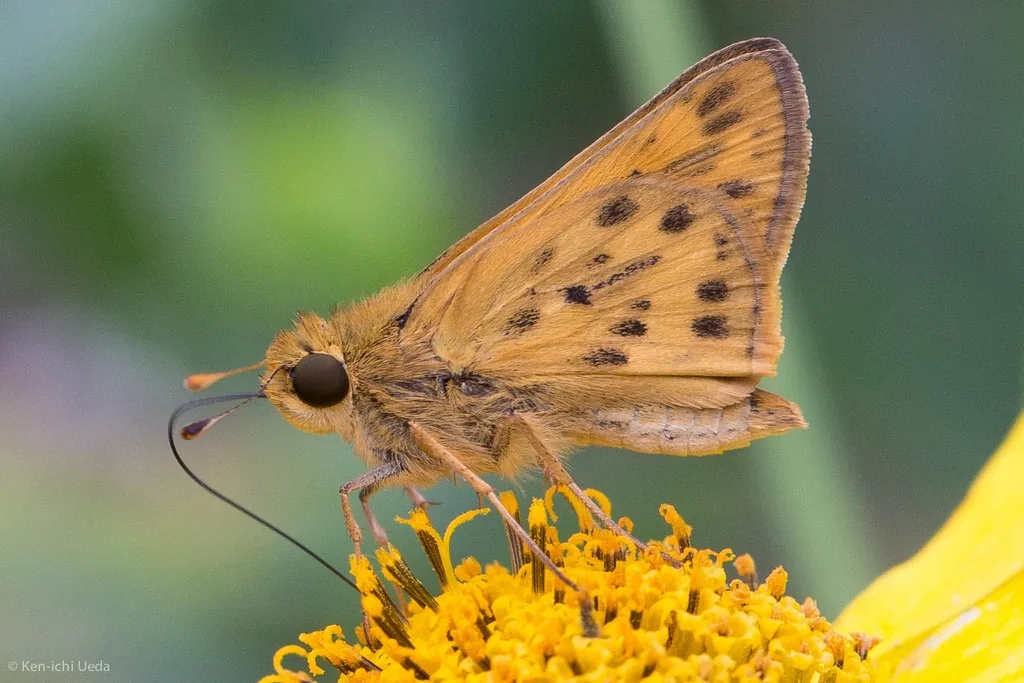
- Adults have very short antennae with a hooked knob at the tip and orange to orange-brown wings. From below, both sexes are orange with a sprinkling of small dark spots.[1][2][3]
- Males are brighter orange, with a jagged dark border on the upper hindwing that looks like flame tips; females are much browner, with wider dark markings and an irregular orange band.[1][3]
- Wingspan is about 1 to 1 1/2 inches (MDC) or 1 1/4 to 1 1/2 inches (BAMONA). UF/IFAS gives 3.0 to 4.0 cm.[1][3][5]
- Caterpillars grow to about 1 inch. They have an oversized black, knob-like head, a narrowed neck, and a grayish tan to greenish brown body with a few narrow dark stripes, including one down the back. UF/IFAS adds that young caterpillars are green before turning darker brown, growing from 2.0 to 3.9 mm long in the first instar to 17.9 to 29.9 mm in the fifth.[2][1][5]
- At rest, skippers can hold their wings in a triangle: the forewings upright and the hindwings folded flat, a pose thought to help them soak up the sun.[4]
- Males have a large black patch on the forewing called a stigma, a scent gland used in courtship. The eggs are glossy, pale turquoise-green and dome-shaped. UF/IFAS describes newly laid eggs as white and pearly, turning bluish after a couple of days, and about 0.75 mm across.[6][5]
- Adults in the desert Southwest and California tend to be paler, especially near Death Valley.[5]
Look-alikes
| Look-alike | How to tell them apart |
|---|---|
| Other grass skippers | Several grass skippers, such as the sachem, Delaware, Peck's, least and tawny-edged skippers, are similar orange and brown; check the jagged hindwing border and the spot pattern.[1] |
Where it lives
Resident across the southern United States and south through the West Indies and Central America to Argentina. It can't survive harsh winters, but each summer it spreads north, as far as northern California, southern Minnesota, southern Ontario and southern New England; in Missouri it arrives at the end of May and flies until frost. UF/IFAS says permanent U.S. populations occur around the Gulf of Mexico, in the desert Southwest, in most of low-elevation California and in Hawaii, where it was introduced and is considered a pest; strays have reached New Brunswick, Canada.[3][1][5]
Biology and life cycle
Males perch in lawns and grassy swales and chase passing females, and also other insects and wind-blown leaves.[1][3]
Females lay eggs singly on the undersides of grass blades or on nearby objects. UF/IFAS says adults mate the day they emerge, females lay eggs three to four days later, and each female lays 50 to 150 eggs.[1][2][3][5]
Young caterpillars notch the blades; older ones eat whole leaves. They roll and tie leaves with silk into shelters lying low in the sod, and from the third instar on they live in silk shelters in the thatch, so you rarely see them. They pupate inside the shelter. UF/IFAS says caterpillars stay inactive in their shelters until nightfall, pupate after about 16 days and emerge as adults seven to ten days later; pupae overwinter in leaf shelters where winters are mild.[2][1][3][5]
There are several broods from May to August in the north, and adults fly all year in Florida and South Texas.[3]
Adults take nectar from many flowers; zinnias and lantana are favorites.[1][2]
Numbers vary from year to year.[1]
It is a native butterfly whose range runs from the southern United States south to Argentina and the Antilles; it moves north each year, where it may have a single brood in late summer.[6][4][3]
In one mating-behavior study cited by UF/IFAS, females traveled an average of 37 meters a day and males 30 meters, with most dispersal right after emergence.[5]
Damage and signs
- Bermudagrass is the preferred host; caterpillars also feed on St. Augustinegrass, bentgrass, crabgrass and occasionally other turfgrasses. UF/IFAS also lists dallisgrass, Kentucky bluegrass, teal lovegrass, sugarcane and broadleaf carpetgrass, and says larvae are most abundant in grass near flower beds, where adults feed and lay eggs.[2][1][3][5]
- Each caterpillar eats out a round spot 1 to 2 inches across. With many larvae, the spots run together into dead patches, usually in turf near the flower beds where adults feed.[2][4]
- In California, larvae feed from May through September.[2]
Health risk
None of the sources reports any risk to people or pets; the caterpillars feed on grass.[2][1]
Control
Prevention
To check for larvae, use a drench test to flush them out of the thatch. UC IPM treats 5 larvae per square yard on bentgrass greens, or 15 per square yard in bermudagrass, as the point where treatment may be warranted.[2]
Traps and physical control
Where larvae are damaging turf, dethatch to remove the thatch they shelter in. UF/IFAS adds that removing debris such as lawn clippings limits the larvae's habitat, but only if an infestation needs treatment.[2][5]
Biological control
Braconid and ichneumonid wasps parasitize the larvae. If treatment is needed, UC IPM lists Bacillus thuringiensis (Bt) and insect-killing nematodes; don't water for 2 days after Bt. UF/IFAS lists the same biological options.[2][5]
Pesticides
UC IPM's turf guidelines also list spinosad. It is toxic to bees, so keep it off blooming weeds, and follow the label.[2]
Where sources disagree
Wingspan: MDC gives 1 to 1 1/2 inches; BAMONA gives 1 1/4 to 1 1/2 inches (3.2 to 3.8 cm); Animal Diversity Web gives 1.0 - 1.25 inches. UF/IFAS gives 3.0 to 4.0 cm.[1][3][6][5]
Common questions
- What is the little orange butterfly darting around my lawn?
- Often a fiery skipper: a small orange-and-brown butterfly with very short antennae and a fast, darting flight that males use to chase passing insects.[1][3]
- Do fiery skipper caterpillars eat grass?
- Yes. They feed on bermudagrass, St. Augustinegrass, bentgrass and other grasses, each one leaving a round dead spot 1 to 2 inches across.[2][1]
- Do they overwinter in the North?
- No. They can't survive harsh winters; in Missouri they arrive from the south at the end of May and stay until the first freeze.[1][3]
- Should I spray my lawn for fiery skippers?
- Usually not. UC IPM suggests treatment only when a drench test turns up many larvae (5 per square yard on bentgrass greens or 15 in bermudagrass). Braconid and ichneumonid wasps parasitize the caterpillars, and dethatching removes their shelters. If needed, start with Bt or insect-killing nematodes.[2]
- Is the fiery skipper a pest?
- Not usually in its native range, UF/IFAS says, though in Hawaii, where it was introduced, it is reported as a turfgrass pest.[5]
Sources
- Missouri Department of Conservation, “Fiery Skipper (Field Guide).” mdc.mo.gov/discover-nature/field-guide/fiery-skipper (accessed 2026-11-14)
- University of California Statewide IPM Program, “Turfgrass Pest Management Guidelines: Fiery Skipper.” ipm.ucanr.edu/agriculture/turfgrass/fiery-skipper/ (accessed 2026-11-14)
- Butterflies and Moths of North America (BAMONA), “Fiery Skipper, Hylephila phyleus (species account).” www.butterfliesandmoths.org/species/Hylephila-phyleus (accessed 2026-11-14)
- University of Missouri Integrated Pest Management, “Fiery Skippers (Fall Garden Adventures).” ipm.missouri.edu/garden/newcomer_insect1.cfm (accessed 2026-11-14)
- University of Florida/IFAS Extension (Featured Creatures), “Fiery Skipper, Hylephila phyleus (Drury), EENY-697/IN1194.” ask.ifas.ufl.edu/publication/IN1194 (accessed 2026-11-14)
- Animal Diversity Web, University of Michigan Museum of Zoology, “Hylephila phyleus (fiery skipper).” animaldiversity.org/accounts/Hylephila_phyleus/ (accessed 2026-11-14)
- iNaturalist, “Hylephila phyleus taxon page (order and family).” www.inaturalist.org/taxa/50340 (accessed 2026-11-14)