On this page
How to identify it
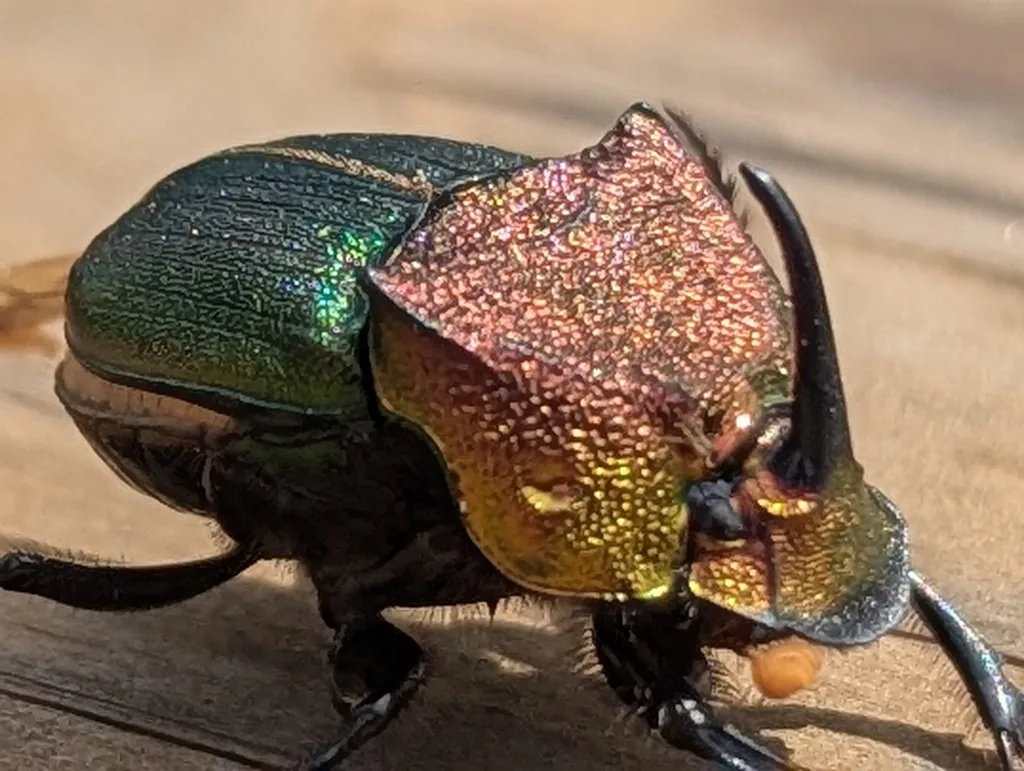
- Adults are stout, oval and strong, dark with bright metallic green or green-blue wing covers and iridescent reds with golden reflections on the thorax. NC State gives 1/2 to 7/8 inch long and the Missouri Department of Conservation 1/2 to 3/4 inch; Michigan beetles averaged about 17 mm. UF/IFAS gives about 1 to 2.2 cm (3/8 to 7/8 inch) from the top of the head to the end of the abdomen and notes rare individuals that are dark blue to black with no bronze or red.[1][2][3][4]
- Males have a horn that curves back over the thorax. They come in two forms: major males with long horns and minor males with much shorter ones (in Michigan, about 5.6 mm against 1.7 mm on average). Females average slightly larger than males. UF/IFAS says females have no horn, and minor males can be sexed by the rear segments of the abdomen. In males the rear corners of the shield behind the head are pointed and raised slightly above the wing covers; in females they are not.[1][2][3][4]
- The antennae are orange, with leaflike plates that can be pressed together or fanned apart, and the strong, well-clawed front legs are built for digging.[2]
- Larvae are C-shaped white grubs that develop inside a ball of dung underground. UF/IFAS adds that the head is hardened and the body soft.[1][5][4]
Look-alikes
| Look-alike | How to tell them apart |
|---|---|
| Other dung beetles | Most dung beetles are dull or shiny black. The rainbow scarab is metallic green and copper, and unlike the ball-rolling kinds it buries its dung ball under the pile instead of rolling it away.[2][5] |
| Phanaeus igneus | Also metallic, but males have a smaller horn. In Florida, where the two share range, UF/IFAS says P. igneus tends to live on sandy soils and the rainbow scarab on clay.[4] |
Where it lives
Native to the southern United States; southeast Michigan marks its northern range limit. Field studies have worked with it in Michigan, Tennessee and the Great Plains. UF/IFAS, citing a 1973 account, describes it across the eastern United States from Massachusetts to South Dakota and south to Texas and Florida, where it has been found everywhere except the Florida Keys and the Everglades.[3][6][7][4]
Biology and life cycle
A pair tunnels under a dung pat and pushes the excavated soil into a mound beside it. The female forms a brood ball from the bottom of the pat, the pair pushes it down the tunnel, and she lays an egg on it; they stock an adjacent tunnel with more dung balls as food. UF/IFAS classes it as a tunneler: the brood ball, often pear-shaped, is moist dung coated with soil, the egg goes at its point, and the tunnel is filled with loose soil to protect it. After laying, the female gives no further care, though the pair stays in the burrow.[1][2][4]
The grub feeds and grows inside the ball. Rainbow scarabs spend the winter in their tunnels, feeding on the stored dung; in Michigan one marked female was recaptured 338 days later, having survived the winter as an adult. UF/IFAS says larvae molt twice and pupate in the ball; north of Florida, overwintering larvae stay below the frost line until spring. In the lab, egg to adult takes two to six months and adults can live over a year, though field survival is likely much shorter.[1][3][4]
Brood ball depth affects how warm the developing young stay: in a Tennessee experiment, females under warmer conditions made more, smaller brood balls and buried them deeper.[6]
In southeast Michigan, adults were active from mid-May to the end of September, and marked beetles moved up to 178 m between captures.[3]
They are usually found around pastures but fly some distance from the nearest cattle or horses, and in Great Plains trapping they preferred carrion bait.[1][7]
Adults leave the tunnels in response to temperature or rainfall. Sandy soils can kill larvae by drying them out, yet east Texas beetles have favored open sandy pastures; where Phanaeus difformis shares its Texas range, the rainbow scarab is found on clay instead.[4]
Studies cited by UF/IFAS ranked dung beetles' preferences as swine, opossum, dog, cow, raccoon and horse dung, in that order, and the rainbow scarab also strongly prefers human dung.[4]
Adults often carry the predatory mite Macrocheles amygdaligera, which rides from pat to pat and eats insect eggs, small larvae and nematodes. Burrowing owls are a documented predator of the beetle.[4]
Damage and signs
- No damage. By clearing manure from pastures, dung beetles reduce pests and flies and speed the return of nutrients to the soil. UF/IFAS adds that feeding enriches clay soils and that dung beetle larvae may outcompete pest flies such as the horn fly.[5][1][4]
- Buried dung can also move seeds: in Tennessee, the food caches rainbow scarabs buried held more seed-sized beads than their brood balls.[8]
Health risk
None of the sources describes any harm to people or pets; the adults work at dung and carrion, and NC State calls the species beneficial.[1][2][7]
Control
Prevention
No control is needed; the rainbow scarab is beneficial, so no chemical control is recommended.[1]
Leave the small soil mounds beside dung alone: they are spoil from the beetles' tunnels.[1]
Protect the beetles when treating livestock for worms: UF/IFAS says many livestock dewormers, used for a long time without careful management, harm dung beetles, and that oral ivermectin has been shown to be less harmful to them than a sustained-release ivermectin bolus.[4]
Where sources disagree
Length: NC State gives 1/2 to 7/8 inch, while the Missouri Department of Conservation gives 1/2 to 3/4 inch and calls the beetle about 3/4 inch long. UF/IFAS gives about 3/8 to 7/8 inch.[1][2][4]
Northern range: a 2023 Michigan study calls southeast Michigan its northern range limit, while UF/IFAS, citing a 1973 account, extends the range north to Massachusetts and South Dakota.[3][4]
Common questions
- What is the shiny green beetle with a horn?
- Likely a male rainbow scarab, a metallic green and copper native dung beetle.[1][2]
- Are rainbow scarabs pests?
- No. They are beneficial dung beetles that bury manure.[1][5]
- Why are there small mounds of soil near dung in my yard?
- Rainbow scarabs push the soil they dig out into mounds beside the dung pat they are tunneling under.[1]
- Why did one show up at my porch light?
- Adult dung beetles often fly to lights at night.[5]
- Do female rainbow scarabs have horns?
- No. UF/IFAS says females lack horns, and some small 'minor' males have greatly reduced ones, so the rear of the abdomen is a surer way to tell the sexes apart.[4]
Sources
- NC State Extension, “Rainbow Scarab (PDIC Factsheet).” content.ces.ncsu.edu/rainbow-scarab-1 (accessed 2026-11-14)
- Missouri Department of Conservation, “Rainbow Scarab (Field Guide).” mdc.mo.gov/discover-nature/field-guide/rainbow-scarab (accessed 2026-11-14)
- Journal of Insect Science, via PubMed Central, “Population structure of Phanaeus vindex (Coleoptera: Scarabaeidae) in SE Michigan (Wassmer and Armstrong 2023).” pmc.ncbi.nlm.nih.gov/articles/PMC10317053/ (accessed 2026-11-14)
- University of Florida/IFAS Extension (Featured Creatures), “Rainbow Scarab, Phanaeus vindex MacLeay, EENY-567/IN1003.” ask.ifas.ufl.edu/publication/IN1003 (accessed 2026-11-14). Used for identification, range, biology, diet and conservation; its human-infestation anecdotes and swine stomach-worm host line are not used (medical/veterinary-source rule).
- Missouri Department of Conservation, “Dung Beetles (Tumblebugs) (Field Guide).” mdc.mo.gov/discover-nature/field-guide/dung-beetles-tumblebugs (accessed 2026-11-14)
- Biology Letters, via PubMed, “Experimental increases in temperature mean and variance alter reproductive behaviours in the dung beetle Phanaeus vindex (Kirkpatrick and Sheldon 2022).” pubmed.ncbi.nlm.nih.gov/35857889/ (accessed 2026-11-14)
- Environmental Entomology, via PubMed, “A comparison of dung beetle attraction to native and exotic mammal dung (Whipple and Hoback 2012).” pubmed.ncbi.nlm.nih.gov/22506995/ (accessed 2026-11-14)
- Current Research in Insect Science, via PubMed, “Impacts of warmer temperatures on secondary seed dispersal by Phanaeus vindex dung beetles (Duerr and Sheldon 2026).” pubmed.ncbi.nlm.nih.gov/41938908/ (accessed 2026-11-14)
- iNaturalist, “Phanaeus vindex taxon page (order and family).” www.inaturalist.org/taxa/83929 (accessed 2026-11-14)