On this page
How to identify it
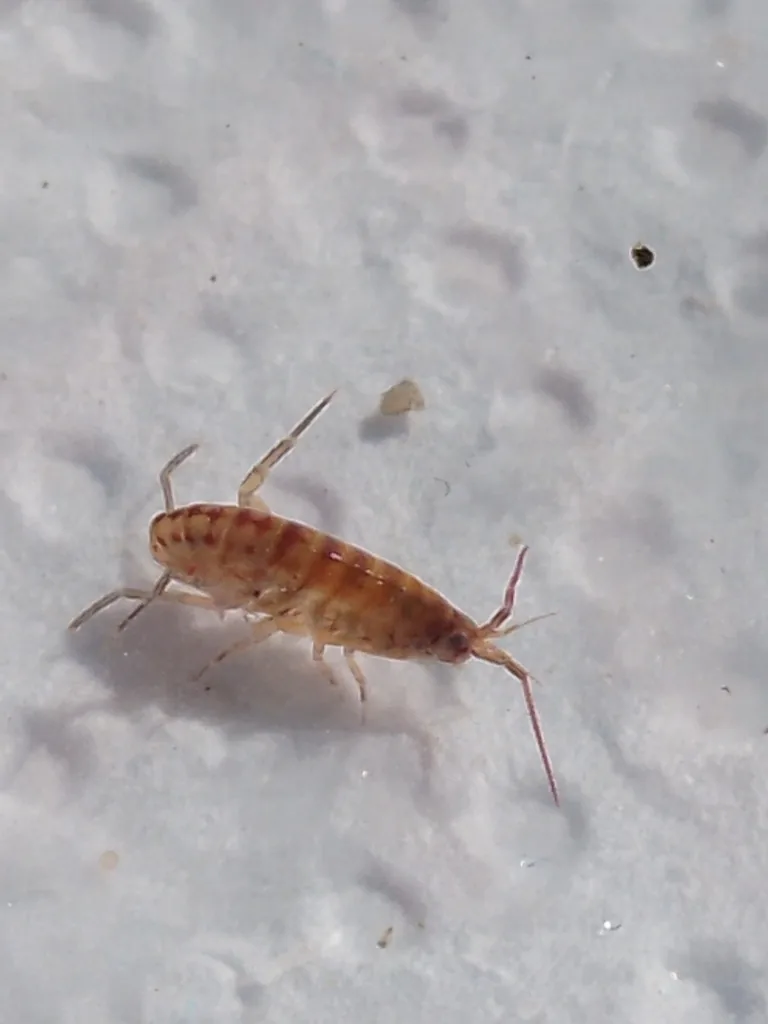
- They are small crustaceans with sideways-flattened, shrimplike bodies. UF/IFAS describes a body with no carapace, seven (rarely six) distinct leg-bearing thoracic segments, two pairs of antennae (one pair usually very small) and chewing mouthparts, and gives adult amphipods as 5 to 20 mm (3/16 to 3/4 inch) long; Gardening Solutions counts five main pairs of walking legs.[2][5][6]
- Live Talitroides sylvaticus are brownish black and about 8 mm long when mature, but they turn red when they die, which is how homeowners usually see them. UF/IFAS gives land-dwelling species as pale brown to greenish to brownish black when alive, often turning pink to red when they die. Florida's two common species are about 7 mm (Talitroides topitotum) and 3.5 mm (Talitroides allaudi) long, and Arcitalitrus sylvaticus reaches 8 mm (3/8 inch).[2][5]
Look-alikes
| Look-alike | How to tell them apart |
|---|---|
| Springtails | Springtails also gather in damp places, sometimes in huge numbers, but UF/IFAS says they are insect-like arthropods with only three pairs of legs, one pair of antennae and usually a forked structure under the abdomen, while amphipods are crustaceans with two pairs of antennae and leg-bearing segments along the thorax.[5] |
Where it lives
UC Riverside records Talitroides sylvaticus from Australia, several Pacific islands including Hawaii, California and Louisiana; in coastal southern California it lives on and in damp ground, especially under ivy. UF/IFAS says amphipods were first described from New South Wales, Australia, were first reported in the Western Hemisphere in 1918 from California, and now number about 90 species in the United States and Canada; two species are common in Florida.[2][5][6]
Biology and life cycle
In damp places, particularly under ivy, they sometimes occur in enormous numbers and jump about like fleas. UF/IFAS says land-dwelling amphipods live in the top half inch of mulch and moist ground and in leaf mold under shrubbery, and most species are active at night. Gardening Solutions describes them as scavengers of decomposing leaves, roots and other organic matter that help recycle nutrients in the soil.[2][5][6]
They lack a waterproof wax layer, so they need damp places, but too much water is also deadly: they can take up water through osmosis at a lethal rate, which pushes them out of soaked ground. UF/IFAS says losing too much water dries them out and gaining it too fast is also lethal, which is why they leave rain-soaked soil for drier spots, where they usually die anyway.[2][5]
Fun fact: a related invasive landhopper in Britain, Arcitalitrus dorrieni, starts drying out whenever the air is below about 95 to 100% relative humidity, and no individual survived below 0°C, which keeps it tied to moist, mild leaf litter.[3]
Another fun fact: in Australian forests, Arcitalitrus sylvaticus is the middle host of a parasitic nematode worm whose final host is a small skink, so lizards that eat the amphipods pick up the worm.[4]
Females carry their eggs in a brood pouch under the body. UF/IFAS says the eggs hatch in one to three weeks, the young look like the adults, and most species go from egg to adult in a year or less, usually producing a single brood.[5][6]
Damage and signs
- UC Riverside reports that after an early rainfall of 0.3 inch in September 1963, lawn shrimp left an ivy patch and large numbers got into a nearby house; they were dead the next day, apparently because the house was too dry.[2]
- After rains, UF/IFAS says large numbers can move into garages or under house doors, where they soon die, and in rainy weather many end up in swimming pools, where they can clog pool filters.[5]
Health risk
UC Riverside describes lawn shrimp only as accidental intruders that die soon after entering a house, and it mentions no bites, stings or health effects.[2]
Control
Prevention
Invasions follow rain or prolonged watering of the ivy or other vegetation where lawn shrimp shelter, since too much moisture forces them to look for drier places. If they keep turning up on walks or in garages after heavy rain, UF/IFAS suggests drying out nearby mulch or ground cover by turning it or cutting back irrigation, and says weather stripping at the bottom of doors helps keep them out.[2][5][6]
Traps and physical control
Those that get indoors find the house too dry and are usually dead by the next day, so there is no need to treat them inside. UF/IFAS says they can be swept or vacuumed up and discarded and that there are no labeled insecticide recommendations; Gardening Solutions likewise lists no recommended chemical controls. In wet spells, pool filters need regular cleaning.[2][5][6]
Where the sources disagree
Color: UC Riverside describes live lawn shrimp as brownish black, turning red at death, and UF/IFAS Featured Creatures says pale brown to greenish to brownish black, often turning pink to red, while UF/IFAS Gardening Solutions calls them often pink and says they turn dark brown or red when they die.[2][5][6]
Name of the 8 mm species: UC Riverside calls it Talitroides sylvaticus, while UF/IFAS uses Arcitalitrus sylvaticus.[2][5]
Common questions
- What are the tiny red shrimp-like things on my garage floor after rain?
- Probably lawn shrimp. They are brownish black when alive but turn red when they die, and they move indoors after rain or prolonged watering of the plants they shelter in.[2]
- Should I spray for lawn shrimp?
- Usually not. UC Riverside says the ones that get indoors soon die because the house is too dry for them; the invasions follow rain or long watering of nearby ivy and other plants. UF/IFAS adds that there are no labeled insecticide recommendations; drying out the mulch and sweeping them up is the approach.[2][5]
- Are lawn shrimp bad for my garden?
- No. UF/IFAS Gardening Solutions says they are not considered pests, help break down dead plant material and will not harm the garden, though they can be a nuisance in pool filters, on decks or inside the home.[6]
Sources
- iNaturalist, “Talitroides topitotum taxon page (order and family).” www.inaturalist.org/taxa/260706 (accessed 2026-11-12)
- University of California Agriculture and Natural Resources, “Amphipods (Urban Entomology, UC Riverside), hosted by UC Marin County Master Gardeners.” cemarin.ucanr.edu/files/138065.pdf (accessed 2026-11-12). Only the UC Riverside section of this PDF is cited; the reprinted University of Florida section is not used.
- Comparative Biochemistry and Physiology A (2003), via PubMed, “Environmental tolerances of an invasive terrestrial amphipod, Arcitalitrus dorrieni (Hunt) in Britain.” pubmed.ncbi.nlm.nih.gov/14613801/ (accessed 2026-11-12). Cited from the PubMed abstract.
- Ecology (2022), via PubMed, “Experimental habitat fragmentation disrupts host-parasite interaction over decades via life-cycle bottlenecks.” pubmed.ncbi.nlm.nih.gov/35581950/ (accessed 2026-11-12). Cited from the PubMed abstract.
- University of Florida IFAS Extension, EDIS (Featured Creatures), “Terrestrial Amphipods or Lawn Shrimp (Crustacea: Amphipoda: Talitridae), EENY-220/IN377 (Featured Creatures).” ask.ifas.ufl.edu/publication/IN377 (accessed 2026-11-14)
- University of Florida IFAS Extension, Gardening Solutions, “Lawn Shrimp (Gardening with Wildlife).” gardeningsolutions.ifas.ufl.edu/design/gardening-with-wildlife/lawn-shrimp/ (accessed 2026-11-14)