On this page
How to identify it
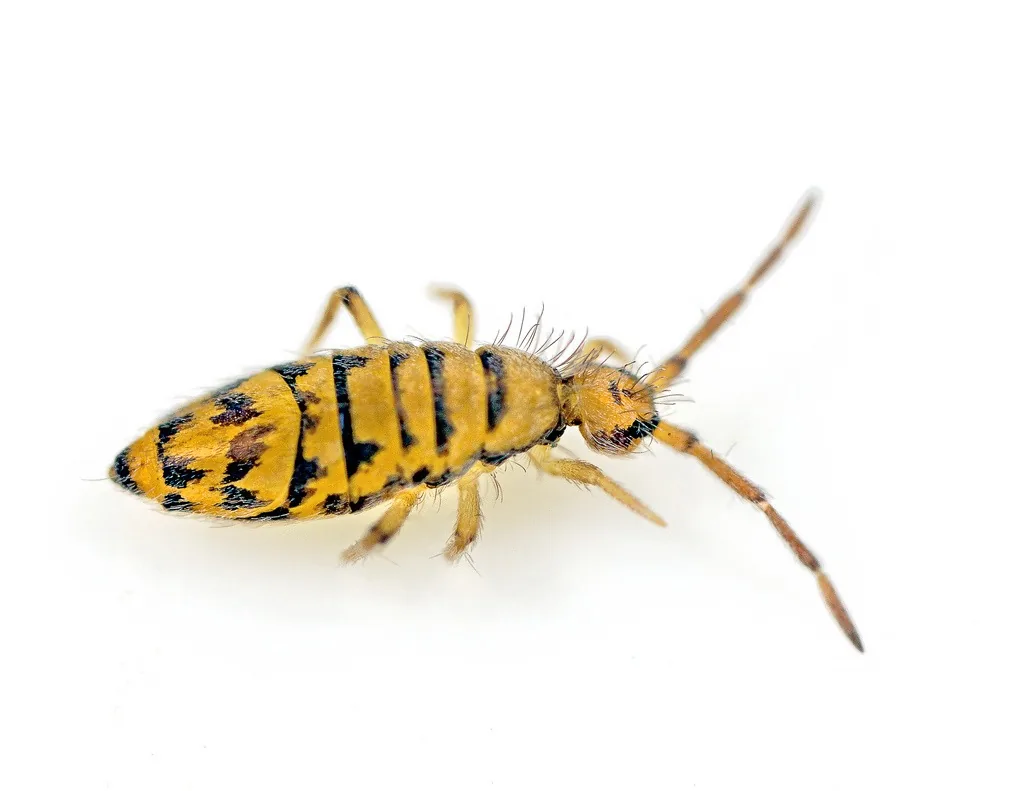
- UC IPM puts them at about 1/16 inch; Penn State says most that get into homes are 1 to 2 mm, with species ranging from 0.2 to 10 mm, and Clemson says most are 1 to 2 mm and usually under 6 mm.[1][3][4]
- Adults are often whitish, bluish or dark gray to black, but some species are yellow, red, orange, purple or mottled. Young look like adults, only smaller and paler.[1][3][5]
- A forked, tail-like spring folded under the abdomen flings them into the air when disturbed: UC IPM says up to several inches, Penn State up to 100 times their body length.[1][3][5]
- Most are slender and elongated, though one group is round and stout, and they have no wings. Whether they count as insects depends on the source (see below); MDC says biologists now place them in their own class, Collembola, and GBIF also treats Collembola as a class.[2][5][6]
Look-alikes
| Look-alike | How to tell them apart |
|---|---|
| Fleas | UC IPM says springtails are sometimes confused with fleas because they jump when disturbed. Minnesota notes fleas are flattened from side to side and hard-bodied, so they are difficult to crush, while springtails have a more rounded, soft body and are easily crushed.[1][2] |
Where it lives
Found in soil, especially compost-rich soil, leaf litter, organic mulch and under bark or decaying wood; indoors in sinks, tubs, floor drains, damp basements, crawl spaces, wall voids and houseplant soil.[1]
Biology and life cycle
They feed on decaying plant material, fungi, molds and algae, and lay eggs in moist soil with lots of organic matter. Penn State says numbers can reach 100,000 per cubic meter of leaf litter, mulch or damp thatch.[1][3][4]
When it gets dry outdoors they search for moisture, entering through screens, doors, vents and potted plants, and may gather on walls in huge numbers after a hot day; indoors they soon die unless they find moisture. Penn State adds that prolonged, saturating rains can also drive them out of the soil and into homes.[1][3][4]
In humid homes with mold, Penn State says springtails can keep an indoor population going, especially in bathrooms and basements and inside the walls of new homes that got soaked before they were closed in.[3]
Most often seen in spring and early summer, but year-round in moist places.[1]
They don't go through metamorphosis; they keep molting even after maturity, from as few as 4 molts in some species to more than 50 in others.[4][5]
Snow fleas are springtails that stay active in freezing weather thanks to an antifreeze-like protein. Penn State and Minnesota name Hypogastrura nivicola; the Missouri Department of Conservation lists both H. nivicola and H. harveyi. They show up by the hundreds on melting snow on warm, sunny days in late winter and early spring, and Penn State says this is more common in or next to wooded areas.[7][2][3][5]
Damage and signs
- Some species chew tiny pits or holes in the roots and leaves of seedlings, which may wilt and die, but mature plants aren't significantly harmed and UC IPM says control is rarely needed.[1][2][4]
- They can coat a pool's surface when they fall in and drown; pool filters and skimmers remove them, and Clemson notes they can be a nuisance in pool drains.[1][4]
Health risk
Two peer-reviewed reports point in different directions. In a 2009 study of two nurses with dermatitis suspected to be caused by the springtail Drepanura, IgE antibodies to springtail proteins were not found in their blood, and skin tests with springtail extract and crushed springtails were negative in the nurses and in volunteers; the authors suggest other organisms or organic matter in the same moist places may be responsible. A 2012 veterinary case report described an apparent Proisotoma springtail infestation in a cat with itchy, scaly dermatitis that the authors speculate the springtails caused; the owner developed an itchy rash on the neck and arms that went away after the kitten was treated and its belongings washed.[8][9]
Control
Prevention
Dry things out: fix leaks, air out damp areas with fans, a dehumidifier or air conditioning, let potted plant soil dry between waterings, and dry out low, wet spots near the foundation or in the crawl space. Clemson says reducing moisture often cuts numbers within a few days.[1][3][4]
Keep them out
Repair torn screens and seal gaps under doors, around windows, pipes and vents with caulk, weatherstripping, fine screen or foam.[1]
Sanitation
Remove excess mulch and wet leaves from around the foundation, don't overwater mulched plants, and make sure downspouts carry water away from the foundation.[1][2]
Traps and physical control
Sweep or vacuum springtails that get inside, repeating as needed, and wash those in sinks and tubs down the drain.[1][2]
Pesticides
UC IPM says insecticide sprays are generally not recommended: they are often no more effective than vacuuming and give only temporary relief unless the moist conditions are corrected, and perimeter treatments, if required, are best done by a professional. Minnesota says pesticides are not effective against springtails and should not be used inside the home. Penn State lists hiring a pest management professional to treat the exterior foundation, and Clemson says perimeter sprays can be effective but break down quickly in moist conditions.[1][2][3][4]
More from the research literature
Antifreeze proteins purified from the snow flea Hypogastrura harveyi turned out to be glycine-rich and very different from other known antifreeze proteins, including two from insects, which suggests springtails evolved their freeze protection independently.[10]
In California lettuce trials, the springtail Protaphorura fimata fed on lettuce seeds and germinating seedlings, leaving more seeds ungerminated and more seedlings injured than in arenas without springtails.[11]
Where the sources disagree
Insect or not: Minnesota calls springtails insects; Penn State calls them insect-like and says some authors separate them from the rest of the class Insecta; Clemson says they were once considered insects and are now placed in their own group, Collembola; MDC says biologists place them in their own class, Collembola, as GBIF does.[2][3][4][5][6]
Size: UC IPM says about 1/16 inch; Minnesota says 1/16 to 1/8 inch; Penn State says species range from 0.2 to 10 mm, with most that get into homes 1 to 2 mm; Clemson says usually less than 6 mm.[1][2][3][4]
Jumping: UC IPM and Minnesota say up to several inches; Penn State says up to 100 times their body length.[1][2][3]
Snow flea species: Penn State and Minnesota name Hypogastrura nivicola; MDC names both H. nivicola and H. harveyi.[3][2][5]
Perimeter sprays: Minnesota says pesticides are not effective and should not be used inside; UC IPM says sprays are generally not recommended and perimeter treatments are best done by a professional; Penn State lists a professional foundation treatment; Clemson says perimeter sprays can be effective but break down quickly in moist conditions.[2][1][3][4]
Skin problems: a 2009 study found no evidence that the springtail Drepanura caused dermatitis in two nurses; a 2012 veterinary case report speculated that Proisotoma springtails caused a cat's dermatitis.[8][9]
Common questions
- Are these tiny jumping bugs fleas?
- If they're in a damp sink, tub or plant pot, they're likely springtails. UC IPM says springtails appear in large numbers in moist indoor areas such as kitchen sinks, bathtubs and houseplant soil and are sometimes confused with fleas because they jump. Minnesota says fleas are flattened side to side and hard to crush, while springtails are soft and easily crushed.[1][2]
- What are the tiny black bugs jumping on the snow?
- They are snow fleas, springtails that South Dakota State says appear by the hundreds on melting snow drifts on warm, sunny days, and that Minnesota says become active as soon as the ground begins to thaw in late winter or very early spring. South Dakota State says they are only a nuisance if found indoors.[7][2]
- Why won't springtails go away after spraying?
- Because the moisture that draws them is still there. Insecticides give only temporary relief; drying out the area is what clears them.[1][4]
Sources
- University of California Statewide IPM Program, “Springtails (Pest Notes, Home and Landscape).” ipm.ucanr.edu/home-and-landscape/springtails/ (accessed 2026-11-13)
- University of Minnesota Extension, “Springtails (household insects).” extension.umn.edu/household-insects/springtails (accessed 2026-11-13)
- Penn State Extension, “Springtails.” extension.psu.edu/springtails (accessed 2026-11-13)
- Clemson Cooperative Extension Home & Garden Information Center, “Springtails (Collembola) in South Carolina: Identification and Management (HGIC 2445).” hgic.clemson.edu/factsheet/springtails/ (accessed 2026-11-13)
- Missouri Department of Conservation, “Field Guide: Springtails.” mdc.mo.gov/discover-nature/field-guide/springtails (accessed 2026-11-13)
- Global Biodiversity Information Facility (GBIF), “Collembola (class) (GBIF Backbone Taxonomy).” api.gbif.org/v1/species/10713444 (accessed 2026-11-13). GBIF treats Collembola as a class of its own, not part of Insecta
- South Dakota State University Extension, “What are those black bugs jumping on the snow?.” extension.sdstate.edu/what-are-those-black-bugs-jumping-snow (accessed 2026-11-13)
- Journal of Insect Science, via PubMed, “Lim CS, Lim SL, Chew FT, Ong TC, Deharveng L (2009), Collembola are unlikely to cause human dermatitis, J Insect Sci 9:3.” pubmed.ncbi.nlm.nih.gov/19611235/ (accessed 2026-11-13). Cited from the PubMed abstract.
- Veterinary Dermatology, via PubMed, “Beccati M, Gallo MG, Chiavassa E, Peano A (2012), A case of an apparent infestation by Proisotoma spp. springtails (Collembola: Isotomidae) in a cat, Vet Dermatol 23(2):157-61.” pubmed.ncbi.nlm.nih.gov/22049948/ (accessed 2026-11-13). Cited from the PubMed abstract.
- Science, via PubMed, “Graham LA, Davies PL (2005), Glycine-rich antifreeze proteins from snow fleas, Science 310(5747):461.” pubmed.ncbi.nlm.nih.gov/16239469/ (accessed 2026-11-13). Cited from the PubMed abstract.
- Journal of Economic Entomology, via PubMed, “Joseph SV, Bettiga C, Ramirez C, Soto-Adames FN (2015), Evidence of Protaphorura fimata (Collembola: Poduromorpha: Onychiuridae) feeding on germinating lettuce in the Salinas Valley of California, Journal of Economic Entomology 108(1).” pubmed.ncbi.nlm.nih.gov/26470124/ (accessed 2026-11-13). Cited from the PubMed abstract.
- Global Biodiversity Information Facility (GBIF), “Entomobrya Rondani, 1861 (GBIF Backbone Taxonomy).” api.gbif.org/v1/species/2120412 (accessed 2026-11-13). Class Collembola, order Entomobryomorpha, family Entomobryidae
- iNaturalist, “Entomobrya taxon page (order and family).” www.inaturalist.org/taxa/171448 (accessed 2026-11-11)