On this page
How to identify it
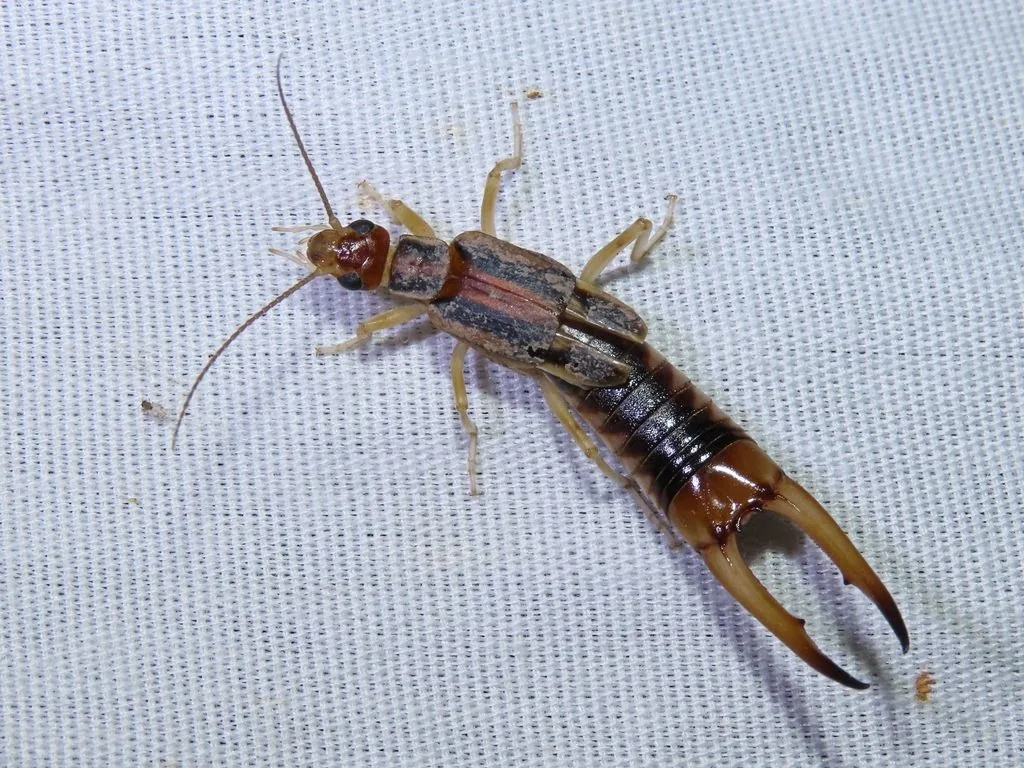
- Both sexes have pincers at the tail; the male's are usually a bit larger and more curved. UF/IFAS says the male's pincers are distinctly curved, while the female's are much straighter and often cross at the tips.[3][6]
- Short, leathery forewings cover folded membranous hind wings, and unlike some earwigs it can fly. UF/IFAS adds that the forewings meet in a straight line down the back and the rounded hind wings stay hidden beneath them.[3][6]
- Earwigs are medium-sized, usually brown to black, and a few have yellow or tan stripes on the body or legs.[2]
- UF/IFAS gives a length of 2 to 3 cm. It is usually reddish brown or brown, with an elongate, somewhat flattened body, long threadlike antennae, and distinctive dark stripes on the upper surface of the body that extend onto the wings.[6]
Look-alikes
| Look-alike | How to tell them apart |
|---|---|
| European earwig | The most common earwig in California and South Carolina yards, about 3/4 inch long and reddish brown. Unlike the striped earwig, it can damage seedlings, flowers, soft fruit and corn silks.[1][2] |
Where it lives
Clemson describes it as a southern species common in farm fields and gardens; in California, UC IPM reports it from Southern California. The University of Florida describes it as found throughout the United States.[2][1][6]
Biology and life cycle
It is a generalist predator that eats almost any smaller insect around it, mostly caterpillars and insect eggs, and sometimes its own nymphs; Clemson adds aphids, scales and mites.[3][2]
Females guard their eggs in a brood nest and bring food back to the young for their first several days.[3]
When attacked by lizards it spits fluid with a rotting-flesh odor that makes them drop it, and it fends off ants with its pincers.[4]
Like other earwigs, it hides by day in dark, cool, moist places and comes out at night. UF/IFAS says striped earwigs spend the day in the soil, in debris and under leaf litter.[1][2][6]
UF/IFAS says the life cycle lasts 40 to 80 days depending on temperature. After mating, the female lays 30 to 55 eggs underground, and the young pass through four or five nymphal stages before becoming adults.[6]
Damage and signs
Health risk
Earwigs aren't harmful to people, although they can bite or nip if trapped in clothing, sat upon or picked up, and they don't burrow into ears. The striped earwig also gives off a very disagreeable odor when crushed.[1][2][4]
Control
Prevention
Replace white outdoor lights with yellow ones, which are less attractive to earwigs, and clear debris from gutters. Striped earwigs in particular are drawn to lights.[1]
Sanitation
Clearing leaves, boards, mulch, woodpiles and other debris near the house removes daytime hiding spots, and fixing drainage keeps the foundation dry.[1][2]
Traps and physical control
Sweep or vacuum up earwigs that get indoors and seal the entry points. UC IPM doesn't recommend indoor pesticides, which won't keep earwigs from coming in.[1][2]
Where sources disagree
Range: UF/IFAS describes it as found throughout the United States, while Clemson calls it a southern species and UC IPM reports it in California from Southern California.[6][2][1]
Common questions
- Do striped earwigs damage gardens?
- No. It doesn't damage plants, and it eats caterpillars, insect eggs and other small insects.[1][3][2]
- Why do I find big striped earwigs near my porch light?
- Striped earwigs are attracted to lights. Switching white outdoor bulbs to yellow ones, which are less attractive to earwigs, can help.[1]
- Can a striped earwig hurt me?
- Earwigs aren't harmful to people, although they can nip if trapped or handled, and a crushed striped earwig smells very bad.[1][2]
- Why does a striped earwig stink?
- It releases sulfur compounds that smell like rotting flesh, a defense that makes lizards reject it.[4][1]
- How can I tell a male striped earwig from a female?
- Look at the pincers. UF/IFAS says the male's are distinctly curved, while the female's are much straighter and often cross at the tips.[6]
Sources
- University of California Statewide IPM Program, “Pest Notes: Earwigs.” ipm.ucanr.edu/home-and-landscape/earwigs/ (accessed 2026-11-11)
- Clemson Cooperative Extension, Home & Garden Information Center, “Earwigs (HGIC fact sheet).” hgic.clemson.edu/factsheet/earwigs/ (accessed 2026-11-11)
- Mississippi State University Extension Service, “Striped Earwig (Bug's Eye View, Vol. 9, No. 13, 2023).” extension.msstate.edu/newsletters/bugs-eye-view/2023/striped-earwig-vol-9-no-13 (accessed 2026-11-11)
- Naturwissenschaften, via PubMed, “Earwigs (Labidura riparia) mimic rotting-flesh odor to deceive vertebrate predators (Byers 2015, USDA-ARS).” pubmed.ncbi.nlm.nih.gov/26071006/ (accessed 2026-11-11)
- iNaturalist, “Labidura riparia taxon page (order and family).” www.inaturalist.org/taxa/307026 (accessed 2026-11-11)
- University of Florida, Entomology and Nematology Department, “Striped earwig, Labidura riparia (UF/IFAS Beneficial Arthropods - Predators - Photographs CD-ROM).” entnemdept.ufl.edu/projex/gallery/dl/Beneficial_Arthropods_Predators/text/striped_earwig.htm (accessed 2026-11-14)