On this page
How to identify it
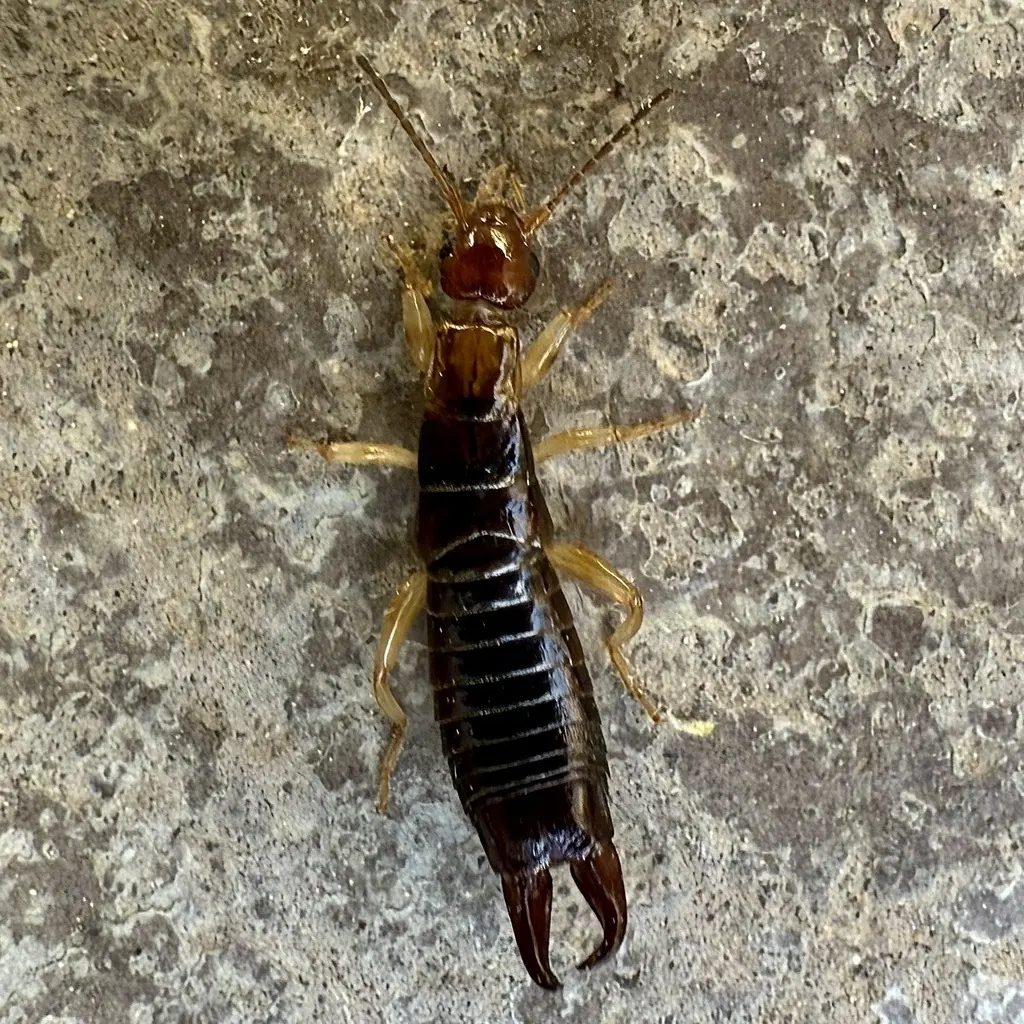
- It is dark brown with light yellow legs marked by dark rings, and US specimens have no wings. UF/IFAS gives adults 12 to 16 mm (~1/2-2/3 in), females slightly larger, with a dark band around the middle of the femur and often the tibia of each pale leg.[2][4]
- Like other earwigs it has a flattened body, beadlike antennae and a pair of pincers (cerci) at the tip of the abdomen, which earwigs use to fend off predators.[2][5]
- The pincers tell the sexes apart: UF/IFAS says males have more curved pincers with the right branch turned sharply inward at the tip.[4]
- Nymphs look like small adults with no wing pads: dark brown head and abdomen, a lighter grayish or yellowish brown pronotum, and whitish legs with a dark ring around the femur. UF/IFAS says there are normally five nymphal stages, occasionally six.[4]
- Don't confuse it with Florida's common winged Doru earwigs, which UF/IFAS says have wings and tan bands on the pronotum and front wings and are important caterpillar predators.[4]
Look-alikes
| Look-alike | How to tell them apart |
|---|---|
| European earwig | The European earwig is reddish brown, has working wings and can fly, and has teeth at the base of its pincers; the ringlegged earwig has no wings.[2] |
Where it lives
A cosmopolitan earwig. In the United States, Clemson says it is found in the South, and the Missouri Department of Conservation lists it among Missouri's earwigs. UF/IFAS says it was first found in the United States in 1884 and is now widespread in the southern states and Hawaii, and also known from many northern states and southern Canada.[3][1][2][4]
Biology and life cycle
Earwigs are active at night and hide by day under mulch, boards, rocks and other cool, damp places.[1][5]
Females guard their eggs and young nymphs. In a 2026 study, eggs left without the mother suffered about 73.6% mortality from insect-killing nematodes late in development, while guarded eggs rarely passed 15%. UF/IFAS says the adults build a small cell in the soil for the eggs, the female drives the male out and cleans and moves the eggs to protect them from mites and fungi, and her care fades about a week after the nymphs hatch.[3][2][4]
It hunts slugs, aphids, caterpillars, termites and other small invertebrates. In laboratory tests it also ate mosquito eggs and preyed on diamondback moth caterpillars.[2][6][7]
Its origins are debated. The Missouri Department of Conservation calls it native, while a 2025 genetic study says its introduced status is open to question and its origin remains unresolved.[2][8]
UF/IFAS says females lay one to seven clutches averaging about 40-50 eggs, roughly 100 to 300 eggs in all, and the eggs hatch in six to 17 days. Adults are long-lived and can survive over 200 days.[4]
In an Ohio greenhouse there were three generations a year, and a full generation can take 61 days, so UF/IFAS considers at least two generations a year likely outdoors in warm climates. In Illinois adults are found all year except winter, when they shelter deep in the soil.[4]
UF/IFAS calls it a voracious predator of insects and sowbugs, including caterpillars, beetle larvae and leafhoppers, and says it is highly cannibalistic; cannibalism of eggs and nymphs by adults is an important cause of death.[4]
Damage and signs
- Sources describe its plant feeding differently: the Missouri Department of Conservation says it eats some plant material but rarely chews living plants, while a 2026 study calls it a secondary pest that feeds on tender plant tissue. UF/IFAS says it is a minor nuisance in southern vegetable gardens and greenhouses, nibbling succulent plants such as lettuce and the roots or tubers of radish, potato and sweet potato, and peanut pods, normally of little consequence.[2][3][4]
- Clemson says it usually stays outdoors but can become a pest of moist, improperly stored grain products.[1]
- Earwigs that wander into homes do not cause damage.[2]
- More often it is a contaminant of produce, sometimes defecating on leafy green vegetables, according to UF/IFAS.[4]
Health risk
Earwigs aren't harmful to people. Clemson says one may give a little nip if you pick it up, but earwigs can't burrow into ears.[9][1]
Control
Keep them out
Seal cracks, weatherstrip doors, keep decaying plant matter away from the house and reduce dampness indoors. A few earwigs inside can simply be picked up or vacuumed.[2][1][5]
Sanitation
Store grain products dry; Clemson ties its pantry problems to moist, improperly stored grain.[1]
Biological control
Because it eats caterpillars, aphids and other pests, control is rarely needed; the Missouri Department of Conservation advises making sure earwigs are the real culprits first. UF/IFAS says these earwigs rarely warrant suppression.[2][3][4]
Pesticides
Residual insecticides in cracks and along baseboards kill earwigs, but NC State and Clemson say control is short-term because more come in from outdoors; UC IPM says indoor sprays won't keep them out.[5][1][9]
When control is needed, UF/IFAS says most residual insecticides kill them easily, and they take bran-and-molasses baits and many other baits, including baits sold for mole crickets.[4]
More from the research literature
A 2020 laboratory study in the Journal of Thermal Biology, testing it as a biological control agent, found that it preyed on diamondback moth caterpillars at 18, 25 and 32°C, with its attack rate rising at the warmer temperatures.[7]
A 2019 study in Argentina found it eating Aedes aegypti mosquito eggs in the laboratory, the first evidence of earwigs eating mosquito eggs.[6]
In banana groves, a 2025 study found more of these earwigs, especially females, in organic groves than in conventionally sprayed ones.[8]
Where the sources disagree
Origin: UF/IFAS says it likely is of European origin and was carried to many other parts of the world; the Missouri Department of Conservation calls it native, and a 2025 genetic study says its origin remains unresolved.[4][2][8]
Common questions
- What are the wingless earwigs with striped legs?
- Likely ringlegged earwigs, named for the dark rings on their pale yellow legs.[2]
- Do ringlegged earwigs hurt my garden?
- Rarely much. They eat slugs, aphids and caterpillars and only occasionally feed on tender plant tissue.[2][3]
- How long do ringlegged earwigs live?
- UF/IFAS says adults are long-lived and can survive over 200 days.[4]
Sources
- Clemson Cooperative Extension Home and Garden Information Center, “Earwigs (HGIC 2421).” hgic.clemson.edu/factsheet/earwigs/ (accessed 2026-11-14)
- Missouri Department of Conservation, “Earwigs (Field Guide).” mdc.mo.gov/discover-nature/field-guide/earwigs (accessed 2026-11-14)
- Journal of Invertebrate Pathology, via PubMed, “Stage-dependent susceptibility of the ring-legged earwig Euborellia annulipes to entomopathogenic nematodes and diatomaceous earth (2026), Journal of Invertebrate Pathology 217:108615.” pubmed.ncbi.nlm.nih.gov/41935617/ (accessed 2026-11-14). Cited from the PubMed abstract.
- University of Florida/IFAS Extension (Featured Creatures), “Ringlegged Earwig, Euborellia annulipes (Lucas), EENY088/IN245 (Featured Creatures).” ask.ifas.ufl.edu/publication/IN245 (accessed 2026-11-14)
- NC State Extension, “Earwigs (Household Pests; M. Waldvogel, P. Alder and C. Hayes; 2008, reviewed 2023).” content.ces.ncsu.edu/earwigs (accessed 2026-11-14)
- Journal of Medical Entomology, via PubMed, “Predation on eggs of Aedes aegypti (Diptera: Culicidae): temporal dynamics and identification of potential predators during the winter season in a temperate region (2019), Journal of Medical Entomology 56(3):737-743.” pubmed.ncbi.nlm.nih.gov/30689912/ (accessed 2026-11-14). Cited from the PubMed abstract.
- Peer-reviewed literature (PubMed), “Temperature-dependent functional response of Euborellia annulipes (Dermaptera: Anisolabididae) preying on Plutella xylostella (Lepidoptera: Plutellidae) larvae (da Silva Nunes G et al., Journal of thermal biology, 2020).” pubmed.ncbi.nlm.nih.gov/33077112/ (accessed 2026-11-14)
- Insects, via PubMed, “Organic farming shapes population dynamics and genetic diversity of Euborellia annulipes in banana groves (2025), Insects 16(6):606.” pubmed.ncbi.nlm.nih.gov/40559036/ (accessed 2026-11-14). Cited from the PubMed abstract.
- UC Statewide Integrated Pest Management Program, “Earwigs (Pest Notes 74102).” ipm.ucanr.edu/home-and-landscape/earwigs/ (accessed 2026-11-14)
- iNaturalist, “Euborellia annulipes taxon page (order and family).” www.inaturalist.org/taxa/196419 (accessed 2026-11-14)