On this page
How to identify it
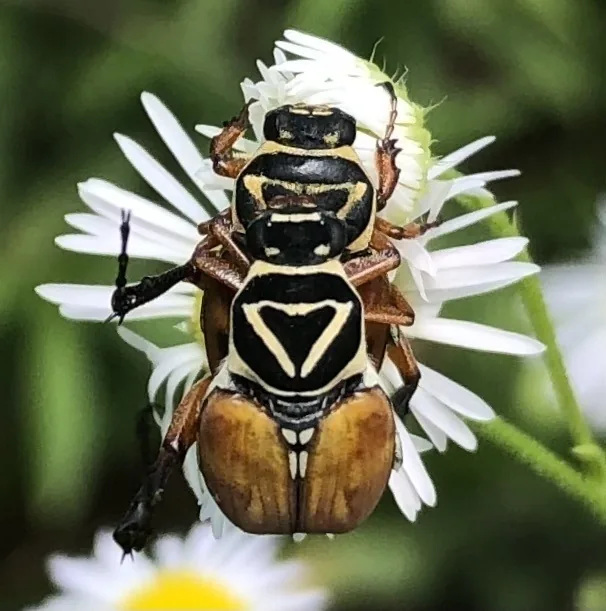
- Adults have a bright yellow triangle on the pronotum, the plate behind the head, and other yellow marks that resemble the patterning of several bees and wasps. UF/IFAS gives adults as about 8 to 11 mm long, with a black head, a mostly reddish-brown clypeus (the front of the face) and clubbed antennae of 10 segments, and suggests the wasp-like pattern may be a form of Batesian mimicry.[1][7]
- Another common name is D beetle.[1]
- Its genus, Trigonopeltastes, also has species in Central America: a 2016 Canadian Museum of Nature study described five new species from Nicaragua, Costa Rica, Belize and Guatemala and added country records from Honduras and Mexico.[5]
- Males have two-toothed front tibiae where females have three teeth, a more swollen and twisted hind femur, and a smoother, less colorful, more velvety pronotum.[7]
Look-alikes
| Look-alike | How to tell them apart |
|---|---|
| Trigonopeltastes floridana | Florida's only other Trigonopeltastes looks similar but is extremely rare. Its yellow mark on the pronotum is U- or V-shaped instead of triangular.[7] |
Where it lives
Missouri's Department of Conservation lists it statewide in Missouri, a Clemson Extension article from the South Carolina Botanical Gardens shows one on rattlesnake master, and it was recorded on planted wildflowers in Auburn, Alabama. GBIF holds 5015 U.S. records since 1990, mostly from the Southeast and southern Plains, led by Florida (1673), Texas (529) and North Carolina (519). UF/IFAS describes it as common throughout the southeastern United States from Florida to eastern Texas and documented north to New Jersey and west to Kansas, and cites a study that found it extremely common on flowers throughout Everglades National Park.[1][2][3][4][7]
Biology and life cycle
Adults are usually seen on flowers in prairies and other open areas, and they usually mate while visiting flowers.[1]
Larvae live in rotting wood.[1]
In a 2019 survey of insects visiting nine native wildflowers planted in Auburn, Alabama, delta flower scarabs were among the beetle visitors, with nine visits recorded; beetles made up 6.1 percent of all flower visits, far behind bees.[3]
UF/IFAS says adults fly from May through August and are active by day, and that males are typically three times more abundant than females.[7]
Larvae have been found in oak stumps around Gainesville, Florida, and inside the bromeliad Tillandsia utriculata in southern Florida. UF/IFAS says the larval stage lasts longest and is the stage that overwinters, feeding on wood or decaying organic matter.[7]
Many details of its life cycle haven't been studied. UF/IFAS expects it to follow its subfamily (Cetoniinae), whose members typically take about a year to reach adulthood.[7]
Damage and signs
- Adults eat pollen, nectar and/or other parts of plants in the carrot, daisy and mint families, including goldenrod, coneflower, rattlesnake master and Queen Anne's lace.[1][2]
- Flower-visiting beetles carry pollen as they feed, though Clemson notes that beetles are messy, fairly inefficient pollinators that eat through flower parts.[2]
- Adults have also been recorded on garden and crop plants including hibiscus, rose, mango, avocado, lychee, citrus, cabbage palm, privet and Brazilian pepper. UF/IFAS says the larvae are not known to cause any major damage and calls the species a likely important pollinator in native ecosystems.[7]
Health risk
It only resembles a wasp; none of the sources describes it stinging, biting or harming people or pets.[1][2]
Control
Biological control
No control is needed. None of the sources treats it as a pest: adults feed on pollen, nectar and flower parts of wildflowers, and beetles as a group are pollinators.[1][2]
Where the sources disagree
Adult diet: Missouri's Department of Conservation says adults eat pollen, nectar and/or other parts of plants; UF/IFAS says the adult diet consists mostly of pollen.[1][7]
Common questions
- What is the small beetle with a yellow triangle on my flowers?
- Likely a delta flower scarab, named for the yellow triangle on the plate behind its head.[1]
- Does it sting?
- None of the sources describes it stinging. Its bee- or wasp-like yellow pattern may simply help protect it from predators.[1]
- Where do the larvae live?
- In rotting wood.[1]
- Is the delta flower scarab bad for my flower garden?
- No. Adults eat pollen, nectar and flower parts of plants such as goldenrod, coneflower and rattlesnake master, and none of the sources treats it as a pest. Beetles are messy pollinators, but they do carry pollen between flowers.[1][2]
- Is it called a delta flower beetle or a delta flower scarab?
- Both names refer to the same insect. UF/IFAS calls it the delta flower beetle and Missouri calls it the delta flower scarab; delta refers to the triangular Greek letter its yellow mark resembles.[7][1]
Sources
- Missouri Department of Conservation, “Delta Flower Scarab (Field Guide).” mdc.mo.gov/discover-nature/field-guide/delta-flower-scarab (accessed 2026-11-12)
- Clemson Cooperative Extension Home & Garden Information Center, “Unsung Pollinator Heroes: Beetles (Watts, May 2024).” hgic.clemson.edu/unsung-pollinator-heroes-beetles/ (accessed 2026-11-12)
- Ecology and Evolution (Wiley), via PubMed Central, “Seed Production and Pollinator Dependence in Native Wildflowers: Guiding Species Selection for Conservation Plantings (Abbate et al. 2025).” pmc.ncbi.nlm.nih.gov/articles/PMC12451063/ (accessed 2026-11-12). PMID 40989565
- Global Biodiversity Information Facility (GBIF), “Trigonopeltastes delta: U.S. occurrence records since 1990 by state (GBIF occurrence search).” api.gbif.org/v1/occurrence/search?taxonKey=1076907&country=US&hasGeospatialIssue=false&occurrenceStatus=PRESENT&year=1990%2C2026&facet=stateProvince&facetLimit=400&limit=0 (accessed 2026-11-12)
- ZooKeys, via PubMed, “Five new species of Trigonopeltastes Burmeister and Schaum from Central America with new country records for other New World Trichiini (Smith 2016).” pubmed.ncbi.nlm.nih.gov/27667956/ (accessed 2026-11-12)
- iNaturalist, “Trigonopeltastes delta taxon page (order and family).” www.inaturalist.org/taxa/84027 (accessed 2026-11-11)
- University of Florida IFAS Extension, EDIS (Featured Creatures), “Delta Flower Beetle, Trigonopeltastes delta (Forster 1771), EENY-704/IN1214 (Featured Creatures).” ask.ifas.ufl.edu/publication/IN1214 (accessed 2026-11-14)