On this page
How to identify it
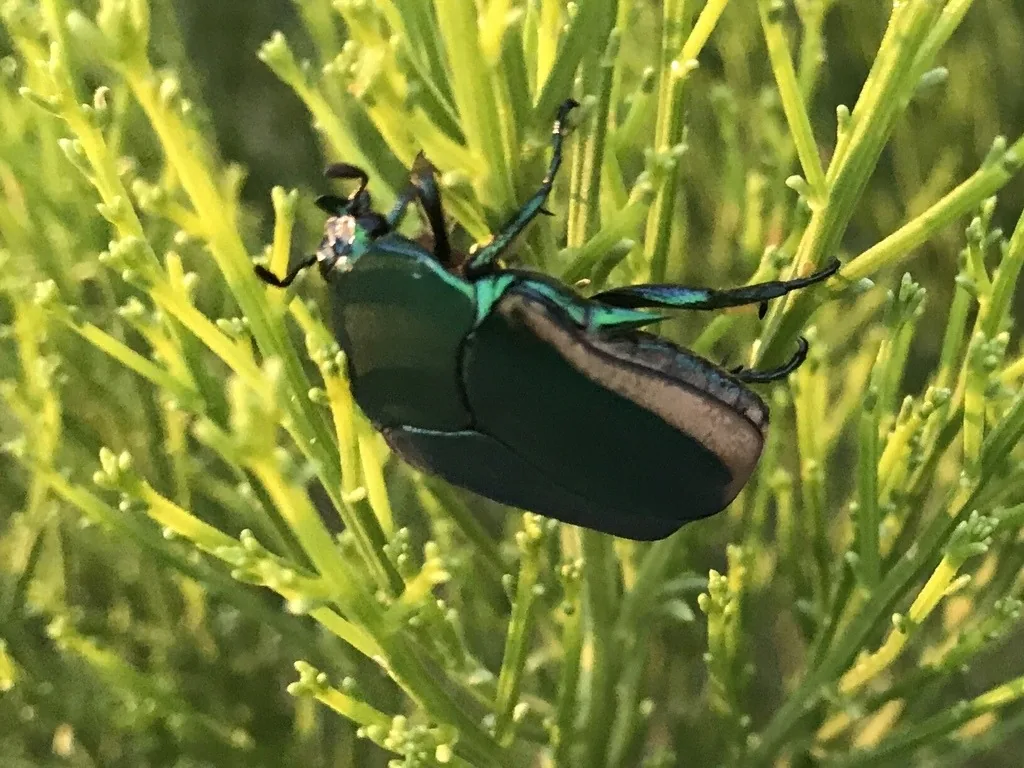
- Adults are 3/4 to 1-1/3 inches long according to UC IPM (Arizona Extension gives 1.25 inches), metallic green with brown or tan wing-cover edges and no visible hairs on top.[1][2]
- A short horn on the face sets it apart from look-alikes. The antennae end in a club of plates, as in other scarabs.[1]
- Grubs are brownish to dirty white and C-shaped, with short brown legs. They grow to 2 inches and, when exposed, roll on their backs and crawl using stiff hairs.[1][2]
- Eggs are white, elliptical to oval and about 1/10 inch long.[1]
Look-alikes
| Look-alike | How to tell them apart |
|---|---|
| Japanese beetle | Japanese beetles are half the size or less and have 12 tufts of white hair around the abdomen. Utah State points to the yellow-orange stripe on the green fruit beetle's wings.[1][3] |
| Green June beetle | The eastern green June beetle is nearly identical but smaller on average; in California it's reported only in the south.[1] |
| Hairy bear beetle (Paracotalpa granicollis) | About 3/4 inch long with mostly brown wing covers and many long whitish hairs on the abdomen and thorax; it has no face horn.[1][3] |
| Dogbane beetle (Chrysochus auratus) | A leaf beetle about 2/5 inch long, longer for its width than a scarab, without the swollen plates at the antenna tips or the face horn.[1] |
Where it lives
UC IPM calls it an occasional pest of ripe fruit in California, Arizona Extension a common pest in Arizona's fruit-growing areas, and Utah State says it is common in Utah; adults fly long distances toward ripe fruit, manure and fermenting fruit. GBIF holds about 11,000 US records since 1990 from 6 states, most from California, Arizona and New Mexico.[1][2][3][6]
Biology and life cycle
Females lay eggs just under the surface of compost, grass clippings, mulch and manure; eggs hatch in about a week. The grubs prefer horse manure, compost piles and soils rich in organic matter, and may become active on warm winter days.[1][2]
Grubs overwinter, pupate in a cell of soil in spring and emerge as adults 2 to 3 weeks later; adults are around from late spring to early fall, with one generation a year.[1][2]
Utah State says adults feed on pollen, nectar, petals and overripe or damaged fruit.[3]
Skunks dig for the grubs in lawns and compost, and pallid bats in southeastern Arizona catch the adults: green fig beetle remains were among the insect parts the bats dropped under their night roosts.[2][5]
Damage and signs
Health risk
It feeds on fruit and organic matter; none of the sources mentions any risk to people.[1][2][3]
Control
Prevention
Choose early-ripening varieties, harvest promptly when beetles start feeding and pick up fallen fruit.[1][2][4]
Keep them out
Window screen or floating row cover over the plant, or small bags over individual fruits, keep beetles off. Put barriers on only as fruit ripens so they don't block pollinators.[2]
Sanitation
Thinly spread or remove compost, clippings, leaves and manure near fruit trees, or compost in screened bins and turn piles often to expose grubs. Arizona Extension adds that letting poultry into these areas also cuts grub numbers.[1][2]
Traps and physical control
Homemade traps baited with a 1:1 mix of grape, peach or apple juice and water catch some adults.[1][2]
Pesticides
UC IPM recommends no insecticide, and Arizona Extension advises against spraying adults because the fruit is ripe or nearly so and residue would stay on it.[1][2]
Where sources disagree
Grub damage: UC IPM says the grubs don't damage fruit or plants; Arizona Extension says large numbers of grubs can kill patches of pasture and lawn by eating the roots.[1][2]
Fruit damage: UC IPM and Arizona Extension treat adults as a pest of ripe fruit, while Utah State says they feed on overripe or damaged fruit and are not known to damage ripening or ripe fruit, leaves or turf.[1][2][3]
More from Arizona Extension
University of Arizona Cooperative Extension calls it a common pest of ripening fruit in Arizona's fruit-growing areas, notes the grubs don't damage fruit and there is one generation a year, and advises picking fruit as soon as the beetles start feeding or covering individual fruits rather than spraying, since pesticide residue would stay on ripe fruit.[2]
Common questions
- What are the big green beetles on my figs?
- Most likely figeater beetles, attracted to ripe and fermenting fruit.[1]
- Is this a Japanese beetle?
- No. Japanese beetles are much smaller with white hair tufts; report suspected ones in California to the county agricultural commissioner.[1]
- Do figeater grubs damage lawns?
- Sources differ. UC IPM says the grubs feed on decaying organic matter and don't damage plants, but Arizona Extension reports dead patches in lawns and pastures where large numbers fed on roots.[1][2]
Sources
- University of California Statewide IPM Program, “Green Fruit Beetle (Pests in Gardens and Landscapes).” ipm.ucanr.edu/PMG/GARDEN/FRUIT/PESTS/grfruitbeetle.html (accessed 2026-11-11)
- University of Arizona Cooperative Extension, “Green Fruit Beetles, Cotinis mutabilis (Yavapai County Cooperative Extension).” extension.arizona.edu/sites/extension.arizona.edu/files/attachment/GreenFruitBeetles.pdf (accessed 2026-11-11)
- Utah State University Extension, “Invasive Insect Look-Alikes.” extension.usu.edu/pests/research/invasive-insect-lookalikes (accessed 2026-11-11)
- Insects (full text via PubMed Central), “Integrated pest management for small-scale farms in developed economies: challenges and opportunities (2019).” pmc.ncbi.nlm.nih.gov/articles/PMC6628405/ (accessed 2026-11-11). Cited from the full text in PubMed Central.
- PeerJ (full text via PubMed Central), “Mesquite bugs, other insects, and a bat in the diet of pallid bats in southeastern Arizona (Czaplewski et al. 2018).” pmc.ncbi.nlm.nih.gov/articles/PMC6284427/ (accessed 2026-11-11). Cited from the full text in PubMed Central.
- Global Biodiversity Information Facility (GBIF), “Cotinis mutabilis: US occurrence records since 1990 by state (GBIF occurrence search API).” api.gbif.org/v1/occurrence/search?taxonKey=1077513&country=US&hasGeospatialIssue=false&occurrenceStatus=PRESENT&year=1990%2C2026&facet=stateProvince&facetLimit=400&limit=0 (accessed 2026-11-11). State counts are records reported (iNaturalist research-grade, museum specimens, surveys), not abundance.
- iNaturalist, “Cotinis mutabilis taxon page (order and family).” www.inaturalist.org/taxa/57665 (accessed 2026-11-11)