On this page
How to identify it
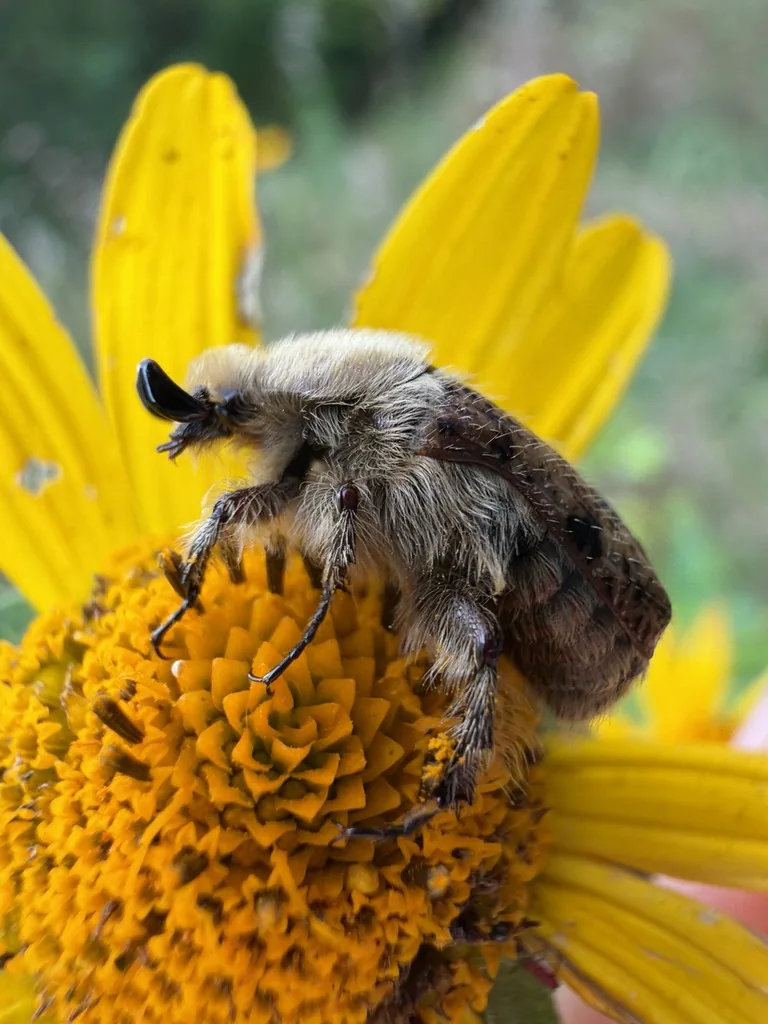
- Adults are broadly oval and yellow-brown to reddish brown with scattered dark spots and dense yellowish hairs, especially on the head and underside. Sources give slightly different sizes: CSU says 12-15 mm and Utah State 0.5-0.6 inch, while Iowa State says 1/2 to 2/3 inch.[1][2][3]
- Adults are strong fliers and buzz audibly, which is where the bumble bee comparison comes from. Utah State says captured beetles give off a pungent, chlorine-like smell.[1][2][3]
- Larvae are C-shaped white grubs that resemble June beetle grubs.[1][2]
Look-alikes
| Look-alike | How to tell them apart |
|---|---|
| June beetle grubs | The grubs look alike, but bumble flower beetle grubs feed on compost and soil organic matter and don't damage plants.[2] |
| Fourspotted sap beetle | Iowa State notes this smaller, black beetle also feeds on damaged fruit, so you may find both on the same damaged fruit.[3] |
Where it lives
CSU calls it common in eastern Colorado and Utah State reports it in Utah, where economic damage is rare. Iowa State says it isn't seen often in Iowa, though reports rose in 2014.[1][2][3]
Biology and life cycle
Adults spend winter in the soil. Females lay eggs in moist, decaying organic matter such as manure, rotting wood and compost piles; Utah State says eggs are laid in spring.[1][2]
Grubs feed on that organic matter and, according to Utah State, mature in June and July and pupate 2 to 5 inches deep. New adults are active from midsummer into early fall (CSU), or mid-August through the end of September in Utah.[1][2]
Damage and signs
- Adults feed on sweet or fermenting liquids: ripe or overripe apples, grapes, melons and peaches, corn at the silk stage, flower pollen and nectar, sap at tree wounds and bacterial ooze on trees. CSU lists sunflower, strawflower, thistle and daylily flowers.[1][2][3]
- They do not cause or spread the tree diseases whose ooze they feed on.[1]
- Grubs normally feed only on organic matter and are beneficial; CSU notes rare root chewing on container shrubs in organic-rich media.[1][2]
- Iowa State calls them opportunists that use existing cracks and wounds, though it has had reports of them damaging tomatoes on the vine.[3]
Health risk
None of the extension sources mentions any risk to people; Utah State notes captured beetles give off a pungent odor.[1][2][3]
Control
Sanitation
Harvest fruit and vegetables promptly, pick up cracked, overripe or fallen produce, and keep compost piles away from affected crops. Iowa State suggests picking tomatoes slightly before they're fully ripe and throwing infested ones well away from the garden.[2][3]
Traps and physical control
Hand-pick adults into a bucket of soapy water.[2]
Pesticides
Utah State does not recommend insecticides, and Iowa State says spraying gives little to no benefit.[2][3]
Common questions
- What is the hairy brown beetle buzzing around my peaches?
- Likely a bumble flower beetle, which is drawn to ripe and damaged fruit.[1][2]
- Are bumble flower beetle grubs in my compost a problem?
- No; they feed on decaying organic matter and are considered beneficial.[2]
- How do I keep them off my fruit?
- Harvest promptly, remove cracked or overripe fruit, and hand-pick beetles into soapy water. Spraying isn't recommended.[2][3]
Sources
- Colorado State University Extension (Colorado Insects of Interest, W. Cranshaw), “Bumble Flower Beetle (Colorado Insect of Interest).” wci.extension.colostate.edu/wp-content/uploads/sites/14/2017/03/BumbleFlowerBeetle.pdf (accessed 2026-11-13)
- Utah State University Extension (Integrated Pest Management), “Bumble Flower Beetle.” extension.usu.edu/planthealth/ipm/notes_ag/veg-bumble-flower-beetle (accessed 2026-11-13)
- Iowa State University Extension and Outreach (Yard and Garden), “The Euphoric Bumble Flower Beetle (Yard and Garden, September 12, 2014).” yardandgarden.extension.iastate.edu/article/2014/09-12/bumbleflower.html (accessed 2026-11-13)
- Global Biodiversity Information Facility (GBIF), “Euphoria inda (Linnaeus, 1758) (GBIF Backbone Taxonomy).” api.gbif.org/v1/species/4995934 (accessed 2026-11-13)