On this page
How to identify it
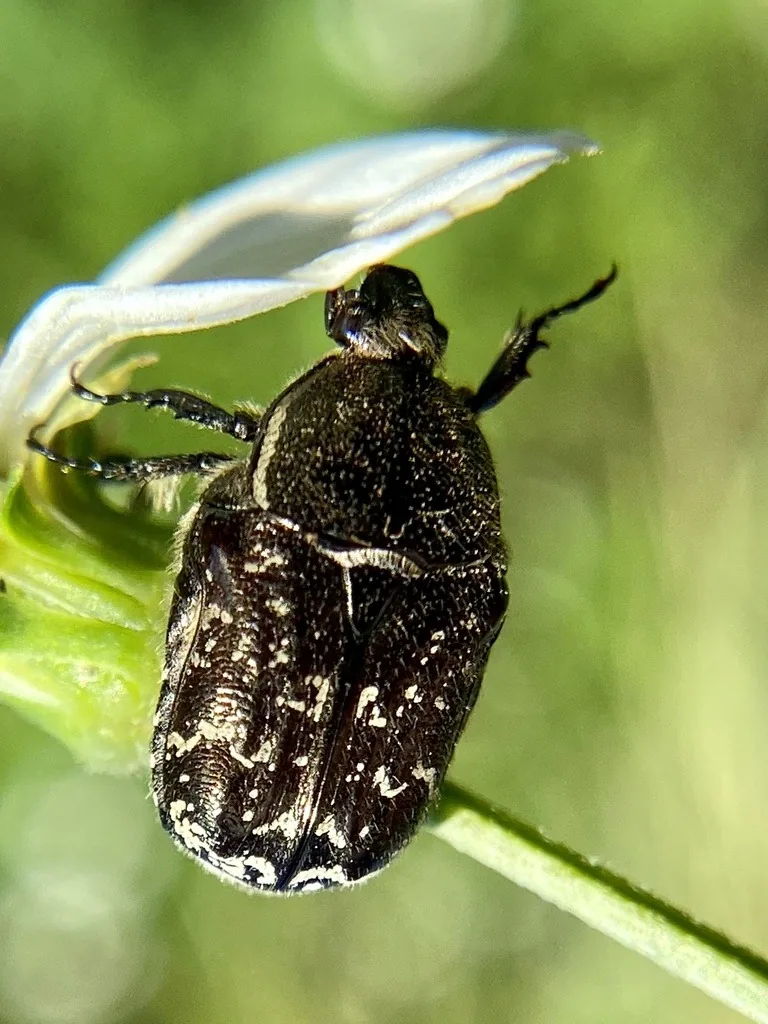
- Adults are up to about 1/2 inch long and dark, with white marks that give them a star-spangled look. UF/IFAS gives 10 to 14 mm (0.39 to 0.55 in) long, dark brown to black with metallic bronze or green reflections, heavily pitted on top with the surface between the pits smooth and shining, and white chalky spots set roughly in crosswise rows on the wing covers.[1][6]
- They buzz loudly in flight, like a huge bee.[1]
- It is one of the beetles most often sent to Florida's Division of Plant Industry for identification.[6]
Look-alikes
| Look-alike | How to tell them apart |
|---|---|
| Other Euphoria flower scarabs | Several other North American Euphoria species are quite similar. Some are brown or have brownish patches, and some are green and nearly identical to the green June beetle, which belongs to a different genus.[1] |
| Protaetia fusca | An Asian flower scarab established in southeastern Florida (Dade, Broward and Palm Beach counties) that is also dark with white or cream markings. UF/IFAS says it is sparsely pitted with a dull surface between the pits, has chalky spots on the pronotum as well as the wing covers, and usually has a strong spine where the wing covers meet at the tip.[6] |
Where it lives
The Missouri Department of Conservation lists it statewide in Missouri. GBIF has about 10,300 U.S. records since 1990, most from Texas and Florida, followed by Georgia, Oklahoma, North Carolina, Missouri, Louisiana, Virginia, Tennessee and Illinois, with fewer from Kansas, Nebraska, Iowa, Michigan, Pennsylvania and New Jersey. Outside the United States, most records come from Costa Rica, Mexico and the Bahamas. UF/IFAS gives the range as the eastern U.S. north to Illinois and Indiana and west to Texas, and says it occurs everywhere in Florida, from Escambia County to Key West: Florida records cover 189 localities in 52 of the state's 67 counties. The Florida State Collection of Arthropods also holds specimens from Nassau, Bahamas.[1][2][3][6]
Biology and life cycle
Larvae develop beneath manure or other decaying material.[1][4]
Adults visit flowers from late spring through fall.[1]
Little is known about the immature stages. Larvae have been found in soil beneath dead sod or manure; an early study gave averages of 62.7 days as a larva and 15.4 days as a pupa, and pupation takes place in an earthen cell.[6]
In Kentucky it has a one-year life cycle, pupating in August, with adults flying from August to October and again in spring. In Florida adults have been collected in every month except October and December, peaking in August at least in Alachua County.[6]
Adults feed on flowers, apparently for pollen, and also come to fermenting sap flows and ripe or decaying fruit. They are attracted to isopropyl (rubbing) alcohol and to aromatic lures used in Japanese beetle traps.[6]
Recorded adult foods include tree sap, many ripening fruits, corn, and the flowers of apple, thistle, mock orange, milkweed, dogwood, sumac, yarrow, daisies and goldenrod. Florida plant records add citrus, figs, mango, avocado, guava, hibiscus, crape myrtle, palms and many more.[6]
Damage and signs
- Adults eat pollen, nectar and perhaps other flower parts, and the beetle sometimes becomes an agricultural pest.[1]
- UF/IFAS lists it as a recorded pest of corn and roses, with Florida notes such as 10 to 15 beetles per ear of corn. Records suggest it can also be a pest of mango and avocado in southern Florida, where large numbers destroy the flowers and so reduce the fruit crop, and beetles have been recorded invading beehives and damaging comb.[6]
Health risk
The Missouri Department of Conservation describes it only as a flower feeder and occasional agricultural pest, with no mention of any risk to people or pets.[1]
Control
Prevention
MDC and UF/IFAS both describe it as only an occasional pest, and neither gives control recommendations for home gardens.[1][6]
Where the sources disagree
Size: MDC gives up to about 1/2 inch; UF/IFAS gives 10 to 14 mm (0.39 to 0.55 in), so the largest run a little over half an inch.[1][6]
Season: MDC says adults visit flowers from late spring through fall; UF/IFAS reports Florida adults in every month except October and December.[1][6]
Common questions
- What is the dark speckled beetle buzzing around my flowers?
- Quite possibly a dark flower scarab: a dark beetle with white flecks that buzzes like a big bee.[1]
- Does it damage plants?
- Sometimes. It feeds in flowers and can become an agricultural pest, but MDC describes this as occasional.[1]
- Is it a bee?
- No, it's a scarab beetle that buzzes like a huge bee in flight.[1]
- Why are speckled beetles in my corn ears?
- Possibly dark flower scarabs. UF/IFAS lists corn as a recorded host, with Florida notes of 10 to 15 beetles per ear.[6]
Sources
- Missouri Department of Conservation, “Dark Flower Scarab (Field Guide).” mdc.mo.gov/discover-nature/field-guide/dark-flower-scarab (accessed 2026-11-11)
- Global Biodiversity Information Facility (GBIF), “Euphoria sepulcralis: U.S. occurrence records since 1990 by state (GBIF occurrence search).” api.gbif.org/v1/occurrence/search?taxonKey=4995949&country=US&hasGeospatialIssue=false&occurrenceStatus=PRESENT&year=1990%2C2026&facet=stateProvince&facetLimit=400&limit=0 (accessed 2026-11-11). Exact count at access: 10,263 U.S. records since 1990 (Texas 2,897; Florida 2,603; Georgia 485; Oklahoma 372; North Carolina 366; Missouri 357).
- Global Biodiversity Information Facility (GBIF), “Euphoria sepulcralis: occurrence records since 1990 by country (GBIF occurrence search).” api.gbif.org/v1/occurrence/search?taxonKey=4995949&hasGeospatialIssue=false&occurrenceStatus=PRESENT&year=1990%2C2026&facet=country&limit=0 (accessed 2026-11-11). Exact counts at access: 11,038 records since 1990; United States 10,263, Costa Rica 630, Mexico 84, Bahamas 21.
- Missouri Department of Conservation, “Scarab Beetles (Scarabaeids) (Field Guide group page).” mdc.mo.gov/discover-nature/field-guide/scarab-beetles-scarabaeids (accessed 2026-11-11)
- iNaturalist, “Euphoria sepulcralis taxon page (order and family).” www.inaturalist.org/taxa/53340 (accessed 2026-10-06)
- University of Florida IFAS Extension, EDIS (Featured Creatures), “A Flower Beetle, Euphoria sepulcralis (Fabricius), EENY-416/IN750 (Featured Creatures).” ask.ifas.ufl.edu/publication/IN750 (accessed 2026-11-14)