On this page
How to identify it
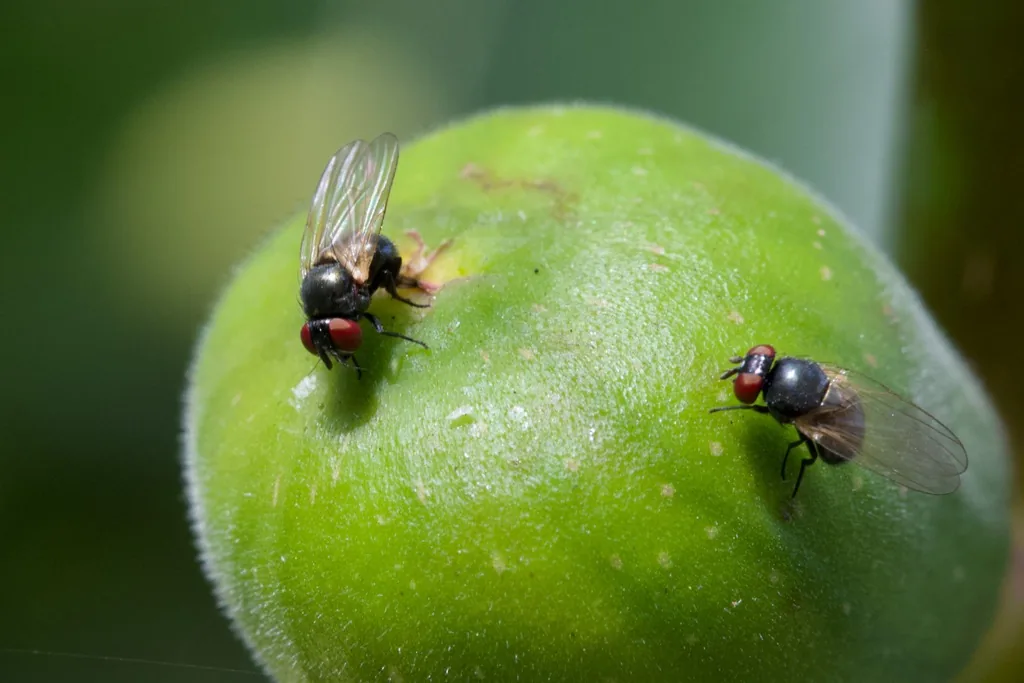
- The adult is a small, glossy, hairy fly, blue-black overall and about 3.5 to 4.5 millimeters long, with all-black legs and wings that extend past the tip of the abdomen when folded.[2]
- Its brick-red eyes are characteristic; related lance flies that also breed in figs have brown eyes.[2]
- Infested figs often show a purple discoloration on the side or around the opening at the tip (the ostiole), though green-ripening varieties may not change color. Cut open, they show brown, irregular feeding tunnels with frass.[2]
- Fully grown larvae chew their way out to pupate, leaving an exit hole, usually low on the side of the fig.[1][2]
Look-alikes
| Look-alike | How to tell them apart |
|---|---|
| Neosilba lance flies | Related lance flies that also develop in figs have brown eyes, and some lay eggs in the exit holes left by black fig fly larvae rather than in the ostiole.[2] |
Where it lives
It is native to the Mediterranean region and the Middle East and has spread to South Africa (first reported in 2007), Mexico (2020) and California. CDFA says residents in Pasadena (Los Angeles County) and Goleta (Santa Barbara County) submitted infested figs in June 2021, and later inspections found it in more counties; its 2024 pest rating proposal lists Alameda, Los Angeles, Orange, Riverside, San Bernardino, San Diego, San Luis Obispo, Santa Barbara, Santa Clara and Ventura. CDFA and the 2026 review say it is not yet known from the main fig-producing areas of the Central Valley.[2][3]
Biology and life cycle
It feeds only on the common fig (Ficus carica) and prefers small, unripe fruit, though ripe figs are occasionally attacked, mainly after harvest when young fruit is scarce.[1][2]
The female inserts her ovipositor (egg-laying tube) through the ostiole and leaves eggs in small clusters under its scales, usually 1 to 8 per fig. Eggs hatch in 3 to 8 days, and the larvae feed first around the ostiole and then through the rest of the fruit.[2][1]
Mature larvae leave the fig, drop to the ground and pupate in the soil, though pupae are sometimes found inside fruit. In a laboratory study of flies from Mexico the larval stage lasted 13 to 15 days and the pupal stage 11 days (see where the sources disagree).[1][4]
Egg to adult takes roughly 18 to 25 days in warm conditions and 40 to 50 days when it is cooler. The fly spends the winter as a pupa in the soil and emerges in spring.[2][1]
There are 4 to 6 generations a year, more in warmer areas and fewer in cooler ones.[1][2]
Damage and signs
Health risk
It feeds only in figs. UC IPM, CDFA and the 2026 review describe it only as a pest of figs and don't mention any risk to people or pets.[1][3][2]
Control
Prevention
UC IPM's 2021 pest alert advises against moving figs out of infested counties, since carrying fruit can spread the fly to new areas. CDFA's 2024 pest rating proposal says the fly is not under eradication or quarantine in California.[1][3]
Sanitation
Pick up and destroy infested figs, both fallen fruit and fruit still on the tree. UC IPM calls sanitation critical, and the 2026 review suggests destroying infested figs by burying them about 40 centimeters (16 inches) deep or sealing them in black plastic bags in the sun so no adults emerge.[1][2]
Traps and physical control
Check figs for feeding damage and exit holes, especially unripe fruit that has just fallen. McPhail-type traps baited with torula yeast can monitor adults, though how well they work is still being evaluated.[1]
Biological control
UC IPM says biological control appears limited. The 2026 review says the only parasitoid reported from it is Pachycrepoideus vindemmiae, a generalist parasitoid of fly pupae, and that none was found in field-collected figs in Mexico or South Africa.[1][2]
Pesticides
No insecticides are registered specifically for this pest on California figs. Larvae inside the fruit are protected from sprays and there are no effective soil drenches for the pupae; insecticidal baits may help against adults. Consult a licensed pest control adviser and the county agricultural commissioner before using any chemical control.[1]
When to call a professional
If you find infested figs in an orchard or yard where the fly is not known, UC IPM says to contact your local UC Cooperative Extension farm advisor and county agricultural commissioner; CDFA's Pest Hotline is 1-800-491-1899.[1][5]
Regulatory status
CDFA gave it an A rating in 2022. An emergency regulation declaring black fig fly eradication areas took effect on September 20, 2021 and expired on March 22, 2022.[3][6]
CDFA's 2024 pest rating proposal assigns a B rating: the fly is established in ten counties, eradication does not appear feasible, it is not under eradication or quarantine, and it is not known to be under official control.[3]
Since September 2020 a USDA APHIS federal order requires commercial shipments of fresh figs from Mexico to be treated by irradiation or certified as grown in an area free of the fly; fresh figs carried by passengers or in non-commercial shipments from Mexico are prohibited.[7]
Where the sources disagree
Counties: UC IPM's 2021 pest alert lists seven southern California counties; CDFA's 2024 pest rating proposal lists ten, adding Alameda, San Luis Obispo and Santa Clara.[1][3]
First detection: the 2026 review says CDFA staff detected it simultaneously in seven southern California counties; CDFA says the first finds were figs submitted by residents in Pasadena and Goleta in June 2021, followed by finds in other counties.[2][3]
Pupal stage: the 2026 review says about 9 to 10 days; the Mexican laboratory study measured 11 days.[2][4]
Common questions
- Why are my young figs turning purple and falling off?
- Black fig fly maggots feeding inside young figs often cause a purple discoloration and make the fruit drop early. Cut a few fallen figs open and look for maggots, brown feeding tunnels or exit holes.[2][1]
- Can I spray to stop black fig fly?
- Sprays do little because the larvae are protected inside the fruit, and nothing is registered specifically for it on California figs. Removing and destroying infested fruit is the key step.[1][2]
Sources
- University of California Statewide IPM Program, “Pest Alert: Black Fig Fly, Invasive Fig Pest Recently Discovered in Southern California (H. Wilson et al., rev. 2021).” ipm.ucanr.edu/legacy_assets/pdf/pestalert/pestalert_blackfigfly.pdf (accessed 2026-11-13)
- Insects (MDPI), via PubMed Central, “The Black Fig Fly, Silba adipata (Diptera: Lonchaeidae): Current Knowledge and Future Research Needs (R. Lasa et al.; Insects 17(3):247, 2026).” pmc.ncbi.nlm.nih.gov/articles/PMC13027197/ (accessed 2026-11-13)
- California Department of Food and Agriculture, “California Pest Rating Proposal: Silba adipata McAlpine, black fig fly (Pest Rating: B; comment period 05/17/2024 to 07/01/2024).” blogs.cdfa.ca.gov/Section3162/wp-content/uploads/2024/07/Silba-adipata.pdf (accessed 2026-11-13)
- Insects (MDPI), via NCBI PubMed, “Bioecological Parameters of the Black Fig Fly, Silba adipata, Collected from Fig Crops in Mexico (E. Paniagua-Jasso et al.; Insects 15(11):883, 2024; abstract).” pubmed.ncbi.nlm.nih.gov/39590482/ (accessed 2026-11-13)
- California Department of Food and Agriculture, “Report a Pest.” www.cdfa.ca.gov/plant/reportapest/ (accessed 2026-11-13)
- California Department of Food and Agriculture, “Initial Statement of Reasons: Title 3 CCR Section 3591.29, Black Fig Fly Eradication Area.” www.cdfa.ca.gov/plant/docs/3591.29_BFF_ISR_2022.pdf (accessed 2026-11-13)
- USDA Animal and Plant Health Inspection Service, “DA-2020-19: APHIS Amends Import Requirements for Fresh Fig (Ficus carica) Fruit from Mexico (Sept. 15, 2020).” www.aphis.usda.gov/import_export/plants/plant_imports/federal_order/downloads/2%20020/DA-2020-19.pdf (accessed 2026-11-13)
- Global Biodiversity Information Facility (GBIF), “Silba adipata McAlpine, 1956 (GBIF Backbone Taxonomy).” api.gbif.org/v1/species/1586899 (accessed 2026-11-13)
- iNaturalist, “Silba adipata taxon page (order and family).” www.inaturalist.org/taxa/689737 (accessed 2026-11-09)