On this page
How to identify it
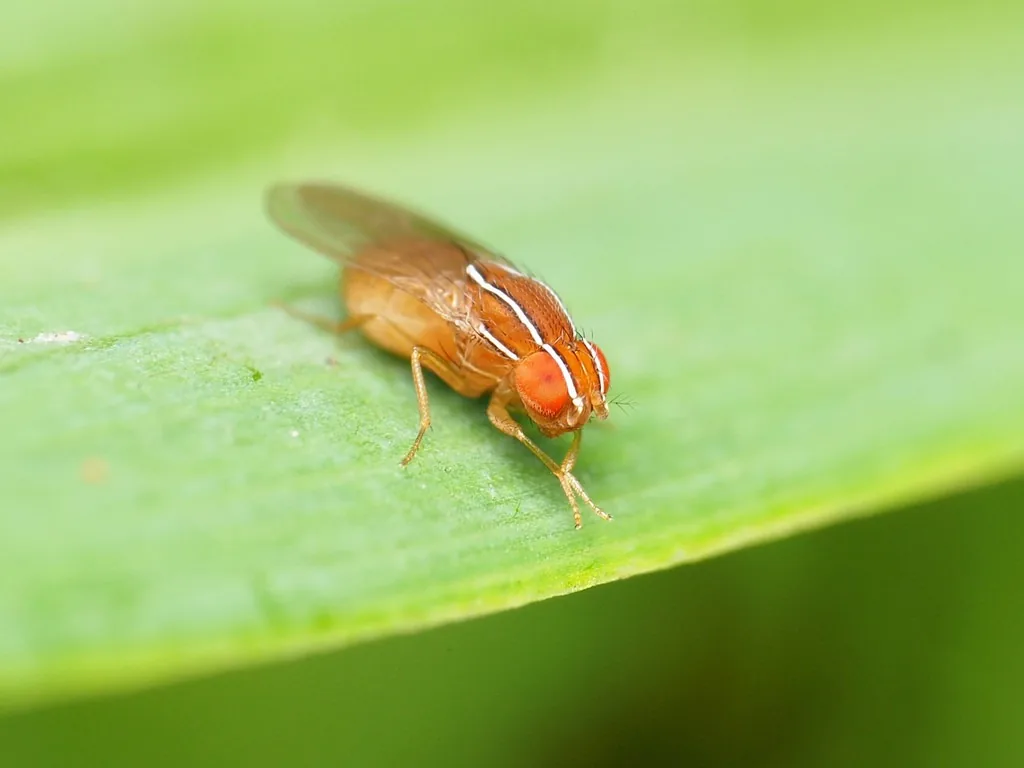
- It's about 2 mm long, light brown to yellow, with white stripes edged in black on the head and thorax. The stripes can be seen with the naked eye or a hand lens.[1][2]
- UW-Madison counts four black-bordered white stripes along each side of the head and thorax; they don't continue onto the abdomen.[2]
- It has bright red eyes and clear wings, and males and females look alike.[1][2]
- The larva is a legless maggot with a single hook-like mouth tooth. It is nearly impossible to tell from the maggots of other vinegar flies, so fruit has to be reared out to adults to know which fly you have.[2][1]
Look-alikes
| Look-alike | How to tell them apart |
|---|---|
| Spotted-wing drosophila | The African fig fly is slightly larger, has white stripes, and often shows up in fruit SWD has already damaged. Reared from the same fruit, SWD adults usually emerge first, around 14 days, and African fig flies shortly after, around 16 days.[1] |
| Common vinegar fly | The African fig fly is slightly larger and has a light body with black-bordered white stripes, which no other vinegar fly in Wisconsin has.[2] |
Where it lives
Sources describe its home range differently: UW-Madison says it is native to Africa, Eurasia and the Middle East, while a 2023 eastern U.S. survey describes its native range as tropical Africa. It was first found in the U.S. in Florida in 2005 and in Kentucky in 2012, and it has been documented as far north as Canada. In a 2022 survey of East Coast orchards, Massachusetts had the northernmost population and none turned up in Maine.[2][3][1]
Biology and life cycle
It is linked to a wide range of plants: more than 80 according to the University of Kentucky and EFSA, and over 70 according to the 2023 orchard survey. Larvae turn up in blackberries, raspberries, grapes, strawberries, figs and tomatoes, and adults are trapped in orchards with peaches, plums, cherries and blueberries.[1][4][3]
It can't cut into fruit skin the way spotted-wing drosophila does. In harder-skinned fruit like grapes, blueberries and persimmons it lays eggs in SWD damage, but in blackberries, raspberries and strawberries it can lay eggs using the plant's structure or directly into soft skin. In figs it lays eggs near the opening used by the fig wasp.[1]
Females lay on average about 60 eggs (UW-Madison); EFSA gives about 60 to 70. In the lab at 75 degrees F it develops from egg to adult in 20 days.[2][4]
EFSA puts its lower temperature threshold around 9 to 10 degrees C and optimum development at 28 degrees C, with 12 to 16 generations a year where conditions allow.[4]
It is a tropical fly that doesn't survive northern winters. It is thought to recolonize northern areas each year from the south, possibly riding air currents; lab work found its cold acclimation weaker than that of some widespread drosophilids.[1][2][3][5]
In Kentucky it shows up in traps in late July or August, peaks in October and November and dies off in December. Virginia orchard surveys found the same pattern: first detected around July, gone around December, with peaks in late summer and mid-fall.[1][3]
Abundance varies a lot from orchard to orchard. In one survey it was more abundant on peaches than on apples in the same orchards, and it was rare in central and northern Florida in spring and absent from early-season berries in Virginia.[3][6]
Damage and signs
- Infested fruit becomes leaky and soft. In figs it can cause a 50% loss of crop yield.[1]
- In raspberries it infests less fruit than spotted-wing drosophila and probably attacks riper fruit, so damage is less visible at harvest. Where SWD is already present, it doesn't add further damage.[1]
- UW-Madison says its biggest economic impact so far has been in commercial fig production, with no significant impact shown on other crops; EFSA expects economic impact in Europe especially on figs and strawberries.[2][4]
Health risk
The University of Kentucky and UW-Madison describe a pest of fruit and don't mention any risk to people or pets.[1][2]
Control
Prevention
Grow early-ripening varieties, since numbers stay low until fall, and refrigerate fruit after harvest to stop eggs and larvae from developing.[1]
Keep them out
Fine exclusion netting helps. UW-Madison suggests mesh of 1/32 inch or smaller, put on after early fruit set but before fruit ripens, covering the plants completely with no gaps at the seams or the soil.[2][1]
Sanitation
Pick clean: remove old and damaged fruit, and seal discards in a plastic bag left in the sun or a freezer for 24 hours to kill larvae before composting or trashing it.[1][2]
Traps and physical control
Monitor with the same traps used for spotted-wing drosophila: a 32-ounce clear container with ten 3/16-inch holes near the top, baited with 1 tablespoon of dry yeast and 4 tablespoons of sugar in 12 ounces of water, or 2 inches of apple cider vinegar, plus a drop of unscented dish soap.[2][1]
Pesticides
No insecticides are labeled specifically for this fly, and UW-Madison does not currently recommend spraying for it in Wisconsin. The University of Kentucky notes sprays used for spotted-wing drosophila also kill it, and advises rotating IRAC classes to slow resistance.[1][2]
Where the sources disagree
Sound fruit: UW-Madison says it cannot start damage in intact, ripe fruit and only lays eggs in overripe or damaged fruit. The University of Kentucky reports it infesting ripening blackberries, raspberries and strawberries through soft skin, and EFSA says it can lay eggs in undamaged, healthy figs, strawberries and guavas.[2][1][4]
Native range: UW-Madison says Africa, Eurasia and the Middle East; the 2023 orchard survey says tropical Africa.[2][3]
Host plants: the University of Kentucky says over 80 plant species and EFSA more than 80; the 2023 orchard survey says over 70.[1][4][3]
Eggs: UW-Madison says females lay on average 60 eggs in the lab; EFSA says around 60 to 70.[2][4]
Either way, damaged fruit is its easiest target, so sanitation and early harvest do the most good.[1][2]
More from Wisconsin Extension
Native to Africa, Eurasia and the Middle East, it was first found in the U.S. in Florida in 2005; outside commercial fig production it hasn't been shown to cause significant economic damage to other crops.[2]
Because new flies arrive from the south each year, strict sanitation can slow buildup on a farm but won't prevent reintroduction.[2]
Common questions
- What are the striped little flies in my figs?
- Likely African fig flies, which have black-edged white stripes on the head and thorax and bright red eyes. In figs it can be a major pest.[1][2]
- How do I keep them out of berries?
- Pick clean, remove damaged fruit, refrigerate the harvest, choose early-ripening varieties, and consider fine netting before the fruit ripens.[1][2]
- Why do they show up only in late summer and fall?
- The fly doesn't survive northern winters and is thought to move north again each year, so numbers build late in the season and peak in fall.[1][3][6]
Sources
- University of Kentucky Entomology (ENTFACT), “African Fig Fly (ENTFACT-232).” entomology.mgcafe.uky.edu/ef232 (accessed 2026-11-13)
- University of Wisconsin-Madison Extension, “African Fig Fly – Pest Alert – Wisconsin Horticulture.” hort.extension.wisc.edu/articles/african-fig-fly/ (accessed 2026-11-13)
- Journal of Insect Science, via PubMed, “A small survey of introduced Zaprionus indianus in orchards of the eastern United States (Rakes et al. 2023).” pubmed.ncbi.nlm.nih.gov/37864807/ (accessed 2026-11-13)
- EFSA Journal (European Food Safety Authority), “Pest categorisation of Zaprionus indianus (EFSA Panel on Plant Health 2022).” pubmed.ncbi.nlm.nih.gov/35281655/ (accessed 2026-11-13)
- microPublication Biology, via PubMed, “Invasive African fig flies have reduced cold acclimation ability compared to cosmopolitan drosophilid species (Hollekim et al. 2026).” pubmed.ncbi.nlm.nih.gov/42395893/ (accessed 2026-11-13)
- microPublication Biology, via PubMed, “Field sampling of Zaprionus indianus in the eastern United States in 2023-2024 (Gray et al. 2025).” pubmed.ncbi.nlm.nih.gov/40756279/ (accessed 2026-11-13)
- Global Biodiversity Information Facility (GBIF), “Zaprionus indianus Gupta, 1970 (GBIF Backbone Taxonomy).” api.gbif.org/v1/species/1557446 (accessed 2026-11-13)
- iNaturalist, “Zaprionus indianus taxon page (order and family).” www.inaturalist.org/taxa/333873 (accessed 2026-10-06)