On this page
How to identify it
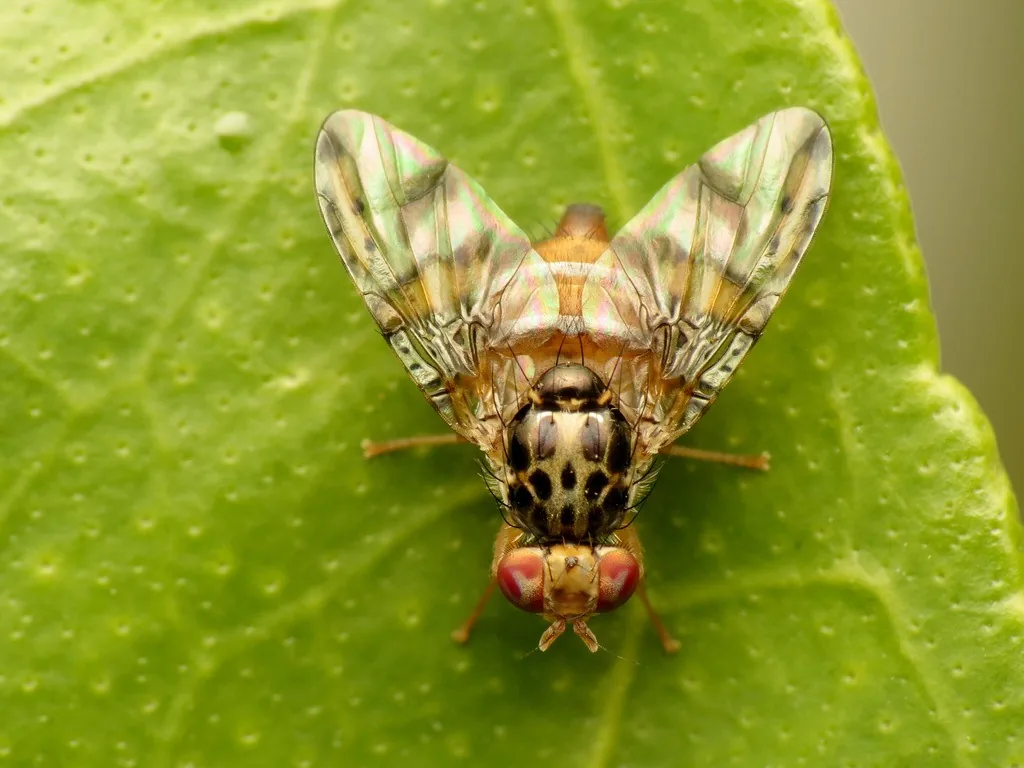
- Adults are short, squat flies about 1/4 inch long, a bit smaller than a house fly.[3][2]
- The thorax is blackish with silver markings, and the tan abdomen has darker cross stripes.[3][2]
- The clear wings carry two light brown bands across them, another along the far front edge, and gray flecks near the base.[3][2]
- Eggs are white, very small and elongate, somewhat banana-shaped. Larvae are white, legless, carrot-shaped maggots that feed inside the fruit, and the pupa sits inside a shiny brown, hard, oval case.[3][2]
- The immature stages look much like those of other invasive fruit flies, so a maggot in fruit needs an expert to identify.[3]
Look-alikes
| Look-alike | How to tell them apart |
|---|---|
| Mexican fruit fly | Another invasive fruit fly that California regulates with its own quarantines. Their immature stages are hard to tell apart, so trapped flies and maggots go to agriculture officials for identification.[5][3] |
Where it lives
Native to Africa, it has spread through the Mediterranean region and southern Europe, the Middle East, western Australia, Central and South America and Hawaii. In the United States APHIS lists it as currently found in Hawaii; mainland populations are treated as transient infestations and eradicated.[3][2][1]
Biology and life cycle
Females lay eggs under the skin of host fruit. Eggs hatch in 2 to 4 days (up to 16 to 18 days in cool weather), and the larvae feed for 6 to 11 days.[3]
Full-grown larvae leave the fruit and pupate in the soil under the host plant; adults emerge 6 to 11 days later and can live up to 2 months.[3]
Development depends on temperature: egg to adult takes anywhere from 5 weeks to 5 months.[3]
It has one of the widest host ranges of any pest fruit fly. California's list includes apple, apricot, avocado, bell pepper, citrus, fig, grape, mango, peach, persimmon, pomegranate, tomato and walnut.[3][5]
Medflies spread mainly in infested fruit and vegetables carried by people. Genetic studies find that invasions in the modern trade network tend to come from several introductions, which keeps the new populations genetically varied.[2][8]
Whole-genome work suggests the fly colonized Europe and Latin America in steps, and it found gene changes tied to cold stress, a sign the species can adapt quickly to colder climates.[9]
Damage and signs
Health risk
It is a crop pest. None of the agency sources reports any risk to people beyond spoiled fruit.[2][3]
Control
Keep them out
Don't bring or mail fresh fruit, vegetables or plants into a state, or back from another country, unless inspectors have cleared them; declare all agricultural products when returning from abroad.[2][7]
Sanitation
Inside a quarantine, don't move homegrown fruit, vegetables or soil off the property. Eat or process produce where it was picked (juice, freeze, cook or grind it in the disposal), or double-bag it in plastic and put it in the trash, not compost or green waste. Pick up fallen fruit the same way.[2][5][7]
Biological control
California and USDA run a preventive release program from Los Alamitos that releases sterile male medflies every week over about 1,750 square miles of the Los Angeles Basin, so wild females that arrive lay infertile eggs. Since it began in 1996, infestations have dropped by over 90 percent, to fewer than one a year on average.[6]
When to call a professional
Detections are handled by state and federal agriculture officials, not homeowners. If you find maggots in homegrown fruit or suspect medflies, report it to your state plant regulatory official or, in California, the pest hotline at 1-800-491-1899.[2][5][7]
Let officials onto your property to place and check traps, inspect plants, treat, or remove produce that may be infested.[2][7]
Quarantine status
USDA APHIS says the medfly is currently found in Hawaii and that California, Florida and Texas are at high risk. The first of many U.S. mainland infestations was in Florida in 1929; California first trapped the fly in 1975.[2][3]
Quarantines restrict moving host fruit and vegetables and are lifted only after three fly generations pass with no new detections, judged by a degree-day model. The Fremont quarantine in Alameda and Santa Clara Counties, set on September 6, 2024 and expanded seven times, was removed on July 31, 2025, freeing 213 square miles.[1]
CDFA's medfly regulation page lists quarantine boundary documents for Alameda and Santa Clara Counties dated January 2, 2026, while its statewide fruit fly page, checked in November 2026, names active quarantines for Caribbean, Oriental and Mexican fruit flies and none for the medfly. Status changes quickly: check the APHIS Pest Tracker or CDFA's quarantine maps before moving produce.[4][5][2]
Common questions
- What happens when medflies are found near my home?
- State and federal agriculture officials respond. Expect traps on your street, a possible quarantine that bars moving homegrown fruit and vegetables off your property, and requests for access to inspect, treat or remove fruit.[2][7][1]
- How big is a Mediterranean fruit fly?
- About 1/4 inch long, a little smaller than a house fly, with a silver-marked black thorax and banded wings.[3][2]
- Is the medfly established in the United States?
- USDA APHIS lists it as currently found in Hawaii. Mainland finds, such as the 2024 Fremont outbreak in California, are treated as temporary infestations and eradicated.[2][1]
Sources
- USDA Animal and Plant Health Inspection Service (APHIS), “APHIS Removes Mediterranean Fruit Fly (Ceratitis capitata) Quarantine in Alameda and Santa Clara Counties, California (DA-2025-41).” www.aphis.usda.gov/news/program-update/aphis-removes-mediterranean-fruit-fly-ceratitis-capitata-quarantine-alameda (accessed 2026-11-11)
- USDA Animal and Plant Health Inspection Service (APHIS), “Mediterranean Fruit Fly (last modified November 14, 2025).” www.aphis.usda.gov/plant-pests-diseases/medfly (accessed 2026-11-11)
- California Department of Food and Agriculture, Plant Health and Pest Prevention Services, “Mediterranean Fruit Fly Pest Profile.” www.cdfa.ca.gov/plant/pdep/target_pest_disease_profiles/mediterranean_ff_profile.html (accessed 2026-11-11)
- California Department of Food and Agriculture, “Mediterranean Fruit Fly: Regulation and Quarantine Boundaries.” www.cdfa.ca.gov/plant/medfly/regulation.html (accessed 2026-11-11)
- California Department of Food and Agriculture, “Invasive Fruit Fly Quarantines in California.” www.cdfa.ca.gov/plant/fruitfly/ (accessed 2026-11-11)
- California Department of Food and Agriculture, “Preventative Release Program (Medfly).” www.cdfa.ca.gov/plant/PDEP/prpinfo/ (accessed 2026-11-11)
- California Department of Food and Agriculture, “Please Help Protect Your Homegrown Produce: Mediterranean fruit fly homeowner fact sheet (CD-015-0924).” www.cdfa.ca.gov/plant/fruitfly/docs/MFF-Homeowner-Fact-Sheet_EN.pdf (accessed 2026-11-11)
- Genetica, via PubMed, “Globalization and fruitfly invasion and expansion: the medfly paradigm (Malacrida et al. 2007).” pubmed.ncbi.nlm.nih.gov/17111234/ (accessed 2026-11-11)
- Scientific Reports, via PubMed, “Global invasion history with climate-related allele frequency shifts in the invasive Mediterranean fruit fly (Deschepper et al. 2024).” pubmed.ncbi.nlm.nih.gov/39461976/ (accessed 2026-11-11)
- iNaturalist, “Ceratitis capitata taxon page (order and family).” www.inaturalist.org/taxa/199404 (accessed 2026-11-11)